Scaling EV Charging Infrastructure Locally: Why Leading Operators Choose SKD Solutions(Part 2)
Navigating Implementation Challenges: Real Risks and Mitigation
While SKD and CKD solutions offer substantial advantages, successful implementation requires honest assessment and management of several challenges. Here's what actually happens—and how to prepare.
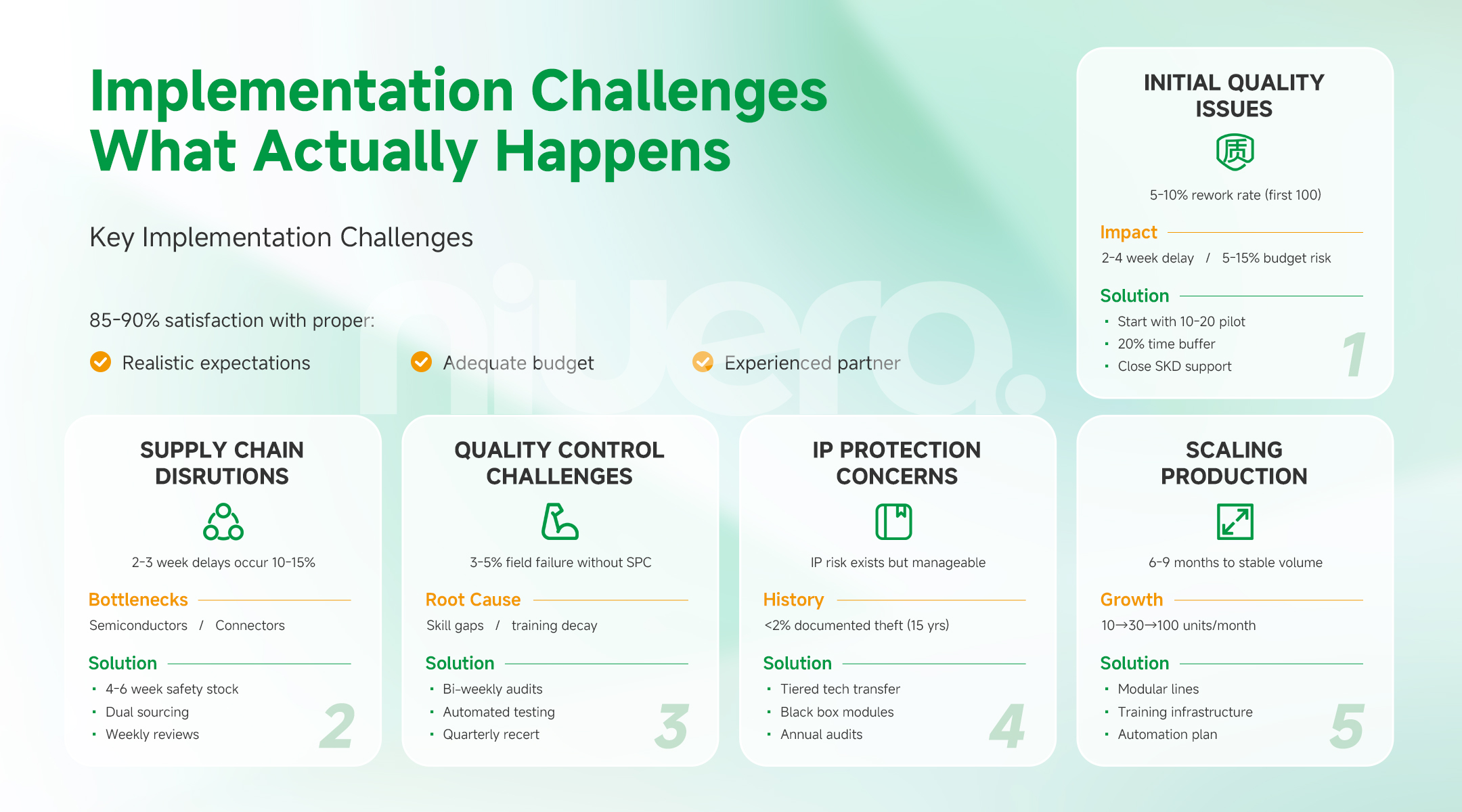
Reality Check:
- First 50-100 units typically have 5-10% rework rate (industry average)
- Common issues: connector assembly errors, wiring mistakes, calibration drift
- Timeline impact: 2-4 week delay in reaching full production efficiency
- Cost impact: 5-15% budget overrun if not properly planned
Mitigation Strategies:
- Start with smaller pilot production (10-20 units) to identify issues early
- Budget 20% time buffer in deployment schedule
- Implement graduated quality gates: component inspection → subassembly test → final system validation
- Maintain close communication with SKD provider during first 100 units
- Document all issues and resolutions in living quality database
Success Metric: By unit 100-150, rework rate should drop to <2% with mature processes.
Challenge 2: Component Supply Disruptions
Reality Check:
- Supply delays of 2-3 weeks occur 10-15% of the time even with good planning
- Causes: port congestion, supplier quality holds, customs delays, force majeure
- Cost impact: Potential 5-10% budget overrun from expedited shipping and schedule compression
- Most common bottlenecks: semiconductors, specialized connectors, control boards
Mitigation Strategies:
- Maintain 4-6 week safety stock for long-lead-time critical components (capacitors, semiconductors, custom enclosures)
- Develop dual-source strategy for high-risk components (adds 2-3% to BOM cost but reduces risk)
- Consider bonded warehouse to defer duty payments while maintaining buffer inventory
- Implement weekly supply chain reviews with escalation protocols
- Build relationships with freight forwarders specializing in electronics (worth the 10-15% premium)
Realistic Expectation: Even with excellent planning, expect 1-2 supply disruptions per year requiring expedited action.
Challenge 3: Quality Control in Distributed Assembly
Reality Check:
- Maintaining consistency across multiple sites or shifts is genuinely difficult
- Human factors: different skill levels, language barriers, training decay over time
- Without proper systems: field failure rates can reach 3-5% (vs. <1% target)
Effective Solutions:
- Implement statistical process control (SPC) at critical assembly stages (power connections, high-voltage terminations)
- Conduct bi-weekly quality audits for first 6 months, then monthly
- Use automated testing equipment that eliminates subjective judgment ($100K-300K investment but worthwhile)
- Automated insulation resistance testing
- Computerized power output validation
- Automated connector insertion force verification
- Establish clear escalation procedures: operator → supervisor → quality engineer → SKD provider technical support
- Quarterly recertification training for all assembly personnel
Proven Results: Companies with robust quality systems report <1% field failure rates even from newly established facilities within 12 months of startup.
Challenge 4: Intellectual Property Protection Concerns
Reality Check:
- Technology transfer inherently involves sharing proprietary information
- Risk levels vary: Low (mechanical assembly) to High (power electronics design)
- Cannot eliminate risk entirely, but can manage it effectively
Practical Solutions:
- Implement tiered technology transfer
- Tier 1 (shared): Assembly procedures, testing protocols, general specifications
- Tier 2 (limited): Troubleshooting guides, component sourcing, calibration methods
- Tier 3 (protected): Detailed circuit designs, firmware source code, advanced algorithms
- Use contractual protections: NDAs with specific damages clauses, non-compete agreements for key personnel
- Provide "black box" modules for most sensitive technologies (e.g., power control algorithms in encrypted firmware)
- Conduct annual audits of assembly facilities with right to inspect documentation
- Maintain control over firmware and software systems via OTA updates and licensing
Industry Perspective: Most manufacturers find market access benefits outweigh IP risks, particularly when proper safeguards are implemented. In 15+ years of SKD programs, documented IP theft incidents are <2% and typically involve low-value mechanical designs rather than core electronics.
Challenge 5: Scaling Production Smoothly
Reality Check:
- Moving from 10 units/month to 100+ units/month creates entirely new challenges
- Common stumbling blocks: quality degradation, workforce turnover, supply chain strain
- Timeline: Typically takes 6-9 months to reach stable volume production
Proven Scaling Approach:
- Design for Manufacturing (DFM) from project inception
- Minimize unique fasteners (standardize on 3-4 types vs. 15-20)
- Eliminate unnecessary adjustment points
- Design assembly sequences that prevent errors (poka-yoke principles)
- Implement modular production lines that scale incrementally
- Start: 1 line, 10 units/month
- Month 6: 2 lines, 30 units/month
- Month 12: 4 lines, 100 units/month
- Establish clear milestones for capacity expansion with go/no-go criteria
- Invest in training infrastructure that supports growth
- Training simulators (1:1 mockup stations)
- Video-based SOPs accessible on shop floor tablets
- Mentorship programs (1 experienced worker per 3 new hires)
- Plan for automation at appropriate thresholds
- Manual assembly: <50 units/month
- Semi-automated: 50-200 units/month
- Automated assembly lines: >200 units/month
Real-World Example: The U.S. market demonstrates this scaling potential. Three years ago there was almost no U.S.-based production of fast chargers; now there are at least 26 firms manufacturing these products within the United States, with facilities having the capacity to produce more than a million charging stations each year—including 60,000 fast chargers according to U.S. Department of Energy data.
The Bottom Line on Challenges: Despite these real challenges, industry surveys show 85-90% satisfaction with SKD implementations among operators who:
- Set realistic expectations (12-18 month ramp to full efficiency)
- Budget appropriately (10-15% contingency)
- Partner with experienced SKD providers
- Invest in training and quality systems
Most significant issues are resolved within the first 6 months with proper support.
The Role of Government Policy and Incentives
Government policies increasingly favor or require localized manufacturing, creating additional incentives for SKD/CKD strategies.
United States
The Bipartisan Infrastructure Law (BIL) mandates that all charging infrastructure eligible for federal grants must be manufactured in America, using domestically produced iron and steel. Under Build America, Buy America Act provisions (effective July 2024), chargers funded by federal money must source the majority of their components from American manufacturers.
Specific Requirements:
- NEVI Formula Program ($5 billion): Requires domestic content, with percentage increasing over time
- Discretionary Grant Program ($2.5 billion): Prioritizes Made in USA with domestic content scoring advantages
- Buy America waiver process available but increasingly difficult to obtain
With $7.5 billion in federal charging infrastructure investment and state-level incentives adding billions more (California: $1.4B, New York: $750M, Texas: $408M), operators implementing local assembly gain significant competitive advantages in securing grants. Analysis shows SKD/CKD operators secure grants at 2-3x higher rates than import-only competitors.
European Union
The EU's trade defense measures, including countervailing duties of 17-45% on Chinese EV equipment imports, explicitly aim to create pull for local manufacturing. The European Commission's Critical Raw Materials Act and Net-Zero Industry Act increasingly emphasize stronger "Made in EU" requirements.
Key Provisions:
- Public procurement: 25% price preference for EU-manufactured equipment in tenders
- State aid: EU countries can provide subsidies up to €200M for local manufacturing facilities
- AFIR compliance: Alternative Fuels Infrastructure Regulation mandates increasing use of EU-produced equipment
Emerging Markets
India:
- Production Linked Incentive (PLI) scheme: 15% tariff rate for companies investing ≥$500M in local manufacturing (vs. 70-100% standard rate)
- Phased Manufacturing Programme: Requires increasing local content: 30% (Year 1) → 50% (Year 3) → 70% (Year 5)
- Incentive payments: 10-15% of incremental revenue for qualified manufacturers
Brazil:
- Rota 2030 program: Tax incentives for local EV infrastructure production
- BNDES financing: Preferential loans (TJLP + 1-2% vs. market rate of 12-15%) for domestic manufacturers
- Import tariff escalation: 18% (2024) → 25% (2025) → 35% (2026)
Southeast Asia:
- ASEAN integration: Reduced tariffs (0-5%) for products with 40%+ ASEAN content
- Thailand BOI: 8-year tax holidays for EV charging manufacturing investments >$10M
- Indonesia: Local content requirements (30% minimum) for projects >100 stations
Countries like Brazil and India are explicitly using tariffs and industrial policy to draw investment in local EV charging manufacturing, creating substantial opportunities for operators implementing SKD strategies aligned with these policies.
Technology Considerations for Localized Assembly
Not all charging technologies are equally suited to SKD/CKD approaches. Certain technical considerations significantly impact success.
Power Module Architecture: Where Performance Cannot Be Compromised
Modern DC fast charging requires power modules achieving 97%+ efficiency to minimize operational costs and grid impact. At a typical 350kW station operating 12 hours daily, the difference between 94% and 97% efficiency represents approximately $1,480 in annual electricity costs—multiplied across hundreds of stations, this becomes millions in operating expenses.
This level of performance demands:
- Precision assembly of power semiconductors with tolerances of ±0.1mm
- Optimized thermal interface materials applied with controlled pressure and thickness
- Calibrated control systems with ±2% accuracy across temperature ranges
- Extensive factory testing including thermal cycling and full-power burn-in
Why This Matters for Your Business: For operators prioritizing efficiency and long-term economics, SKD models using pre-assembled, factory-tested power modules from specialized manufacturers ensure performance isn't compromised during localization. Leading manufacturers have developed modular architectures maintaining 97%+ efficiency across 60kW to 480kW power ranges through controlled factory assembly and testing. These pre-integrated modules then integrate seamlessly into local assembly processes, preserving system-level performance even through distributed assembly.
This approach provides the best balance: the cost and speed benefits of local assembly without sacrificing the efficiency that determines 10-year operational economics.
Cooling System Considerations
High-power charging generates substantial heat—a 350kW station dissipates 10-15 kW of heat that must be managed effectively. Inadequate thermal management causes:
- Reduced efficiency (1-2% degradation)
- Accelerated component aging (50% lifespan reduction)
- Safety shutdowns during peak demand periods
- Increased maintenance requirements
Air-Cooled Advantages for SKD Implementation:
- Simpler assembly processes: No fluid handling, leak testing, or hydraulic connections
- Easier maintenance: Serviceable with standard HVAC skills widely available
- Lower field failure risk: No pump failures, fluid degradation, or leak-related issues
- Reduced assembly complexity: 30-40% fewer assembly steps vs. liquid cooling
Advanced air-cooled designs can achieve thermal performance supporting full-power operation across -40°C to +70°C ambient temperature ranges—critical for installations in diverse global climates from Nordic regions to Middle Eastern deserts. Modern designs employ:
- High-density aluminum fin arrays with optimized geometry
- Intelligent variable-speed fan control minimizing acoustic emissions
- CFD-optimized airflow paths preventing thermal recirculation
Real-World Performance: Properly designed air-cooled systems maintain junction temperatures within safe operating limits while keeping acoustic emissions below 65dB even at full power—suitable for urban and residential installations with strict noise ordinances.
Voltage Range and Future-Proofing
Global charging infrastructure is transitioning to higher-voltage platforms. Current 400V vehicles are being joined by 800V platforms (Porsche Taycan, Hyundai IONIQ 5/6, Genesis GV60, Kia EV6) and emerging 1000V platforms for commercial vehicles. BloombergNEF projects that by 2030, 800V+ platforms will represent 40-50% of new EV sales globally.
SKD Advantage: Power modules supporting wide voltage ranges (200-1000V) accommodate both current 400V vehicles and emerging 800V/1000V platforms without hardware changes. This flexibility provides:
- Investment protection: No equipment obsolescence as vehicle platforms evolve
- Market flexibility: Serve both consumer (400V/800V) and commercial (1000V) segments
- Competitive advantage: Support latest vehicles immediately upon market launch
Operators deploying 200-1000V capable modules today avoid costly retrofits in 3-5 years when higher-voltage vehicles reach significant market share.
Acoustic Design for Urban Deployment
Urban and residential charging installations face increasingly strict noise regulations: 55dB (residential, nighttime), 60dB (mixed-use), 65dB (commercial) are common limits globally. Exceeding these limits results in:
- Installation permit denials (30-40% rejection rate in residential zones)
- Neighbor complaints and operational restrictions
- Reduced charging power during sensitive hours (limiting revenue)
Design Considerations: Charging systems maintaining <65dB acoustic levels even at full power enable deployment in noise-sensitive locations. Achieving this requires:
- Variable-speed fan control responding to real-time thermal loads
- Acoustic enclosure design with sound-absorbing materials
- Vibration isolation for fan assemblies
- Strategic component placement minimizing turbulent airflow
This capability is critical for operators serving mixed-use developments, workplace charging, and urban fleet facilities where noise complaints can force operational compromises or site closures.
Quick Decision Framework: Is SKD Right for Your Operation?
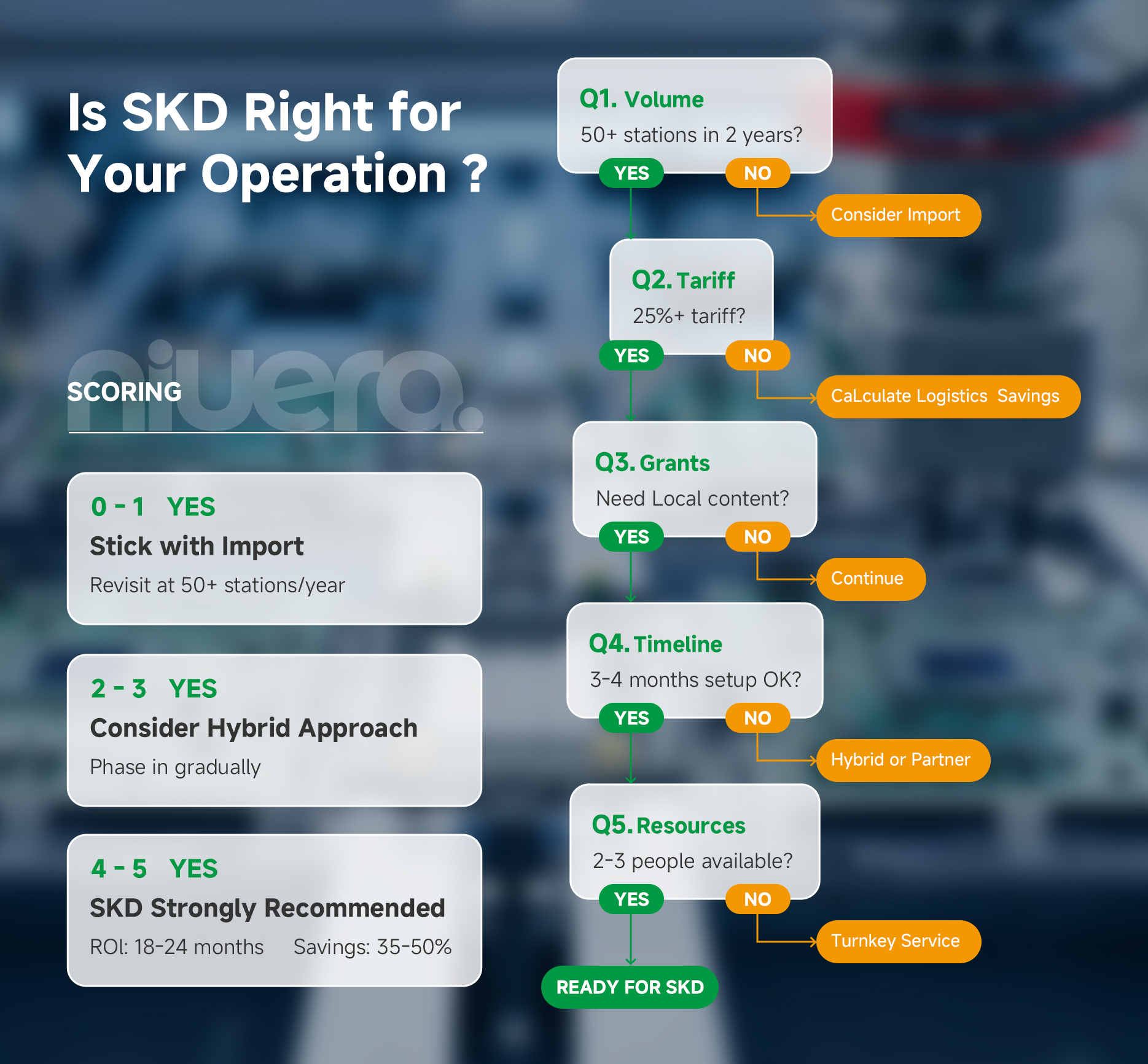
Question 1: Deployment Volume
Will you deploy 50+ stations in this market over the next 2 years?
- ✅ Yes → Continue to Question 2
- ❌ No → Consider traditional import or partnering with established local operators
Question 2: Tariff Exposure
Are you facing 25%+ tariffs on full equipment imports?
- ✅ Yes → Continue to Question 3
- ⚠️ No → Calculate if time-to-market and logistics savings alone justify SKD (~15-20% total cost reduction)
Question 3: Grant Eligibility Requirements
Do you need to meet local content requirements to access government incentives?
- ✅ Yes → SKD/CKD likely required (40-60% local content achievable with SKD, 70-90% with CKD)
- ⚠️ No → Continue to Question 4
Question 4: Implementation Timeline
Can you invest 3-4 months in setup before beginning deployment?
- ✅ Yes → Continue to Question 5
- ❌ No → Consider:
- Partnering with established local assembler (pay 10-15% premium, immediate start)
- Hybrid approach: Import first 50 units while establishing SKD capability
Question 5: Technical Resources
Can you dedicate 2-3 people to manage assembly operations?
- ✅ Yes → You're ready for SKD implementation
- ❌ No → Explore turnkey SKD services where provider manages assembly operations (available from select manufacturers)
Scoring Your Readiness
4-5 Yes answers:
- SKD is strongly recommended
- Projected ROI: 18-24 months
- Cost savings: 35-50% over import model
2-3 Yes answers:
- Consider hybrid approach
- Start with imports while building SKD capability
- Phase in local assembly as volume grows
0-1 Yes answers:
- Stick with imports for now
- Revisit SKD when deployment exceeds 50 stations/year
- Monitor tariff developments and policy changes
Conclusion: Localization as Competitive Advantage
The global charging infrastructure industry stands at an inflection point. Trade barriers and local content requirements are no longer temporary anomalies but structural features of the market landscape that will define competitive success for the next decade.

The United States market alone demonstrates this transformation: from almost no domestic fast charger production three years ago to at least 26 manufacturing firms with over one million units of annual capacity today—a complete industry restructuring in just 36 months.
The Strategic Imperative
For charging network operators, SKD and CKD solutions represent more than cost optimization—they're strategic enablers of international expansion in an increasingly fragmented global trading system. The operators who move decisively to establish localized assembly capabilities will capture multiple first-mover advantages:
Economic Advantages:
- 35-50% total cost reduction vs. tariff-burdened imports
- 60-70% faster deployment (30-45 days vs. 90-120 days lead time)
- Access to $10-50 billion in global government incentives requiring local content
- Protection from future tariff escalation and trade policy volatility
Competitive Advantages:
- Faster response to market opportunities (secure prime locations first)
- Ability to customize for local requirements (standards, language, payments)
- Superior service and support leveraging local technical teams
- Stronger relationships with government and utilities through local job creation
Strategic Advantages:
- Supply chain resilience against geopolitical disruptions
- Technology capability building enabling product evolution
- Platform for regional expansion leveraging established operations
- Defensive positioning against trade barrier escalation
What Success Requires
Success in this new landscape requires more than just shipping components instead of finished products. It demands:
1. Experienced Partners Manufacturers who offer not just components, but comprehensive solutions:
- Product design and certification support (navigating UL, CE, CCC, BIS requirements)
- Complete component supply and logistics management (2,000-5,000 parts coordinated)
- Assembly process transfer with proven SOPs and training programs
- Ongoing technical support with defined SLAs (24/7 availability for critical issues)
2. Realistic Expectations
- 12-18 month ramp to full operational efficiency (not 3-6 months)
- Initial quality challenges requiring 10-15% budget contingency
- Continuous improvement mindset rather than "set and forget"
- Long-term commitment (3-5 year horizon for full ROI realization)
3. Proper Investment
- Training and quality systems (often underestimated at 10-15% of setup costs)
- Safety stock and supply chain buffers (4-6 weeks of inventory)
- Technical personnel capable of managing assembly operations
- Facility infrastructure meeting ESD and safety requirements
4. Strategic Patience The operators succeeding with SKD share common characteristics:
- Focus on 3-5 year value creation, not just Year 1 costs
- Willingness to invest in capability building (training, systems, processes)
- Partnership approach with SKD providers rather than transactional relationships
- Commitment to continuous improvement and operational excellence
The Path Forward
The question facing today's charging infrastructure operators isn't whether localization will shape the industry's future—evidence from U.S., Europe, and emerging markets confirms this trend is irreversible. The question is whether individual operators will lead this transformation or follow it.
For operators deploying 100+ stations annually in markets with significant tariffs (25%+): SKD implementation should be an immediate strategic priority. Delaying means ceding competitive advantages to early movers already securing grant funding, prime locations, and market share.
For operators in earlier deployment stages: Begin planning now. Develop relationships with SKD-capable manufacturers, understand certification requirements in target markets, and model financial scenarios. When deployment volume reaches the threshold (typically 50 stations/year), you'll be ready to move quickly.
For global operators with multi-market strategies: Regional hub approaches offer optimal economics. Establish 2-3 strategic assembly facilities serving major markets rather than attempting country-by-country operations.
Niuera's Approach to SKD Solutions

Niuera specializes in high-efficiency EV charging modules and comprehensive SKD/CKD solutions, supporting charging network operators in establishing local manufacturing capabilities worldwide. Our approach combines:
Proven Technology Platform:
- Power modules delivering 97%+ efficiency across the 60kW to 480kW range
- Advanced air-cooled thermal management supporting -40°C to +70°C operation
- Wide voltage capability (200-1000V) accommodating current and future EV platforms
- Acoustic optimization maintaining <65dB even at full power for urban deployments
Complete SKD Service Package:
- Product adaptation and certification support for local requirements
- Component supply management and logistics coordination
- Comprehensive assembly process transfer with detailed SOPs
- Multi-week hands-on training programs for production teams
- Ongoing technical support with 24/7 availability
Global SKD Experience:
- Successfully deployed in North America, Europe, and emerging markets
- Track record with operators ranging from 50 to 500+ stations annually
- Flexible engagement models from pure component supply to turnkey assembly management
- Proven results: 85-90% customer satisfaction across international deployments
Take the Next Step
Evaluate Your SKD Readiness - Use our decision framework above. If you scored 3+ "Yes" answers, SKD warrants serious evaluation.
Request a Preliminary Assessment - Contact our SKD solutions team for a no-obligation 30-minute discussion of your specific situation: market dynamics and tariff exposure analysis, volume threshold assessment, preliminary timeline and investment requirements.
Download Supporting Resources - Access our free resource library including SKD vs Import Financial Model Template, SKD Implementation Checklist, and detailed case studies from North America, Europe, and Asia deployments.
Stay Informed - Subscribe to our SKD Market Intelligence Newsletter for monthly updates on tariff and trade policy developments, government incentive programs, SKD case studies, and technology developments supporting localized manufacturing.
The charging infrastructure industry is undergoing its most significant transformation since the introduction of DC fast charging. Operators who recognize localization as a strategic imperative—not just a cost optimization tactic—will be best positioned to capture the opportunities in this rapidly evolving market.
The foundation you build today through SKD implementation will determine your competitive position for the next decade. Whether you're ready to begin immediately or planning for future implementation, now is the time to develop your localization strategy.
References and Data Sources
Tariff and Trade Policy:
- U.S. Trade Representative, Section 301 Review (2024)
- European Commission, Anti-Subsidy Investigation Report (2024)
- Canada Border Services Agency, Tariff Updates (2024)
Government Programs:
- U.S. Department of Energy, NEVI Program Documentation
- U.S. Department of Transportation, Build America Buy America Act
- European Commission, Alternative Fuels Infrastructure Regulation (AFIR)
- India Ministry of Heavy Industries, Production Linked Incentive Scheme
Market Data:
- U.S. Department of Energy, Domestic Manufacturing Analysis (2024)
- BloombergNEF, EV Charging Infrastructure Outlook (2024)
- International Energy Agency, Global EV Outlook (2024)
Industry Analysis:
- Alliance for Automotive Innovation, Manufacturing Survey Data
- CharIN (Charging Interface Initiative), MCS Standards Development
All data current as of December 2024. Market conditions, tariffs, and policies subject to change.
About Niuera
Niuera specializes in high-efficiency EV charging modules and comprehensive SKD/CKD solutions for the global charging infrastructure market. With proven deployments across North America, Europe, and Asia, we enable charging network operators to build local manufacturing capabilities while maintaining the efficiency and reliability required in demanding commercial applications.
Our modular power platforms, delivering 97%+ efficiency from 60kW to 480kW, combine with complete assembly transfer programs to enable rapid, cost-effective market entry in any region. For more information on how Niuera can support your localization strategy, visit www.niueraenergy.com or contact our solutions team at info@niueraenergy.com.
The $15 Billion Two-Wheeler EV Charging Gap: Industry Estimates Point to Massive Infrastructure Opportunity in Asia-Pacific
Scaling EV Charging Infrastructure Locally: Why Leading Operators Choose SKD Solutions(Part 1)