
Building a Reliable Charging Network: How Module Architecture Affects Station Uptime

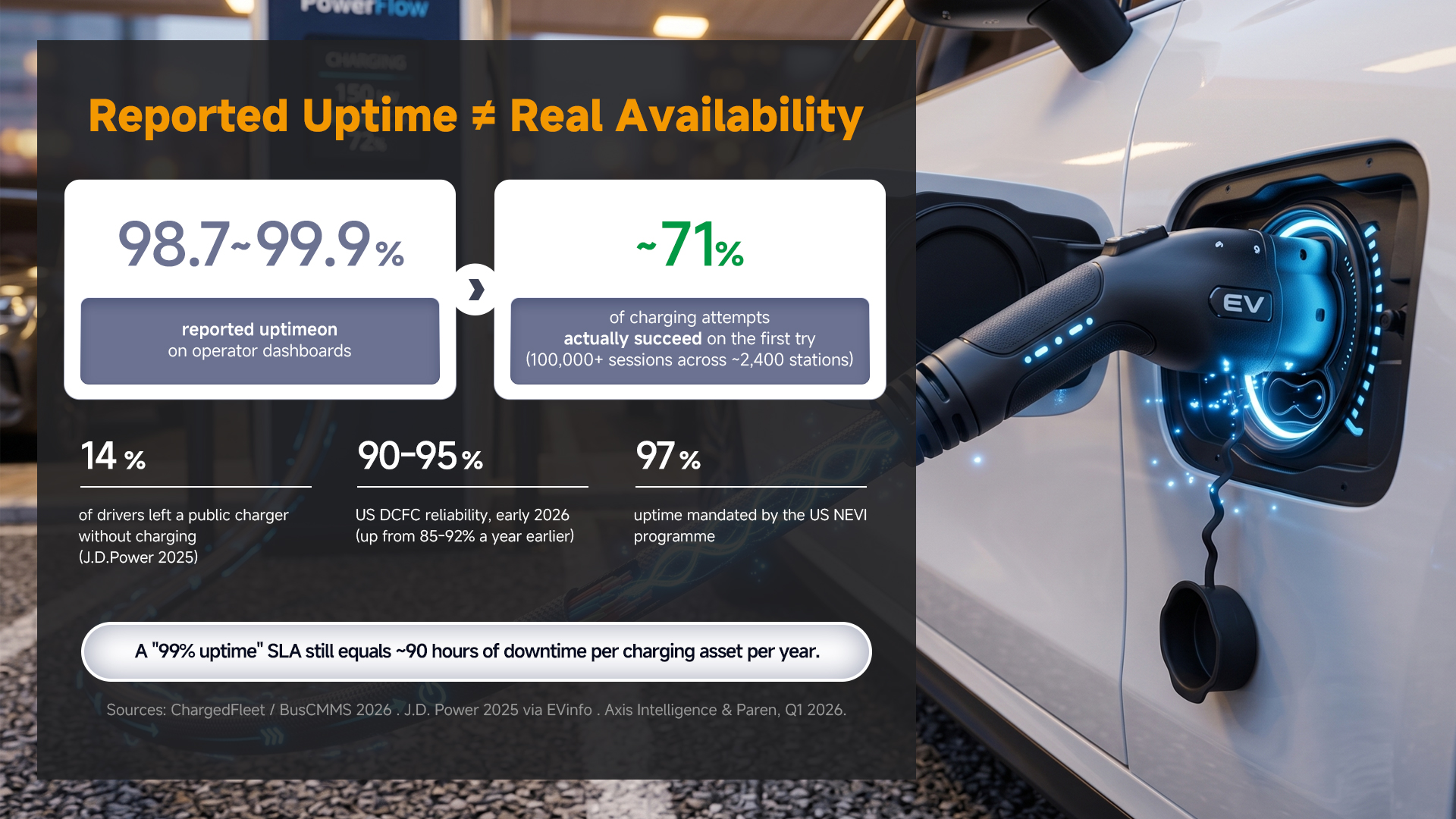
Ask a charging network operator what keeps them up at night and the answer is rarely peak power or headline efficiency. It is uptime — and, more precisely, the widening gap between the uptime a dashboard reports and the availability a driver actually experiences. Industry data covering more than 100,000 charging sessions across some 2,400 stations found that while networks reported uptime of 98.7 to 99.9 percent, only about 71 percent of charging attempts actually succeeded on the first try.1 A 2025 J.D. Power study found that 14 percent of drivers who visited a public charger left without successfully charging.2 As one analysis put it bluntly, a charger can report 99 percent uptime and still turn away one driver in three.3
That gap is a margin problem, not a maintenance footnote. And a large part of it is decided in a place most buyers never inspect: the power-conversion module inside the station. This article is about that layer — how charging-module architecture shapes real-world uptime, and what an operator should specify to build a network that stays available.
The uptime number is not the uptime story
Start with the benchmark. A 97 percent uptime target has become the working standard for public charging — it is the threshold the US NEVI programme mandates for federally funded chargers, and the figure most operators aim for.4 But even a strong SLA hides a lot of downtime. A "99 percent uptime" guarantee still equals nearly 90 hours of downtime per charging asset per year.1 For a commercial site where every hour of availability is revenue and driver trust, 90 lost hours is not a rounding error.
The market-wide picture is improving but still uneven. Independent monitoring put the US DC fast-charging reliability average at roughly 90 to 95 percent through early 2026, up from about 85 to 92 percent a year earlier, with the weakest markets still around 78 percent — meaning more than one charging attempt in five fails in the worst regions.5 Reported uptime and real success are two different measurements, and the difference is dominated by hardware behaviour: whether a fault takes down a whole station, how gracefully the station degrades under stress, and how quickly a failed part can be returned to service.
Those three questions are architecture questions. They are answered when the station is designed, not when it is repaired.
Where stations actually fail — and why architecture decides it
A DC charging station is not one big power supply. It is a rack of power-conversion modules working in parallel, each converting grid AC into the DC the vehicle's battery accepts. How those modules are arranged determines what happens when one of them has a problem — and something always eventually does.
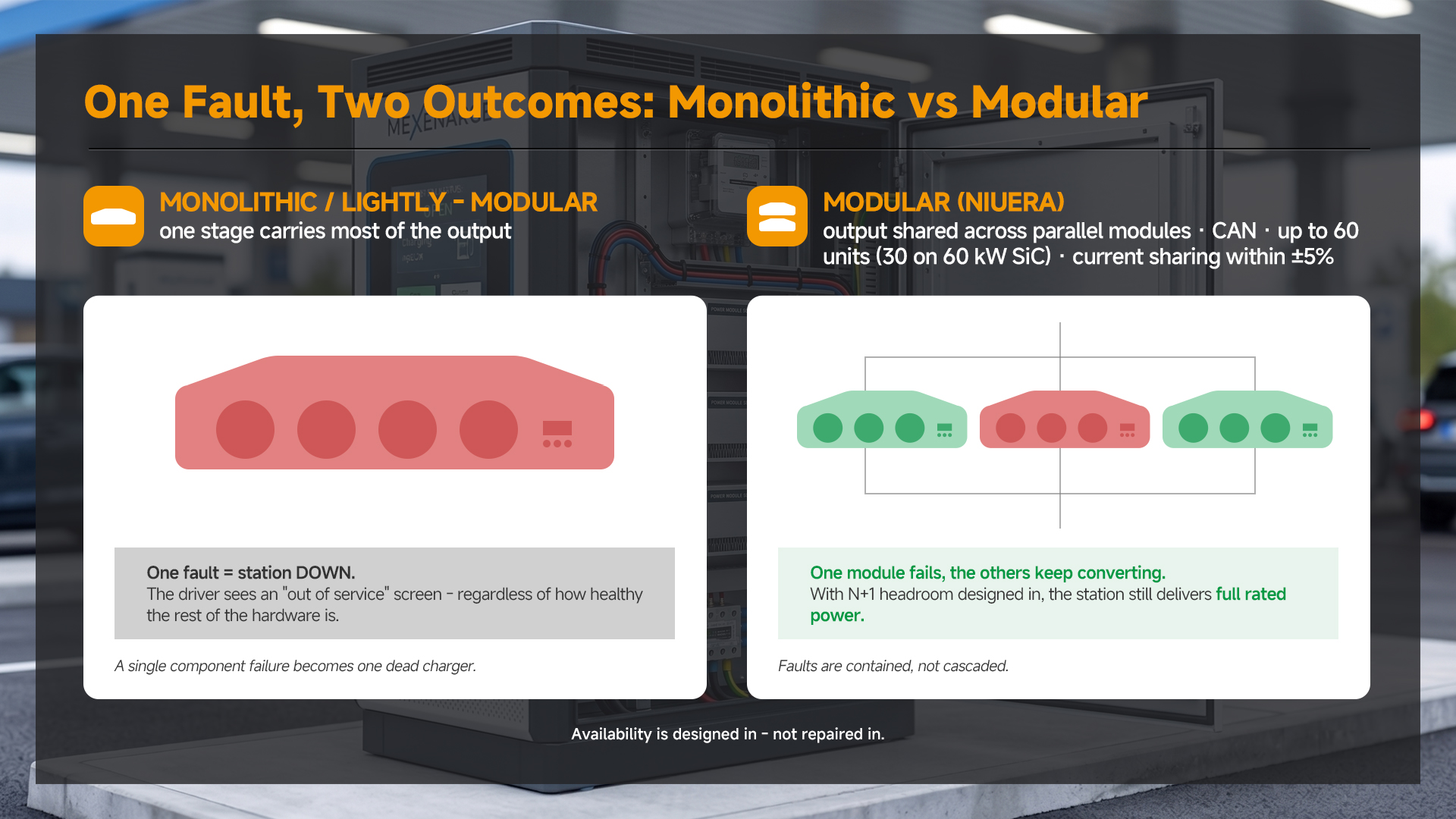
In a monolithic or lightly-modular design, a single power stage carries a large share of the station's output. When it faults, the station loses a large fraction of its capacity or goes dark entirely. One component failure becomes one dead charger, and the driver who pulls up sees an out-of-service screen regardless of how healthy the rest of the hardware is.
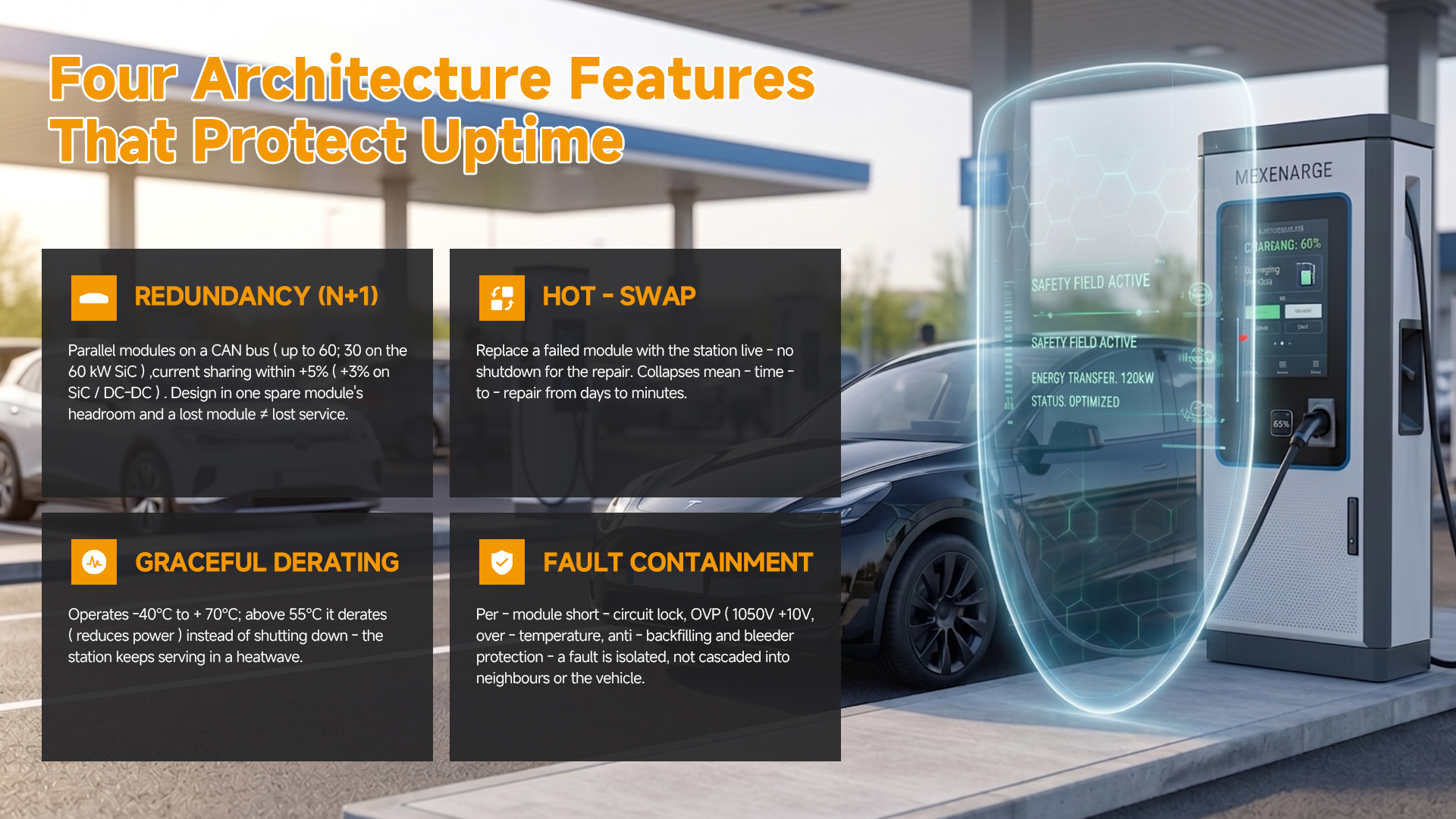
In a properly modular design, output is shared across many independent modules operating in parallel and coordinating over a communication bus. Niuera's AC-DC modules, for example, run in parallel under CAN control — up to 60 units on a bus (30 for the 60 kW SiC modules) — sharing current with a balancing accuracy within ±5 percent (±3 percent on the SiC and DC-DC modules).6 This arrangement changes the failure model completely:
-
A single module failure is not a station failure. If one module drops out, the others keep converting power. The station loses that module's slice of capacity, not its service. With one spare module's worth of headroom designed in (an N+1 approach), a station can lose a module and still deliver full rated power.
-
Faults are contained, not cascaded. Each module carries its own protection — short-circuit protection with a lock-out mode, output over-voltage protection (1050 V ±10 V trip), over-temperature protection, a built-in bleeder circuit, and battery-current anti-backfilling protection — so a fault in one module is isolated rather than propagated into neighbouring hardware or the vehicle.6
Stress produces derating, not shutdown. Niuera modules operate from -40°C to +70°C and, rather than tripping off in heat, apply a derating function above 55°C: the station keeps serving at reduced power instead of going offline.6 In a heatwave, a charger that keeps working at 80 percent output beats one that shows an error screen.
The point is that availability is designed in. A modular, redundant, self-protecting architecture converts most single-component failures from "station down" into "station slightly reduced" — which is the entire difference between the reported-uptime number and the success-rate number.
The second half of uptime: how fast you recover
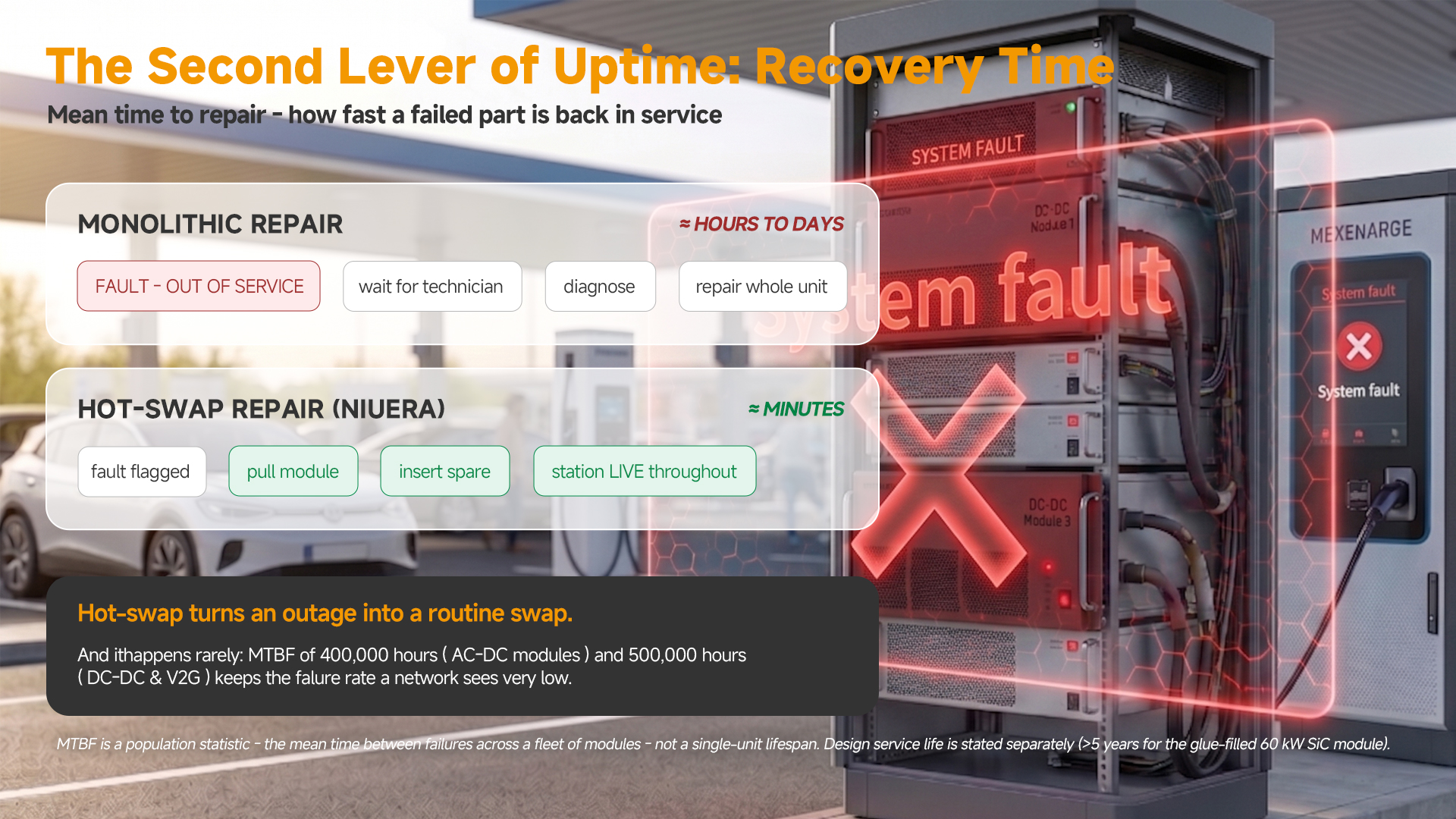
Availability has two levers. The first is how often the hardware fails and how well the station tolerates it. The second is how quickly a failed part returns to service — the mean time to repair. Architecture drives this one too.
Niuera's AC-DC charging modules use hot-swap technology: a failed module can be pulled and replaced while the rest of the station keeps operating, without shutting the station down for the repair.6 Compare the two service models. In a non-modular charger, a power-stage fault means an out-of-service station until a technician arrives, diagnoses, and repairs — often a multi-day window if parts or specialists must travel. With hot-swappable modules, the same fault becomes a few-minute module change from local spares, with the station live throughout. The repair stops being an outage.
Two module characteristics make that model dependable over years, not just on day one:
-
Statistical reliability. Niuera's AC-DC modules are rated at an MTBF of 400,000 hours at 40°C, and the DC-DC and V2G modules at 500,000 hours or more.6 MTBF is a population statistic — the expected mean time between failures across a fleet of modules, not a promise that any single unit runs for 45 years — but a high MTBF directly lowers the failure rate an operator will see across a network, which is exactly what keeps a redundant station from ever dropping below full power.
-
Durability by construction. The 60 kW SiC module uses a full glue-filling (potting) process and a purpose-designed air duct to survive harsh, humid, dusty environments, with a design service life of more than five years; control runs on a TI dual-core DSP at up to 100 MHz for precise, stable regulation.6 Fault-alarm features such as the DC-DC module's fan-failure alarm mean a degrading component announces itself before it becomes an outage.6
One clarification worth making, because it confuses buyers: the modules themselves carry an IP20 rating, because they live inside the station's sealed enclosure. It is the finished charging station — the cabinet — that provides the outdoor IP protection (IP55 on Niuera's public charging stations). The module's job is conversion and reliability; the enclosure's job is the environment. Judging a module by an enclosure rating, or vice versa, is a common specification error.
What this means for maintenance economics
The financial case follows directly from the architecture. Downtime has two cost components — lost charging revenue and the service cost of the repair — and modular hot-swap design attacks both.
On the revenue side, redundancy plus derating keeps the station earning through the exact events (a module fault, a hot afternoon) that would otherwise zero out its output. On the service side, hot-swap collapses mean-time-to-repair and converts unplanned emergency call-outs into planned, low-skill module swaps from a local spares pool. The operator holds a few spare modules per site cluster rather than dispatching specialists for whole-unit diagnosis. Over a multi-year asset life, the difference between "every fault is a truck roll and an outage" and "most faults are a live module swap" is the difference between a network that hits its uptime SLA profitably and one that pays penalties to miss it.
This is also where hardware meets software: because the modules report status over CAN and the station over OCPP, faults surface as alarms an operator can act on before a driver is turned away. (The analytics and predictive-maintenance side of that story is a topic in its own right, and one we will take up separately.)
Why this matters more in emerging markets
In a mature market with a dense service network, a poorly architected charger is expensive. In an emerging market, it can be unworkable. Where a replacement part or a qualified technician may be days away, the cost of an outage is measured in lost operating days for the fleet that depends on the charger, not hours. The same architectural features that improve a US network's SLA — redundancy so a fault does not stop service, hot-swap so a local operator can restore full capacity without a specialist, graceful derating so heat does not force a shutdown, wide-temperature tolerance and glue-filled durability so the hardware survives the environment — are precisely the features that make a charging network viable where support is thin and conditions are hard. Architecture that is a margin optimisation in one market is a precondition for operating at all in another.
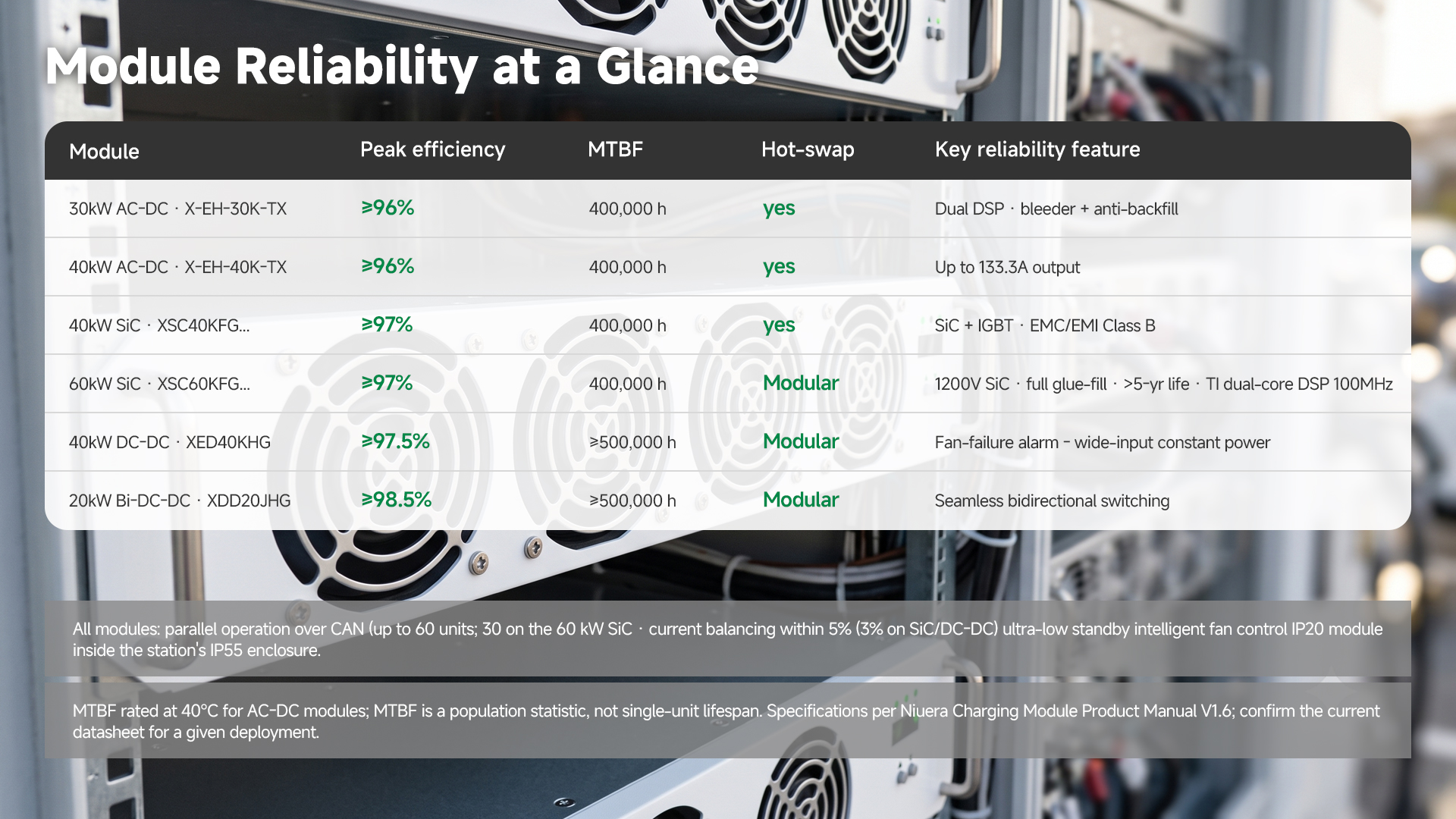
Module reliability at a glance
| Module | Peak efficiency | MTBF | Hot-swap | Reliability features |
| 30 kW AC-DC (X-EH-30K-TX) | ≥96% | 400,000 hrs | Yes | Dual DSP, bleeder + anti-backfill, short-circuit/OVP/OTP, derate >55°C |
| 40 kW AC-DC (X-EH-40K-TX) | ≥96% | 400,000 hrs | Yes | As above; up to 133.3 A output |
| 40 kW SiC (XSC40KFG…) | ≥97% | 400,000 hrs | Yes | SiC + IGBT, EMC/EMI Class B |
| 60 kW SiC (XSC60KFG…) | ≥97% | 400,000 hrs | Modular | 1200 V SiC, full glue-filling, >5-yr service life, TI dual-core DSP 100 MHz |
| 40 kW DC-DC (XED40KHG) | ≥97.5% | ≥500,000 hrs | Modular | Fan-failure alarm, wide-input constant power |
| 20 kW Bi-DC-DC (XDD20JHG) | ≥98.5% | ≥500,000 hrs | Modular | Seamless bidirectional switching |


All modules: parallel operation over CAN (up to 60 units; 30 on the 60 kW SiC), current balancing within ±5% (±3% on the SiC and DC-DC modules), ultra-low standby power, intelligent fan speed control, IP20 (module) inside the station's IP55 enclosure. MTBF is rated at 40°C for the AC-DC modules. Specifications per Niuera module manual V1.6; confirm against the current datasheet for a given deployment.6
The takeaway for network operators
Uptime is not a number you manage after the fact; it is an outcome you specify up front. The reported-uptime figure on a dashboard and the success rate a driver experiences diverge for architectural reasons: whether a single fault takes the station down, whether the station degrades gracefully under stress, and how fast a failed part is back in service. A modular, redundant, self-protecting, hot-swappable module architecture — with high MTBF and durability built for the environment — is what closes that gap. It keeps the station earning through the faults and heat that would otherwise stop it, and it turns repairs from outages into routine swaps.
For an operator comparing hardware, the reliability questions are concrete: Is output shared across redundant modules or concentrated in one stage? Can a failed module be hot-swapped with the station live? Does the module derate or shut down under thermal stress? What is the MTBF, and what is the design service life? The answers decide what your network's uptime will actually be — long after the spec sheet's efficiency figure has stopped mattering.
Specifying for uptime?
Niuera's charging-module range is built for the availability an operator actually needs: modular hot-swap architecture, ≥96–98.5% efficiency, 400,000–500,000-hour MTBF, graceful thermal derating, and glue-filled durability for harsh sites. Download the module datasheets, or arrange a technical consultation to review the right module architecture and redundancy plan for your network. Reach us at info@niuera.cn or +86 0512-68303879, or visit www.niueraenergy.com.
FAQ
Does one module failure take the whole station offline?
In a properly modular design, no. Niuera's modules run in parallel over CAN and share current, so if one drops out the others keep converting power; the station loses that module's capacity, not its service. Designing in one spare module's worth of headroom (N+1) lets a station lose a module and still deliver full rated power.6
What is hot-swap and why does it matter for uptime?
Hot-swap means a failed module can be removed and replaced while the station keeps operating, rather than shutting down for the repair. It collapses mean-time-to-repair and converts an outage into a few-minute module change from local spares.6
What does the MTBF figure actually mean?
MTBF (400,000 hours for the AC-DC modules, 500,000+ for DC-DC and V2G) is a statistical measure of the mean time between failures across a population of modules — not a guarantee that a single unit lasts 45 years. A high MTBF lowers the failure rate a network sees, which is what keeps a redundant station from dropping below full power. Design service life is stated separately (over five years for the glue-filled 60 kW SiC module).6
Why are the modules rated IP20 if the stations work outdoors?
The module lives inside the station's sealed enclosure, so it carries a module-level IP20 rating; the finished station cabinet provides the outdoor protection (IP55 on Niuera's public charging stations). The two ratings describe different parts of the system.6
How does the station keep working in extreme heat?
Niuera modules operate from -40°C to +70°C and apply a derating function above 55°C — reducing output rather than shutting down — so the station keeps serving at reduced power in a heatwave instead of going offline.6
References
-
ChargedFleet — Redefining the Charging Reliability Layer (2026); corroborated by BusCMMS — EV Charging Infrastructure Maintenance 2026.
-
J.D. Power — 2026 U.S. Electric Vehicle Experience (EVX) Public Charging Study findings, as reported by EVInfo (May 2026).
-
Codibly — The Cost of a Failed EV Charge (2026).
-
U.S. Federal Highway Administration — National Electric Vehicle Infrastructure (NEVI) minimum standards, including the 97% uptime requirement; FLO — reliability blog series on standardised charger uptime.
-
Axis Intelligence — Electrify America Reliability 2026; Paren — Q1 2026 U.S. charging reliability data.
-
Suzhou Niuera Energy Co., Ltd. — Charging Module Product Manual, V1.6 (2026). All module names and specifications in this article are drawn from this manual. MTBF is a population statistic (mean time between failures across a module fleet), not a single-unit service life; the 40 °C rating applies to the AC-DC modules. Station-level IP ratings are per Niuera charging station documentation.
Industry reliability figures cited above are drawn from the published sources listed and are attributed to those sources. Product specifications are subject to change; please confirm current specifications with Niuera for any specific project.
Solar, Storage, Charging: Why South America's E-Moto Infrastructure Should Be Built as One System
India's Electric Two-Wheeler Market: Charging Infrastructure for the PM E-DRIVE Era
Related blog