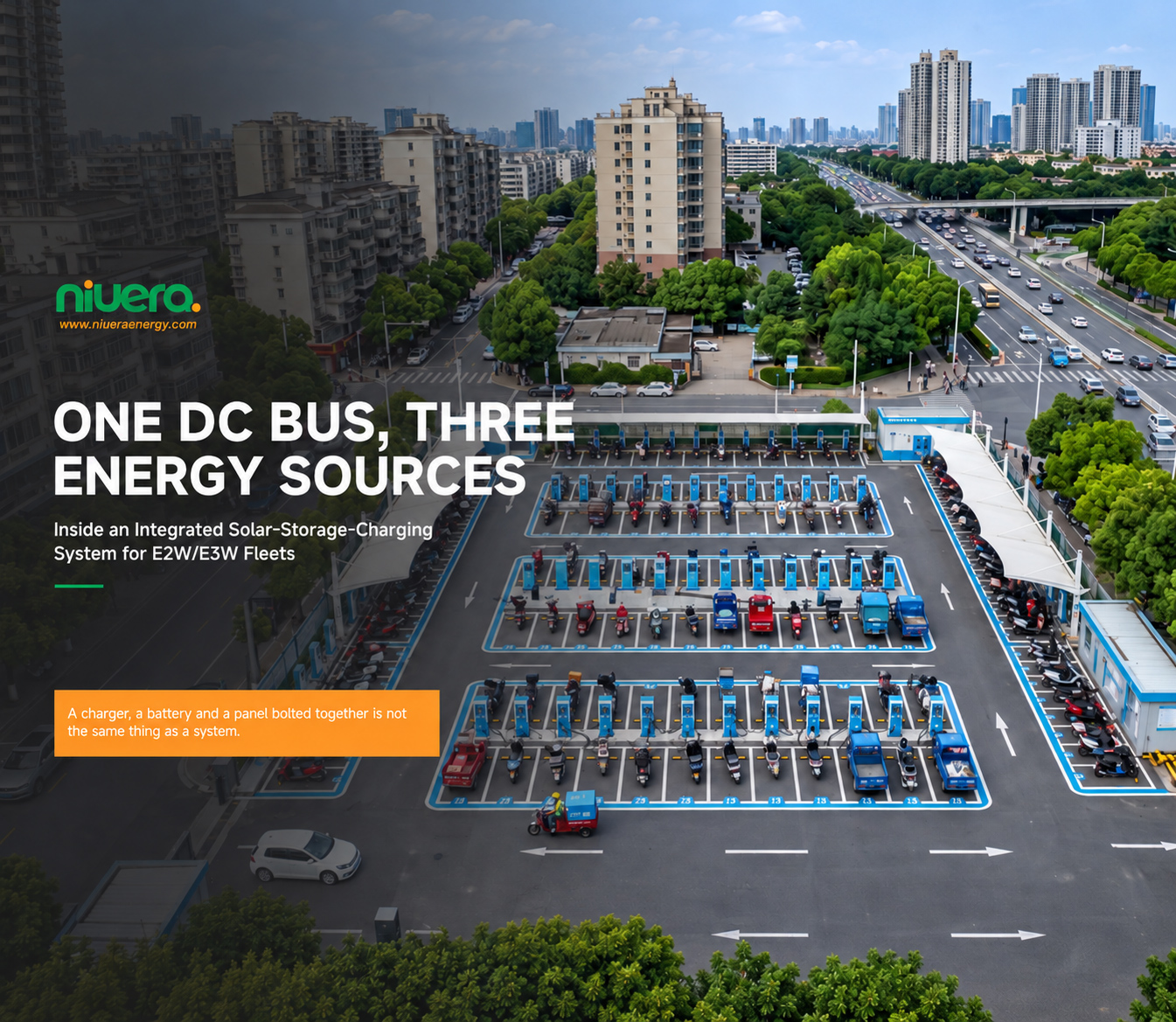
India's Electric Two-Wheeler Market: Charging Infrastructure for the PM E-DRIVE Era

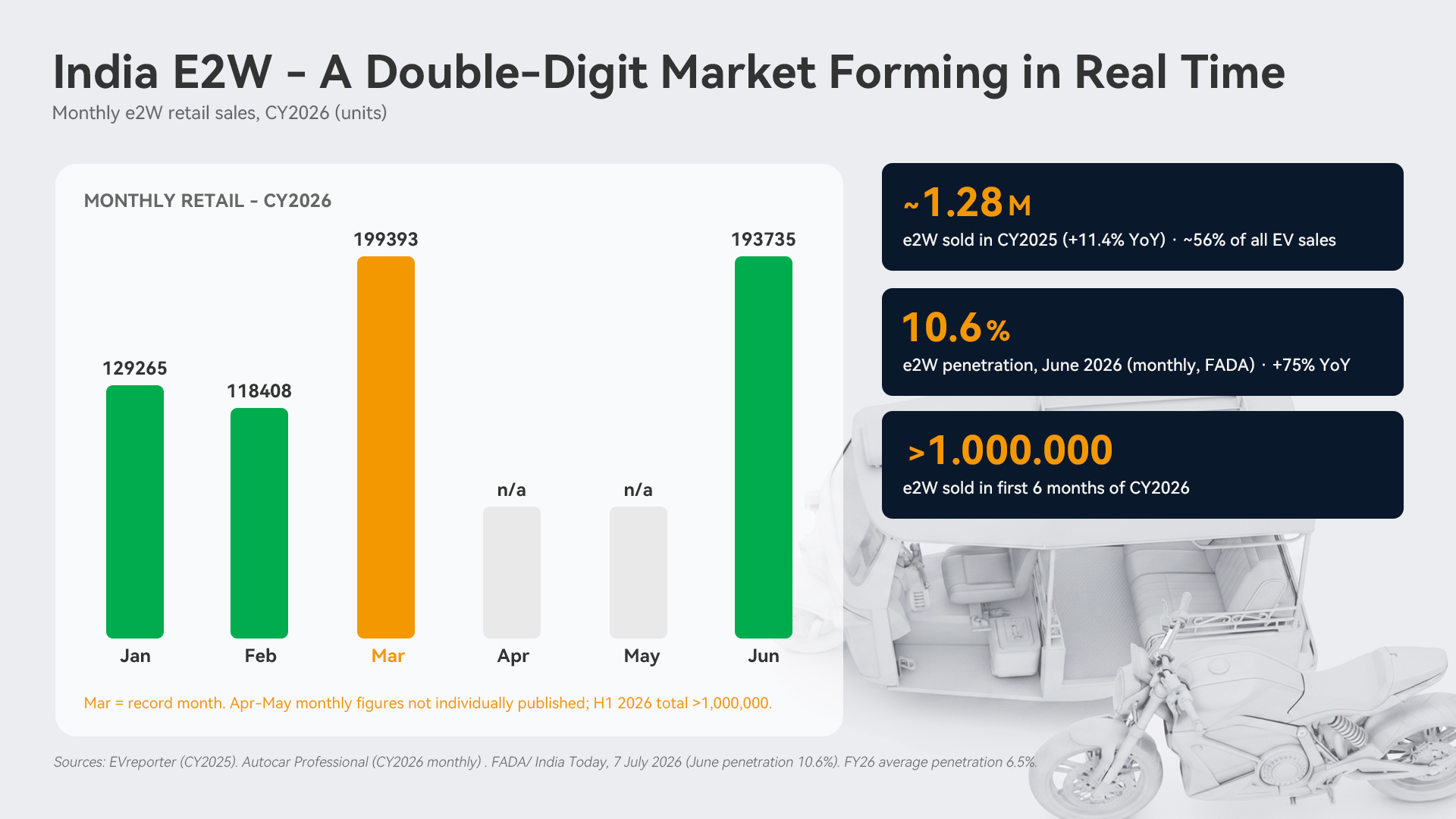
India buys more two-wheelers than any country on earth, and it is electrifying them at a pace that surprises even the optimists. In June 2026, electric two-wheeler retail sales reached 193,735 units, up roughly 75 percent year on year, lifting monthly electric penetration in the two-wheeler segment to 10.6 percent.1 Two-wheelers account for the large majority of private vehicles on Indian roads, so a double-digit electric share in the country's biggest vehicle category is a genuinely large market forming in real time.2
But there is a clock on part of this story. The central subsidy that helped drive the surge — the PM E-DRIVE scheme's incentive for electric two-wheelers — is scheduled to end on 31 July 2026, days after this article publishes.3 That makes mid-2026 an unusually clarifying moment to ask the right question. When the vehicle subsidy tapers, what is the durable constraint on adoption? The answer, increasingly, is not the vehicle. It is where and how the vehicle charges. This article looks at where India's e2W market actually is in mid-2026, what happens as the subsidy sunsets, and where purpose-built charging hardware fits — honestly, including where it does not.
The demand picture in mid-2026
The headline numbers are unambiguous. Across calendar year 2025, India sold roughly 1.28 million electric two-wheelers, an 11.4 percent increase over 2024, and e2Ws made up about 56 percent of all electric vehicles sold in the country.4 Momentum has carried into 2026: the segment crossed one million units within the first six months of the year, with March 2026 alone posting a record 199,393 units.5
For the 2025–26 financial year, the Federation of Automobile Dealers Associations put e2W penetration at about 6.5 percent on average, up from 6.1 percent a year earlier, with retail volumes growing around 22 percent year on year.6
The gap between that fiscal-year average (6.5 percent) and the June 2026 monthly figure (10.6 percent) is itself the story: adoption is accelerating month over month, and part of the recent spike is a pull-forward of demand ahead of the subsidy deadline. Some of that demand is being borrowed from the second half of the year. The underlying trajectory, though, is clearly upward, and it is concentrated in exactly the urban, high-utilisation use cases — commuting, gig delivery, last-mile logistics — where charging behaviour is most demanding.
The subsidy cliff, and what comes after
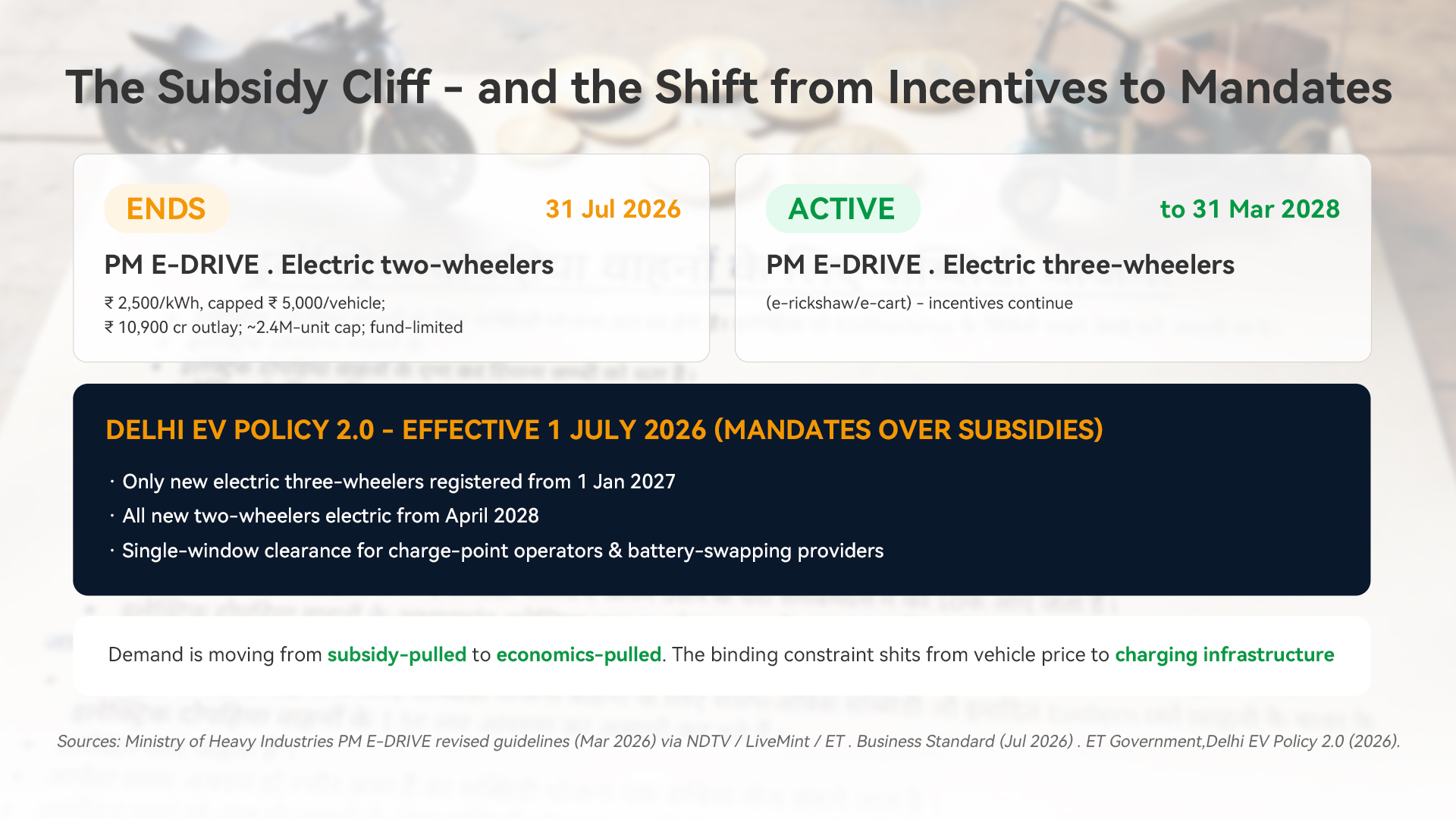
The PM E-DRIVE scheme (Prime Minister's Electric Drive Revolution in Innovative Vehicle Enhancement) is a ₹10,900 crore programme that replaced the earlier FAME II subsidies. Under revised guidelines notified in March 2026, electric two-wheelers registered up to 31 July 2026 qualify for an incentive of ₹2,500 per kWh of battery capacity, capped at ₹5,000 per vehicle; electric three-wheelers (e-rickshaws and e-carts) remain eligible until 31 March 2028.3 The two-wheeler support is also unit-capped at roughly 2.4 million vehicles, and the scheme is fund-limited overall — if the outlay is exhausted, it ends early.7
Two implications follow, and both point the same way.
First, the vehicle-purchase incentive for two-wheelers is ending, while the vehicles keep coming. India's largest EV market is transitioning from subsidy-pulled to economics-pulled demand, because the operating-cost case for an electric two-wheeler stands on its own once the vehicle is on the road. The strategic constraint shifts from "can a buyer afford the bike" to "can a rider conveniently and reliably recharge it."
Second, policy is visibly moving from subsidies toward mandates. Delhi's EV Policy 2.0, effective 1 July 2026, leans less on purchase incentives and more on regulatory levers: only new electric three-wheelers may be registered from 1 January 2027, and all new two-wheelers in the city must be electric from April 2028, alongside a single-window clearance process for charge-point operators and battery-swapping providers.8 Transport groups have already flagged that charging and swapping infrastructure is not yet adequate for those timelines.9 Whatever one thinks of the mandates, the direction is clear: the policy conversation has moved from putting bikes on the road to keeping them energised.
How Indians actually charge — and where the hardware opportunity really is
It is worth being precise here, because the honest answer shapes everything about product fit.
Most private electric two-wheeler owners in India charge at home, overnight, from a standard socket using the AC charger bundled with the vehicle. For a commuter who parks at home, that is the cheapest and most convenient option, and it needs no public infrastructure at all. A blog that claims every e2W needs a DC fast charger would be selling a solution to a problem most private riders do not have.
The real demand for purpose-built charging hardware sits in four places where home charging does not work:
-
Commercial and gig fleets — food and parcel delivery riders who cannot afford midday downtime and often do not charge at a single home base.
-
Battery-swap networks — India has a large swapping ecosystem for two- and three-wheelers (Battery Smart, Bounce, Sun Mobility and others), and every swapped pack is charged in a back-room cabinet that needs charging hardware.
-
Public and community top-up points — kiosks, parking, retail forecourts and dealerships serving riders without dependable home charging.
Off-grid and weak-grid locations — peri-urban and rural sites where the grid is unreliable or absent.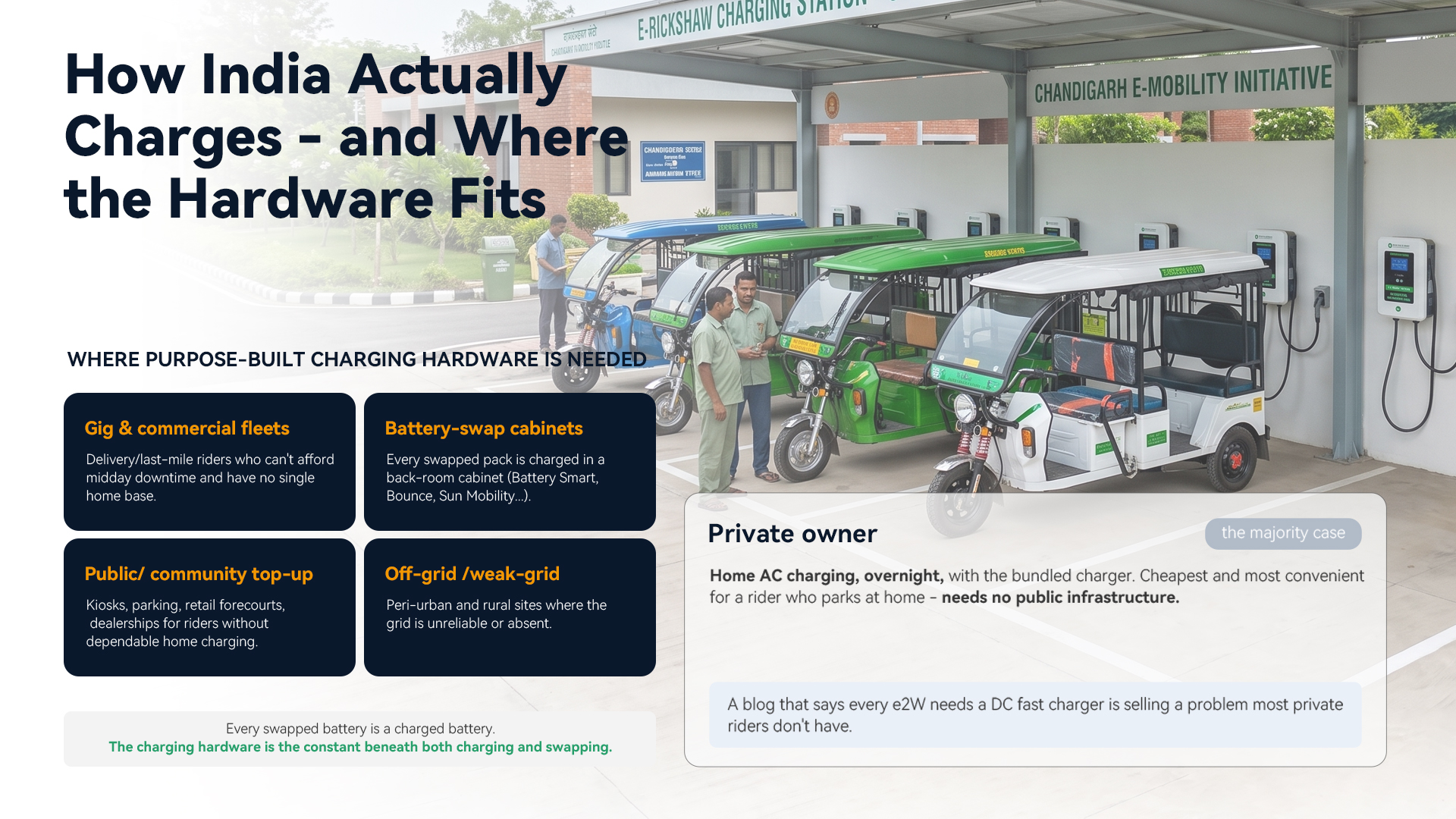
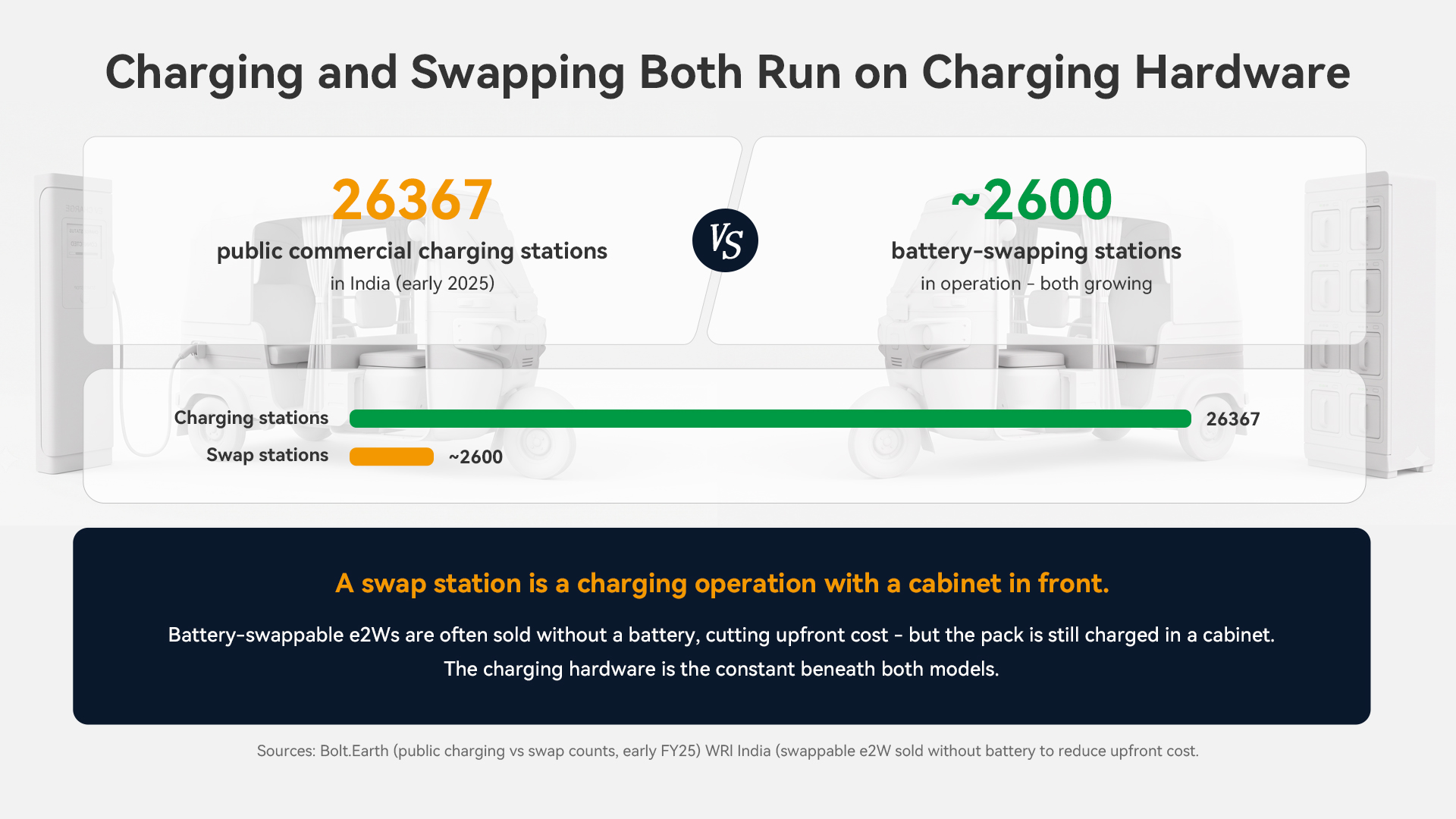
The scale context matters. India had already built more than 26,000 public commercial EV charging stations by early 2025, against roughly 2,600 battery-swapping stations — both figures growing, and both representing charging-hardware demand, since a swap station is a charging operation with a cabinet in front of it.10 The swap model is especially significant for India because battery-swappable two-wheelers are often sold without a battery, cutting the rider's upfront cost in a highly price-sensitive market.11 Whichever model wins in a given city, the charging hardware underneath it is the constant.
Where Niuera's range fits
Where Niuera's range fits
Niuera's low-voltage vehicle charging line is built for exactly these use cases and for Indian conditions: 48V/60V/72V lithium platforms, variable grid quality, heat and dust, and operators who need digital payment and remote management. Indian e2W platforms are predominantly built on 48V, 60V and 72V lithium systems; Niuera's single-phase stations output an adjustable DC voltage in the 20–120 VDC range (30–120 VDC on floor and cabinet models, 20–120 VDC on the wall-mounted series) and the three-phase stations output 48–100 VDC, covering that range directly. All stations are for lithium chemistries (LFP and NMC), not lead-acid.12
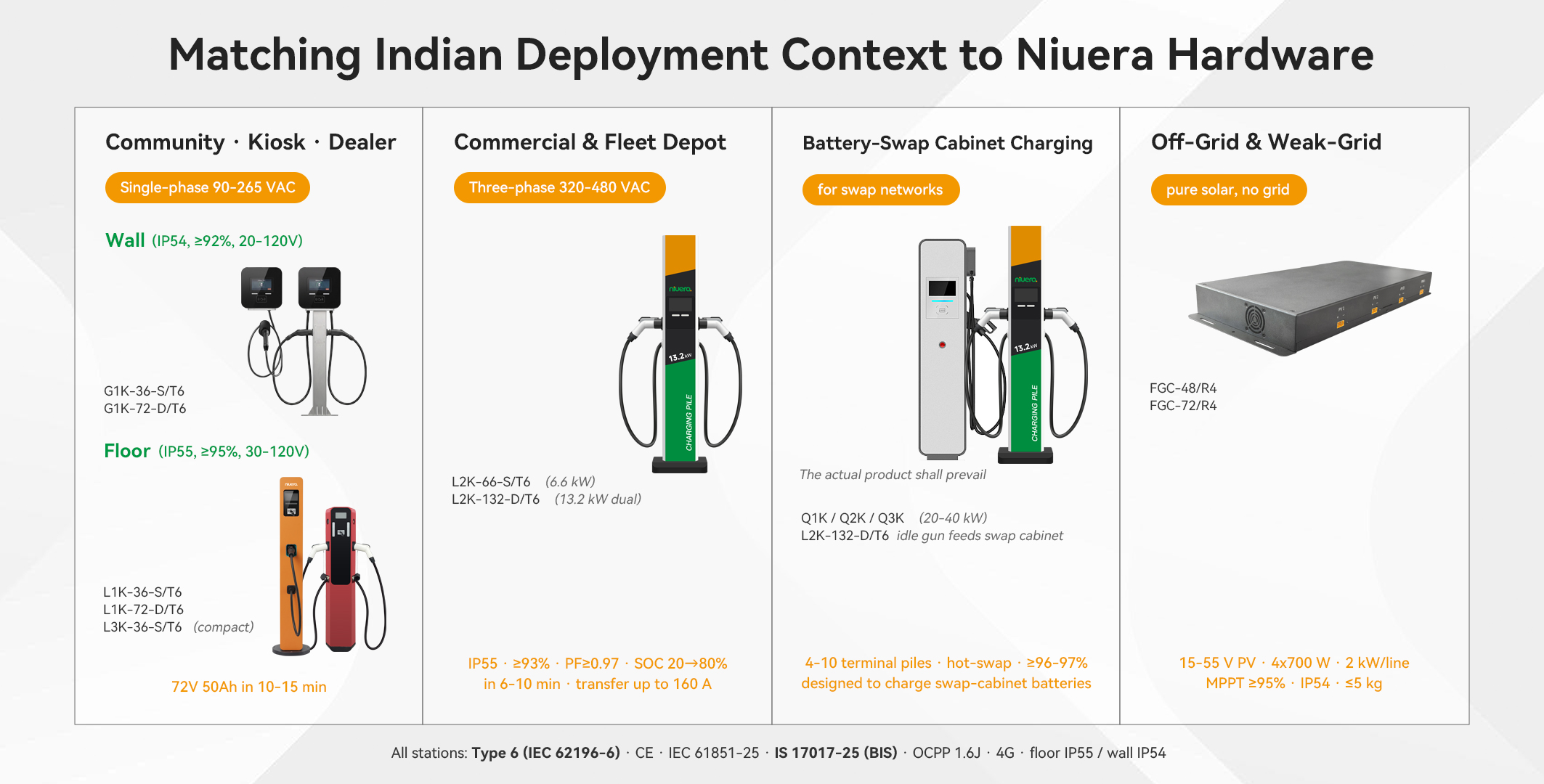
Community, kiosk and dealership charging (single-phase). For homes, dealerships and rider service points on single-phase supply, the wall-mounted G1K-36-S/T6 (3.6 kW) and G1K-72-D/T6 (7.2 kW, dual gun) mount on a wall or pedestal, run on 90–265 VAC, and hold a power factor of ≥0.99 at 220 VAC; the 7.2 kW unit delivers up to 7.2 kW into one gun or 3.6 kW per gun when both are in use.12 For community parking, commercial forecourts and storefronts that need tougher outdoor protection, the floor-standing L1K-36-S/T6 (3.6 kW) and L1K-72-D/T6 (7.2 kW dual gun) run on the same single-phase input at IP55 and ≥95 percent efficiency, and the compact L3K-36-S/T6 delivers 3.6 kW from a roughly 22 kg floor cabinet.12 A standard 72V 50Ah pack recharges in about 10–15 minutes on these stations.12
Commercial and fleet depots (three-phase). Delivery and logistics fleets with three-phase supply and tight shift patterns need throughput. The L2K-66-S/T6 (6.6 kW) and L2K-132-D/T6 (13.2 kW, dual gun) run on three-phase 320–480 VAC, output 48–100 VDC at ≥93 percent efficiency and ≥0.97 power factor, and the 13.2 kW unit refills a 72V 50Ah pack from roughly 20 to 80 percent state of charge in 6–10 minutes, transferring up to 160 A to a single gun when needed.12
Battery-swap cabinet charging. For the swap networks that are central to Indian two- and three-wheeler mobility, the charging problem is in the cabinet. The L2K-132-D/T6 can feed a swap cabinet from an idle gun, and the Q-series distributed charging pile — Q1K-2K-4/T6 (20 kW), Q2K-3K-6/T6 (30 kW) and Q3K-4K-8/T6 (40 kW) — drives 4 to 10 terminal piles at up to 97 percent peak module efficiency with hot-swappable modules, and is explicitly designed to charge the batteries inside a swapping cabinet.12
Off-grid and weak-grid sites. Where the grid is unreliable or absent, the FGC-48/R4 and FGC-72/R4 solar DC piles run entirely on photovoltaic input (four channels, 700 W each, 2 kW per output line, ≥95 percent, MPPT, IP54, under 5 kg), with no grid connection or electricity cost.12
What the Indian market demands of the hardware
Product fit is necessary but not sufficient. India imposes specific requirements that any serious charging product must meet.
BIS certification to IS 17017. IS 17017 is India's governing standard for EV supply equipment, with parts and sections aligned to the international IEC 61851 and IEC 62196 families.13 Niuera's stations are certified to IS 17017-25 (BIS), alongside CE and IEC 61851-25 — the credential that makes the equipment eligible for the Indian market and for institutional tenders.12 For a supplier entering India, this is the entry ticket, not a nice-to-have.
Connector localisation. India has developed its own combined AC/DC charging connector standard for light electric vehicles — engineered domestically and among the first of its kind for LEVs.14 That means connector strategy in India is not a default; it is a design decision. Niuera stations use the Type 6 connector under IEC 62196-6 and support customised or local connector variants and adapters, which is what serving a market with its own LEV connector standard actually requires.12
Digital, UPI-era payment. India transacts in small digital increments through UPI at a scale no other market matches. Niuera stations support QR-code, RFID and password payment and integrate with operator platforms over OCPP 1.6J with built-in 4G, so charge records, billing and revenue accounting run through the operator's own back-end.12
Wide input voltage and heat tolerance. Grid quality varies widely across Indian towns and peri-urban areas. Single-phase stations accept 90–265 VAC to ride through the swings that trip narrower-tolerance equipment; floor-standing stations carry IP55 protection, resist dust and salt air, and operate from -20°C to +55°C, while the wall-mounted G1K series is IP54-rated and derates above 40°C for sheltered sites.12
The policy and standards environment
The regulatory backdrop is broadly supportive but shifting in character. The centre's direct two-wheeler purchase subsidy is ending in July 2026, while states move toward mandates and infrastructure rules: Delhi's single-window clearance for charge-point operators and swapping providers is designed to remove a real friction in getting a site energised.8 For a hardware supplier, the practical implication is that charging equipment entering India should arrive certified to IS 17017 (BIS) and ready for local conformity checks, with a connector plan that fits India's LEV standard. Operators should confirm the current certification, connector and networking requirements for their specific deployment and state, because the policy and standards picture is moving quarter to quarter.
The takeaway for operators and investors
India's electric two-wheeler market has reached the point where the vehicle is no longer the hard part. The PM E-DRIVE two-wheeler subsidy sunsets at the end of July 2026, but the bikes are already selling on their own operating economics, and the policy momentum — state mandates, infrastructure rules — is now about keeping them charged. The durable investment is in the charging layer: the fleet depots, the swap-cabinet back rooms, the community kiosks, and the off-grid points that turn a subsidised purchase into a working vehicle for years.
That is where Niuera's range is aimed: single-phase stations for homes, dealerships and kiosks; three-phase stations for commercial depots; distributed piles and dual-gun units for swap-cabinet charging; and solar piles for off-grid sites — all built for 48–72V lithium platforms, IS 17017 (BIS) certified, and specified for India's grids, connectors and payment behaviour.
The subsidy was the on-ramp. The charging infrastructure is the road.
Planning an India deployment?
Niuera works with fleet operators, swap networks, dealerships and charge-point operators across India to match the right charging hardware to each site and to the country's BIS and connector requirements. Request the full product catalogue and IS 17017-25 (BIS) documentation, or arrange a product-fit consultation for the G1K, L1K, L3K-36, L2K, Q-series and FGC solar range. Reach us at info@niuera.cn or +86 0512-68303879, or start a conversation at www.niueraenergy.com.
FAQ
Does an electric two-wheeler in India need a DC fast charger?
Not usually, if it is privately owned and parked at home — most private riders charge overnight on AC from the bundled charger. Purpose-built charging hardware matters for commercial and gig fleets, battery-swap networks, public top-up points, and off-grid sites, where home charging is not an option.12
Is Niuera's equipment certified for the Indian market?
Niuera's stations are certified to IS 17017-25 (BIS), alongside CE and IEC 61851-25. IS 17017 is India's governing EVSE standard, aligned to IEC 61851 and IEC 62196.1213 Operators should still confirm current, deployment-specific requirements.
What about India's own connector standard?
India has developed a combined AC/DC connector standard for light electric vehicles.14 Niuera uses the Type 6 connector (IEC 62196-6) and supports customised and local connector variants and adapters, so hardware can be matched to the connector a given deployment requires.12
What battery voltages do the stations support?
Single-phase stations output an adjustable DC voltage in the 20–120 VDC range (30–120 VDC floor/cabinet, 20–120 VDC wall-mounted); three-phase stations output 48–100 VDC. Both cover the 48V, 60V and 72V systems common in Indian e2Ws. Lithium (LFP/NMC) only, not lead-acid.12
How does the hardware support battery swapping?
The L2K-132-D/T6 can feed a swap cabinet from an idle gun, and the Q-series distributed pile is designed to charge the batteries inside a swapping cabinet — so the same hardware serves both direct-charging and swap operators.12
Sources
[1] India Today, "Electric two-wheeler market grows 75%, EV penetration reaches 10.6%: FADA," 7 July 2026 (June 2026 e2W retail 193,735 units, +74.98% YoY, monthly penetration 10.6%).
[2] NITI Aayog (two-wheelers account for 70–80% of all private vehicles in India).
[3] Ministry of Heavy Industries, PM E-DRIVE scheme revised guidelines (notification 27 March 2026), via NDTV, LiveMint and Economic Times, March 2026 (e2W incentive ₹2,500/kWh capped ₹5,000/vehicle; e2W eligible to 31 July 2026; e3W to 31 March 2028; ₹10,900 crore outlay).
[4] EVreporter, "Electric Vehicle Sales Trend in CY 2025," January 2026 (India e2W ~1,279,951 units in 2025, +11.4% YoY; e2W ~56.4% of EV sales).
[5] Autocar Professional, "Electric 2W Sales Race Past a Million Units in First 6 Months of CY2026," July 2026 (Jan 129,265; Feb 118,408; Mar 199,393 record monthly).
[6] ETAuto / FADA, "TVS Motor Dominates as Electric Two-Wheeler Sales Surge to 6.5% Market Share in FY26," 2026 (FY26 e2W penetration 6.5%, up from 6.1%; retail +21.8% YoY).
[7] Business Standard, "PM E-Drive scheme may get a longer run as EV makers seek support," July 2026 (e2W subsidy up to ₹5,000/vehicle or ₹2,500/kWh; ~2.4 million-unit cap; fund-limited ₹10,900 crore).
[8] ET Government / ETAuto, "Delhi EV Policy 2.0," 2026 (effective 1 July 2026; e3W-only new registration from 1 January 2027; all new 2W electric from April 2028; single-window clearance for CPOs and swapping providers).
[9] ETInfra / ETAuto, "Delhi transport union opposes EV-only mandate, flags infrastructure gaps," 2026.
[10] Bolt.Earth, "Fast Charging vs Battery Swapping: Evaluating ROI for Indian EV Fleets," 2026 (>26,367 public commercial charging stations by early FY25; ~2,600 battery-swapping stations).
[11] WRI India, "Battery Swapping: An Alternative Fast Re-fueling Option for E-2Ws and E-3Ws in India," 2026 (swappable e2Ws sold without battery to reduce upfront cost; battery GST 18% vs 5% on EVs). Content rephrased for compliance.
[12] Suzhou Niuera Energy Co., Ltd., Electric Motorcycle / Low-Voltage Vehicle Fast Charging Stations product catalogue V1.6 (English), 2026. All product names and parameters drawn directly from this catalogue. Certifications (CE, IEC 61851-25, IS 17017-25 / BIS) per Niuera product documentation, confirmed current by the manufacturer.
[13] Wikipedia, "Plug-in electric vehicles in India" (IS 17017 is India's governing EVSE standard, with parts largely compatible with IEC 61851 and IEC 62196), accessed 2026; corroborated by EVreporter, "A Guide to EV Charging and EV Standards in India."
[14] Motown India, "Indigenous charging standard for 2-wheelers, 3-wheelers developed" (India's combined AC/DC charging connector standard for light electric vehicles).
Building a Reliable Charging Network: How Module Architecture Affects Station Uptime
Charging the Boda-Boda: How East Africa's Electric Motorcycle Boom Is Reshaping the Charging Question
Related blog