Solar, Storage, Charging: Why South America's E-Moto Infrastructure Should Be Built as One System
Event: Power2Drive South America 2026 · São Paulo · 25–27 August · Booth B4.60F

Something unusual is happening in São Paulo. The city's delivery riders — the couriers who move food and parcels for Uber, 99, Rappi and iFood — are switching to electric motorcycles faster than almost any comparable group in the Western hemisphere, and they are doing it through subscription and swapping rather than ownership. Vammo, the São Paulo-headquartered battery-swapping operator, passed one million battery swaps a little over a year after launch, runs a fleet of around 5,000 electric motorcycles serving those platforms with a waiting list still forming, and raised a USD 45 million Series B in late 2025 to scale across Latin America.1 Mottu, the region's motorcycle rental business built around last-mile couriers, reached an estimated USD 280 million in annual recurring revenue in 2025, up 87 percent year on year across Brazil and Mexico.2
The commercial logic is straightforward: Vammo's subscription bundles the vehicle and the swapping network into one monthly plan and delivers roughly 30 percent lower total cost of ownership than a petrol equivalent.3 When electrification lowers a courier's cost of doing business by that margin, adoption stops being an environmental choice and becomes an operating decision.

But every swapped battery, every subscription kilometre, and every "30 percent cheaper" claim rests on a physical fact that gets far less attention than the vehicles: somewhere, something has to charge those packs — reliably, affordably, and at scale. That is an infrastructure question, and in South America it is best answered not with a charger alone, but with solar, storage and charging designed as one system. This article explains why, and what such a system looks like in practice.
Why a charger alone is the wrong unit of design in Brazil
In a market with cheap, rock-steady grid power, a charging station is simply a box you plug into the wall. Brazil is not that market, for three reasons that compound.
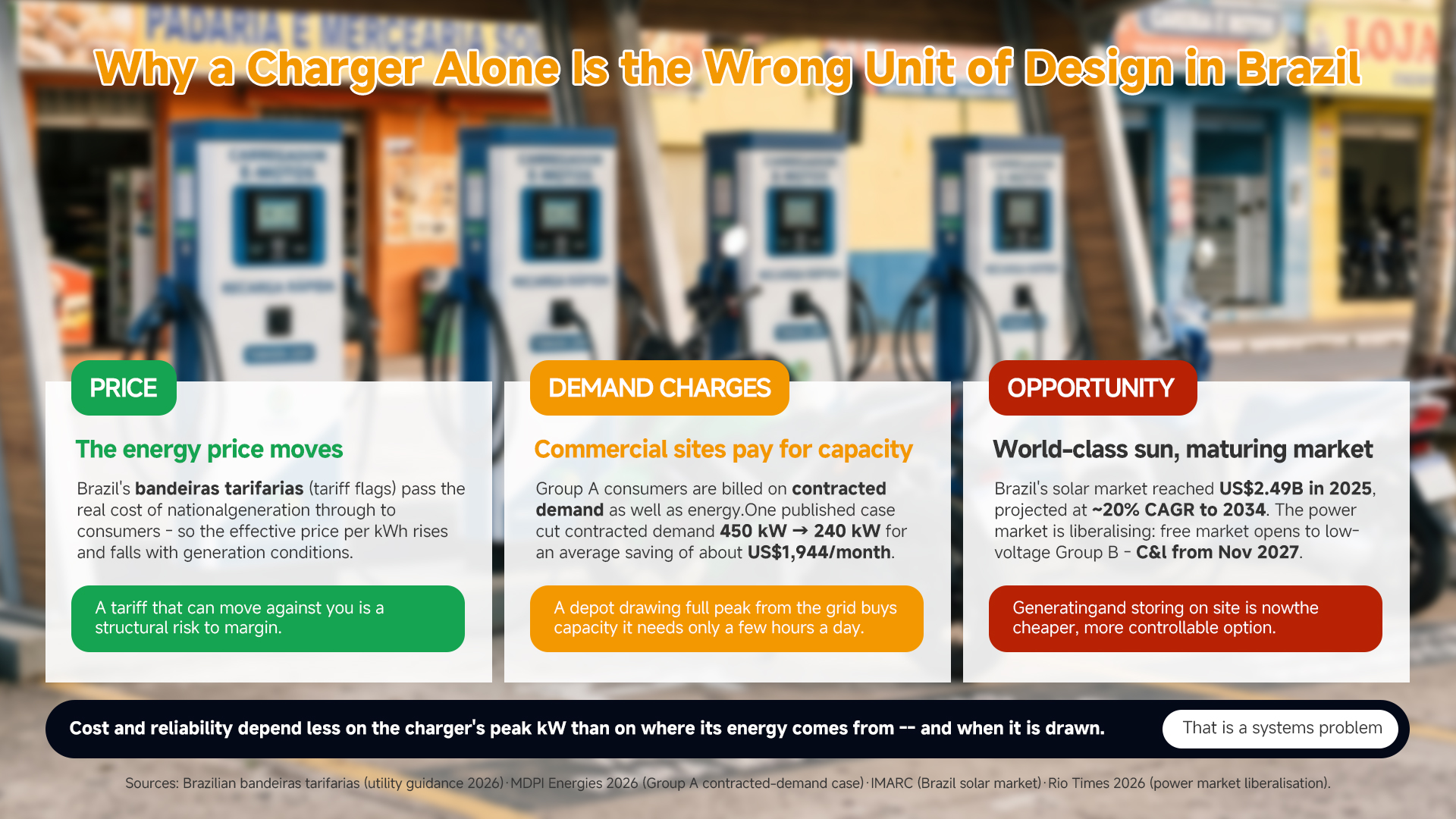
Electricity is expensive, and the price moves. Brazil's bandeiras tarifárias (tariff flag) system passes the real cost of national generation through to consumers, so the effective price of a kilowatt-hour rises and falls with hydrological and generation conditions rather than staying fixed.4 For a commercial operator whose entire margin is the spread between what it pays for energy and what it charges riders, a tariff that can move against you is a structural risk, not a line item.
Commercial connections are billed on demand, not just consumption. Larger Brazilian consumers (Group A) pay for contracted demand as well as energy, and managing that contracted demand is a recognised lever for cutting electricity cost — one published case reduced contracted demand from 450 kW to 240 kW for an average saving of about USD 1,944 per month.5 A charging depot that draws its full peak from the grid is buying expensive capacity it may only need for a few hours a day.
And Brazil has world-class sunshine plus a fast-maturing solar market. Brazil's solar market reached about USD 2.49 billion in 2025 and is projected to grow at roughly 20 percent CAGR through 2034.6 Meanwhile the power market itself is being liberalised: recent decrees will open the free electricity market to low-voltage Group B consumers, with commercial and industrial customers eligible from November 2027.7
Put those together and the conclusion is not subtle. In Brazil, the cost and reliability of an e-moto charging business are determined less by the charger's peak kilowatts than by where its energy comes from and when it is drawn. That is a systems problem — which is exactly what an integrated solar-storage-charging station is built to solve.
What an integrated E2W/E3W station actually is
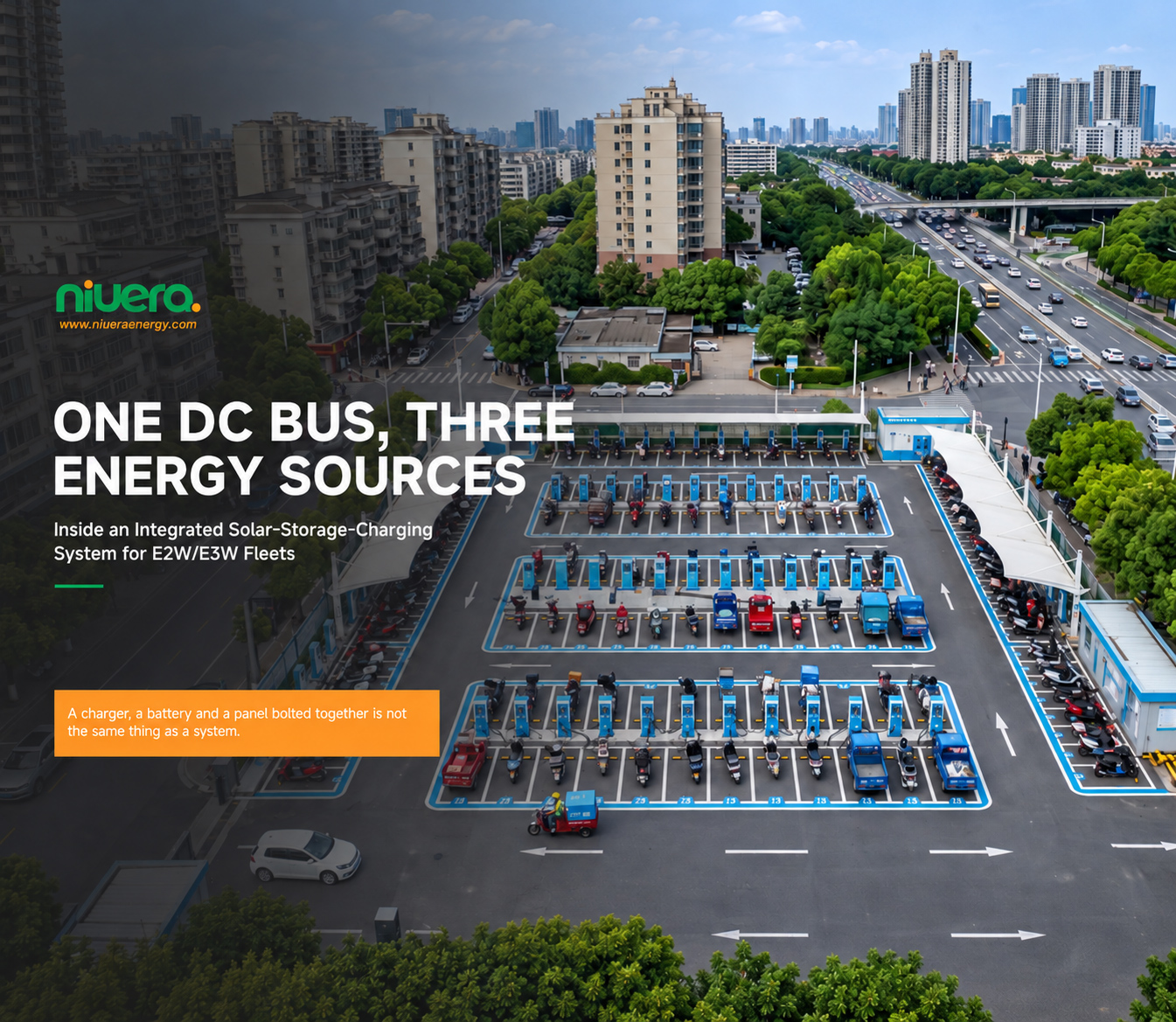
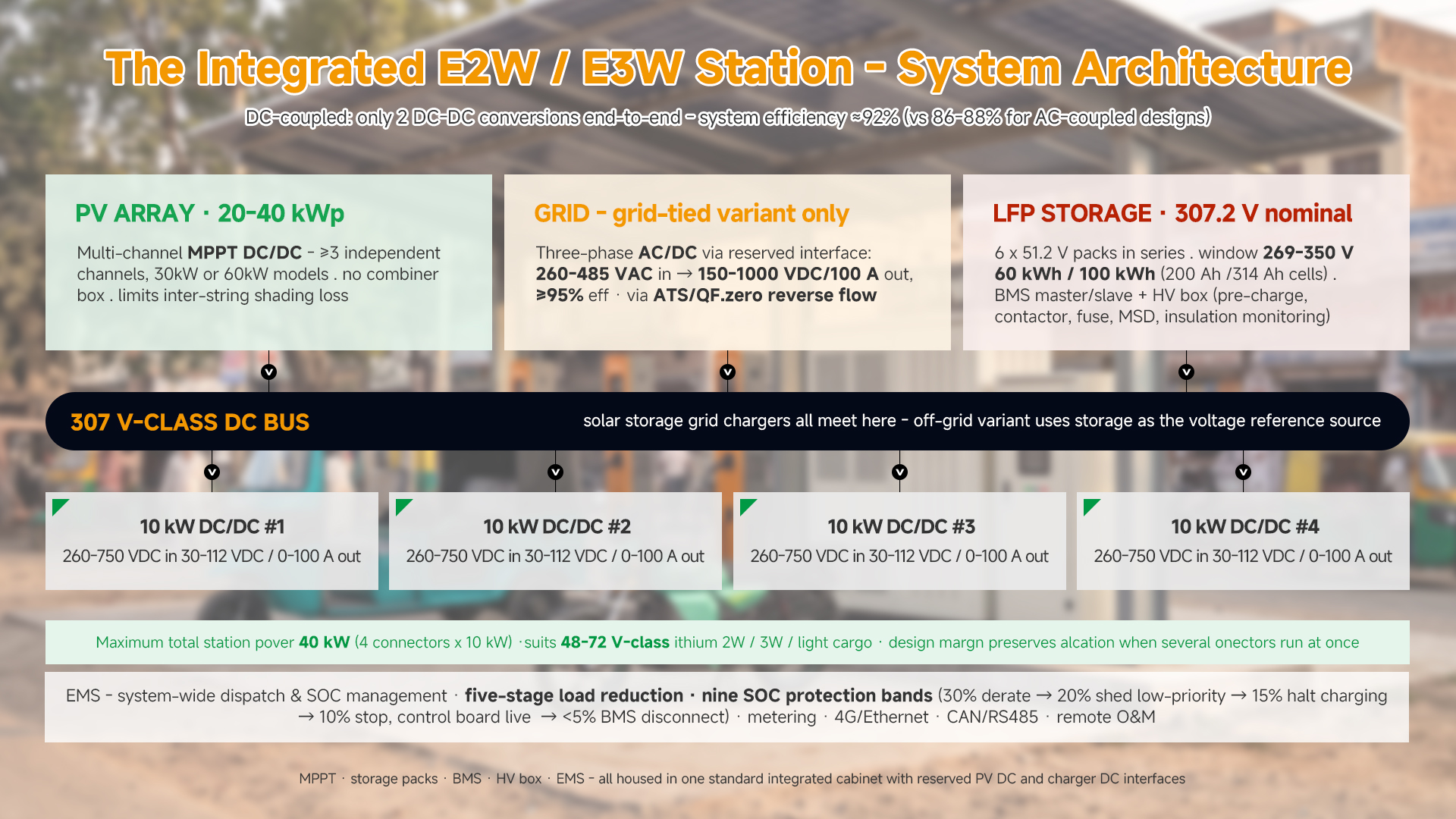
Niuera's integrated energy storage and charging solution for electric two- and three-wheelers is designed as a single coordinated system rather than a collection of separately purchased parts. The architecture works like this:8
-
Generation. A photovoltaic array of 20–40 kWp, fed through a multi-channel MPPT DC/DC controller — no fewer than three independent channels, in 30 kW or 60 kW standard models. Independent per-channel tracking removes the need for a separate combiner box and limits the effect of shading between strings, raising overall yield. PV modules can be customer-supplied or included in the standard configuration.
-
A common DC bus. Everything meets on a 307 V-class DC bus — solar, storage, grid and chargers — so energy moves between sources and loads without unnecessary conversion stages. Because the architecture is DC-coupled, the whole chain involves only two DC-DC conversions, giving a system efficiency of about 92 percent — against 86–88 percent for a typical AC-coupled design.
-
Storage. An LFP energy storage system with a nominal 307.2 V (six 51.2 V standard battery packs in series) and an operating window of 269–350 V, offered in 60 kWh and 100 kWh capacities (200 Ah and 314 Ah cells respectively). It integrates BMS master/slave control and a high-voltage box — pre-charge circuit, main contactor, fuse, MSD and insulation monitoring — connected directly to the bus. This is what stores surplus daytime solar for evening shifts and buffers fluctuation.
-
Off-grid or grid-tied. The off-grid variant runs independently, with the storage system acting as the voltage reference source. The grid-tied variant adds a three-phase AC/DC module through a reserved interface (input 260–485 VAC, output 150–1000 VDC / 100 A, efficiency ≥95 percent), with mains connected via ATS/QF transfer and zero reverse flow protection so the station never pushes power back into the utility network.
-
Charging output. Four 10 kW DC/DC charging modules, each with a wide input of 260–750 VDC and an output of 30–112 VDC at 0–100 A, suiting the 48–72 V-class lithium systems used by electric two-wheelers, three-wheelers and light cargo vehicles. Maximum total station power is 40 kW (four connectors × 10 kW); in practice the station spends most of its time well below full load, and that design margin is what preserves power allocation and continuity when several connectors are in use at once.
-
One integrated cabinet. MPPT, storage packs, BMS, HV box and EMS all sit in a single standard cabinet, with reserved PV DC and charger DC interfaces (plus an AC input on the grid-tied variant). That removes on-site combining, extra wiring and multi-cabinet footprint — faster to deploy and simpler to maintain.
The brain. An EMS handling system-wide power dispatch and SOC management, with a five-stage load-reduction strategy and nine SOC protection bands, multi-source switching, metering, 4G/Ethernet remote communication, CAN/RS485 device networking, data acquisition and remote O&M. In off-grid mode the EMS treats storage SOC as its primary criterion so the battery is never run flat: at 30 percent it begins reducing power, at 20 percent it shuts down lower-priority connectors, at 15 percent it halts all charging, at 10 percent the system stops while keeping the control board powered for recovery, and below 5 percent the BMS disconnects autonomously.
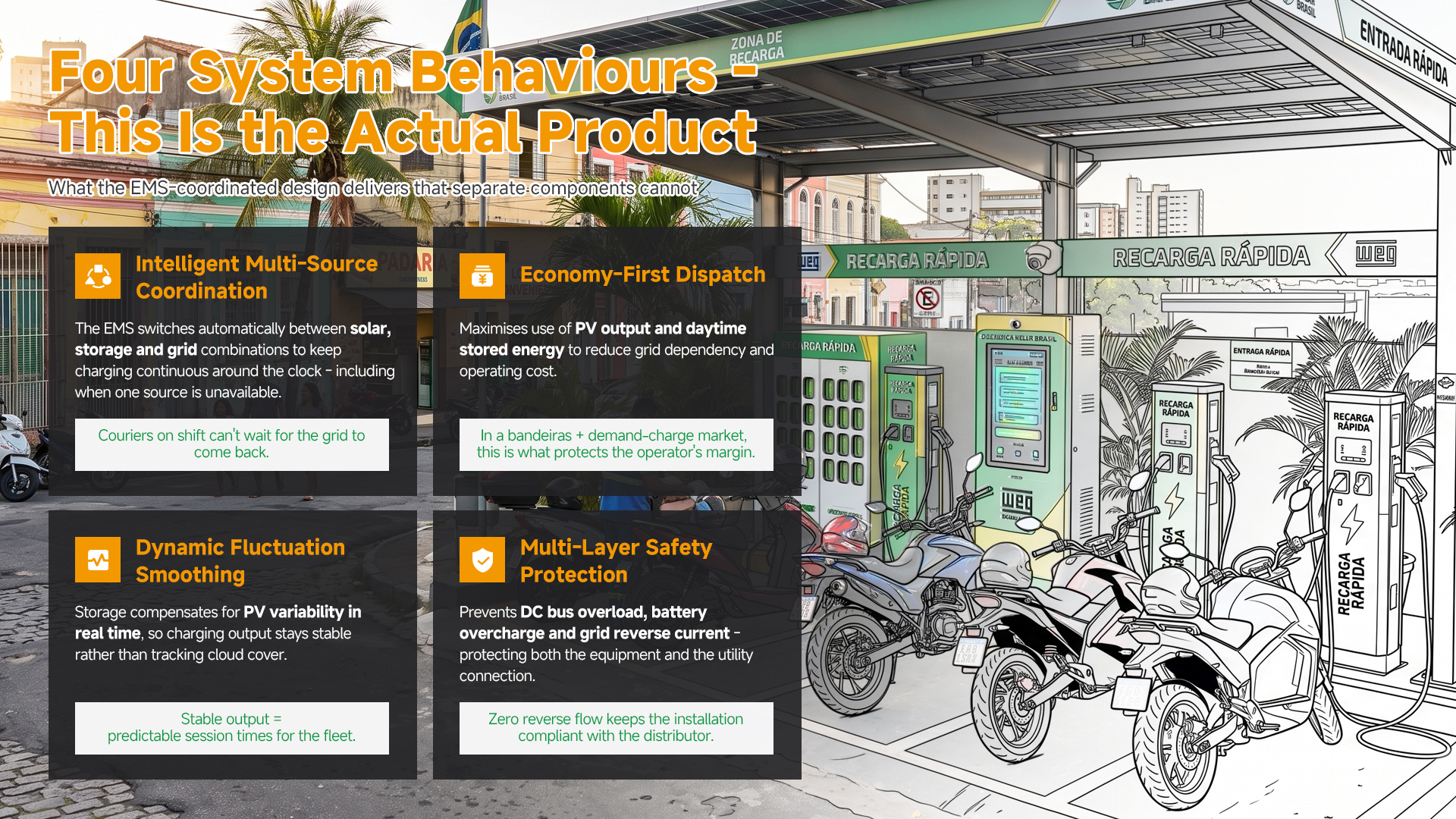
Four behaviours follow from that design, and they are the actual product:8
1. Intelligent multi-source coordination. The EMS switches automatically between solar, storage and grid combinations to keep charging continuous around the clock — including when one source is unavailable.
2. Economy-first dispatch. It maximises use of PV output and daytime stored energy to reduce grid dependency and operating cost. In a bandeiras market with demand charges, this is the feature that protects the operator's margin.
3. Dynamic fluctuation smoothing. Storage compensates for PV variability in real time, so the charging output stays stable rather than tracking cloud cover.
4. Multi-layer safety protection. The system prevents DC bus overload, battery overcharge and grid reverse current, while the EMS's five-stage load-reduction strategy ensures the station never operates beyond its capability envelope under any condition — protecting both the equipment and the utility connection.
Why this fits the swap-and-subscribe model so well
Here is the part most charger vendors miss. South America's e-moto growth is not primarily a story of individuals buying bikes and charging them at home; it is a story of fleets, subscriptions and swap networks — Vammo, Mottu and the operators around them. That business model concentrates charging demand into predictable, high-volume, operator-controlled locations. And concentrated, predictable, operator-controlled charging load is the ideal case for an integrated solar-storage system, for three reasons:
-
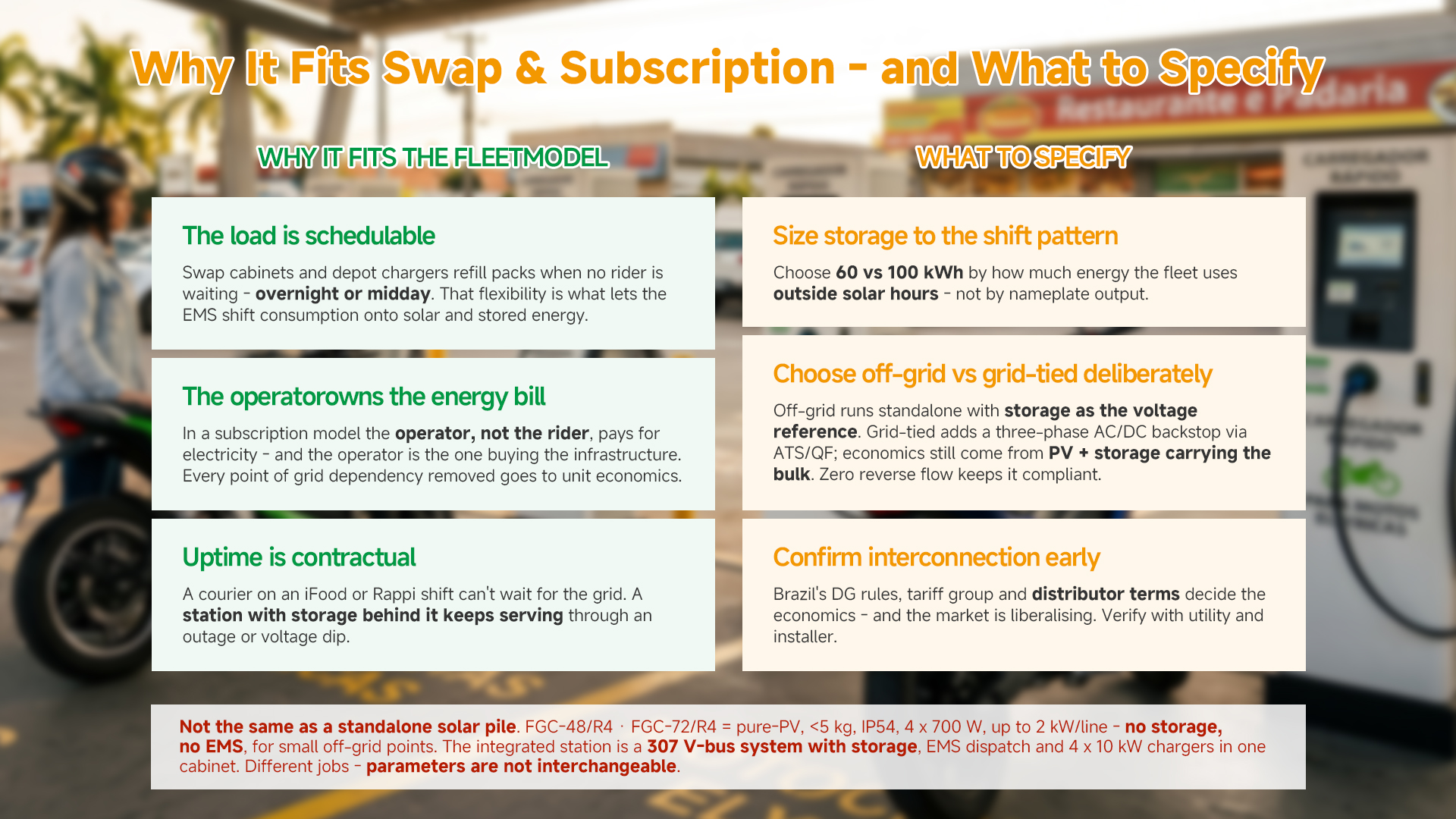
The load is schedulable. Swap cabinets and depot chargers refill packs when the rider is not waiting on them — overnight, or in the middle of the day. That flexibility is precisely what lets an EMS shift consumption onto solar generation and stored energy rather than expensive peak grid draw.
-
The operator owns the energy bill. In a subscription model the operator, not the rider, pays for electricity. Every percentage point of grid dependency removed goes straight to the operator's unit economics — and it is the operator who is deciding what infrastructure to buy.
-
Uptime is contractual. A courier on an iFood or Rappi shift cannot wait for the grid to come back. A station with storage behind it keeps serving through an outage or a voltage dip; a grid-only charger does not.
The same logic extends to South America's electric three-wheelers and light cargo vehicles, which share the 48–72 V-class battery architecture the station's 30–112 VDC output is built to serve, and to the many peri-urban and rural sites where a strong grid connection is either slow to obtain or simply unavailable.
What to specify, and what to be careful about
For an operator or developer evaluating this approach, the honest guidance is as follows.
Size storage to the shift pattern, not the peak. The choice between 60 kWh and 100 kWh should follow how much energy the fleet consumes outside solar hours, not the station's nameplate output. A station serving evening delivery peaks needs more stored energy than one serving daytime commuters.
Decide off-grid versus grid-tied deliberately. The off-grid variant stands alone with storage as the voltage reference — the right answer where a connection is slow, costly or unavailable. The grid-tied variant adds the three-phase AC/DC module as a backstop, but the economic case still comes from PV plus storage carrying the bulk of the energy. Zero-reverse-flow protection matters here: it keeps the installation compliant with the distributor's requirements while the system optimises behind the meter.
Confirm local interconnection and compliance requirements early. Brazil's distributed-generation and tariff rules, and the ongoing liberalisation of the power market, are moving — a system's economics depend on the specific distributor, tariff group and interconnection terms at the site.47 Confirm these with your utility and installer before finalising a configuration.
Do not confuse this with a standalone solar charging pile. Niuera also offers the FGC-48/R4 and FGC-72/R4 pure-photovoltaic DC charging piles — compact, sub-5 kg, IP54, four PV channels at 700 W each and up to 2 kW per output line — which are designed for small, off-grid operating points with no storage and no EMS.9 Those are a different product for a different job. The integrated station described here is a 307 V-bus system with dedicated storage, EMS dispatch and four 10 kW chargers in one cabinet. Both are legitimate answers; they are not interchangeable.
The takeaway
South America's electric two- and three-wheeler transition is being led by fleets and swap networks whose entire proposition is a lower, more predictable cost per kilometre. That proposition is only as solid as the energy system underneath it. In a market with variable tariffs, demand-based commercial billing, excellent solar resource and a grid that is not uniformly strong, the right unit of design is not a charger — it is a station where generation, storage, dispatch and charging are engineered together.
Build it that way and the operator gets three things a grid-only charger cannot deliver: energy cost that is largely under their control, output that holds steady through clouds and outages, and a charging asset that keeps earning when the network does not cooperate.

Niuera will be exhibiting at Power2Drive South America 2026, part of The Smarter E South America, at the São Paulo North Exhibition Center (Expo Center Norte) from 25 to 27 August 2026 — find us at Booth B4.60F.
See it at Power2Drive South America — São Paulo, 25–27 August 2026
Niuera will be exhibiting at Power2Drive South America 2026, part of The Smarter E South America, at the São Paulo North Exhibition Center (Expo Center Norte) from 25 to 27 August 2026 — find us at Booth B4.60F.
We will be showing the full South American product range: charging stations and charging modules for electric two- and three-wheelers, and the integrated energy storage and charging solution described in this article.
Come and talk to our team at Booth B4.60F about a site-specific configuration, or request the full product catalogue and the integrated-station specification in advance. Reach us at info@niuera.cn or +86 0512-68303879, or visit www.niueraenergy.com.
FAQ
What is the total charging capacity of the integrated station?
Four 10 kW DC/DC charging modules (wide 260–750 VDC input, 30–112 VDC / 0–100 A output), for a maximum total station power of 40 kW across four connectors. In practice the station operates below full load most of the time, and that design margin preserves power allocation when several connectors are used simultaneously.8
How much solar and storage does it include?
A 20–40 kWp PV array (customer-supplied or included) via a multi-channel MPPT controller (≥3 independent channels, 30 kW or 60 kW models), and an LFP storage system of 60 kWh or 100 kWh at a nominal 307.2 V (269–350 V window) with BMS and high-voltage box.8
Can it run without a grid connection?
Yes. The off-grid variant runs independently with the storage system as the voltage reference source. The grid-tied variant adds a three-phase AC/DC module (260–485 VAC in, 150–1000 VDC / 100 A out, ≥95% efficiency) via ATS/QF as a backstop. The EMS switches between sources automatically to keep charging continuous. For small sites needing neither storage nor an EMS, the FGC solar DC piles are the simpler option.89
Why does DC coupling matter?
Because the station is DC-coupled around a 307 V-class bus, the energy path involves only two DC-DC conversions, giving a system efficiency of about 92 percent versus 86–88 percent for a typical AC-coupled design — a direct saving on every kilowatt-hour the station handles.8
Does it feed power back into the grid?
No — the system includes zero-reverse-flow protection, alongside protection against DC bus overload and battery overcharge, plus the EMS's five-stage load-reduction strategy and nine SOC protection bands.8
Does it suit electric three-wheelers as well as two-wheelers?
Yes. The 30–112 VDC output range covers the 48–72 V-class lithium battery systems used across light electric two- and three-wheelers, including cargo trikes.8
Can it support a battery-swapping operation?
Yes — swap-cabinet charging is a scheduled, operator-controlled load, which is the ideal profile for solar-plus-storage dispatch. Talk to us about matching the configuration to your cabinet charging profile.
References
-
Electrek — Vammo lands huge investment, leading battery swapping in LATAM (October 2025) and Vammo rides past 1 million battery swaps (February 2025).
-
Sacra — Mottu company profile: revenue and growth estimates, 2025.
-
Construct Capital — Vammo Raises $45M to Scale Electric Mobility in LATAM (2025).
-
ANEEL (Brazilian Electricity Regulatory Agency) — bandeiras tarifárias (tariff flag) system and published tariff guidance.
-
Energies (MDPI) — A Decision-Support Framework for Contracted Demand and Tariff Management in Brazilian Group A Consumers (2026).
-
IMARC Group — Brazil Solar Energy Market report (2025–2034).
-
Brazilian federal energy decrees on opening the free electricity market to Group B consumers, as reported in 2026.
-
Suzhou Niuera Energy Co., Ltd. — Integrated PV-Storage-Charging Station for Electric Two- and Three-Wheelers: Technical Introduction (2026). All station specifications in this article are drawn from this document.
-
Suzhou Niuera Energy Co., Ltd. — Electric Motorcycle / Low-Voltage Vehicle Fast Charging Stations product catalogue, V1.6 (2026), for the FGC-48/R4 and FGC-72/R4 photovoltaic DC charging piles.
Market figures cited above are drawn from the published sources listed and are attributed to those sources. Company financial figures marked as estimates are third-party estimates, not audited results. Product specifications are subject to change; please confirm current specifications with Niuera for any specific project.
Talking to the Battery: BMS Communication, Connectors and Safe Fast Charging for Light EVs
Building a Reliable Charging Network: How Module Architecture Affects Station Uptime
Related blog