India's Electric Three-Wheelers After the Subsidy: Why Low-Voltage DC Charging Is the Missing Piece
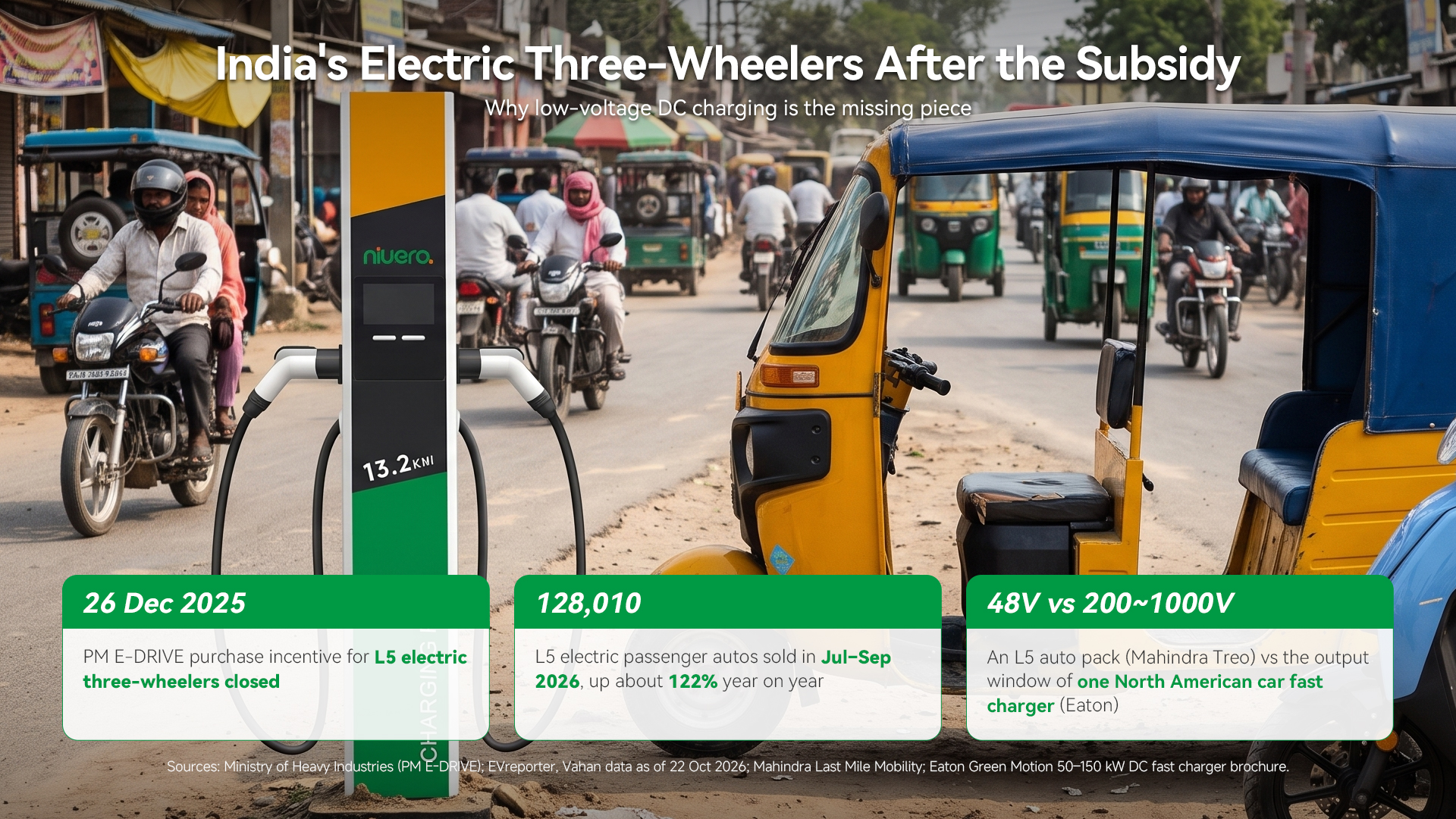
On 26 December 2025, India's central purchase incentive for registered electric three-wheelers in the L5 category closed.1 The government had said it would stop the incentive on reaching its target of 288,809 vehicles or on that date, whichever came first.2 A reasonable expectation was that sales would stall once the subsidy ended.
They did the opposite. In the July–September 2026 quarter, sales of electric L5 passenger autos reached 128,010 units, up about 122% from 57,738 in the same quarter a year earlier, and overtook the e-rickshaw as the larger passenger segment; e-rickshaw sales fell about 16% to 93,036 units.3 Electric L5 goods carriers grew every quarter over the same period, reaching 15,026 units, up about 115% from 6,987 a year earlier.3
That is a market running on operating economics, not on a purchase incentive. It also changes what the charging problem looks like. The vehicles now growing fastest are commercial, high-mileage and lithium-powered. On a model such as Mahindra's Treo, a full charge from a standard socket takes close to four hours.4 Car fast chargers are built for a different voltage class, connector and protocol. The public charging programme funded under the same scheme had approved 8,147 chargers by late September 2026, while the ministry reported in August that none of the chargers approved by then had been installed.5,6
This article sets out who these vehicles are, what their batteries need, why neither car chargers nor two-wheeler chargers fill the gap, and what a depot operator should check before buying low-voltage DC charging hardware.
Two kinds of three-wheeler, two different charging problems
India's electric three-wheeler market is really two markets that happen to share a wheel count.
The first is the e-rickshaw: a low-cost passenger vehicle that has been a mainstay of last-mile transport in small towns and cities since its formal introduction in 2010.7 In January 2025, WRI India estimated that lead-acid e-rickshaws accounted for about 90% of that market, with lithium-ion making up the remaining 10%, because lead-acid batteries are cheap upfront and easy to service locally.7
The second is the L5 category: registered electric autos for passengers and cargo, built to the same duty as the CNG and diesel autos they replace. These are the vehicles behind the growth figures above. They run on lithium packs; Mahindra's Treo, for example, uses a 7.4 kWh, 48 V lithium-ion battery, and Bajaj's RE E-TEC 9.0 carries an 8.9 kWh LFP pack.4,8
The distinction matters for charging hardware, because a lithium DC fast charger and a lead-acid e-rickshaw are not a good match. Niuera's stations are specified for lithium batteries only.9 So the honest scope of this article is the L5 segment and the lithium share of e-rickshaws, not the whole three-wheeler fleet.
The L5 segment is also where the momentum is. EVreporter's analysis of Vahan registration data shows L5 rising from about 34% to about 58% of combined electric three-wheeler passenger sales year on year, and EV penetration within the L5 passenger category reaching 53.78% in the July–September quarter, up from 46.95% the quarter before.3 For the L5 goods category, EV penetration rose from 27.52% to 31.36% over the same step.3 On a monthly basis, October 2026 registrations put EV penetration at 54.5% of L5 passenger sales and 34% of L5 cargo sales.10
Retail data from the dealers' federation tells the same story through a different lens. FADA reported that electric models made up 62.6% of all three-wheeler retail sales in October 2026, up from 52.2% a year earlier.11 That figure covers FADA's whole three-wheeler category rather than L5 alone, so it is not directly comparable with the L5 figures above; both point the same way.
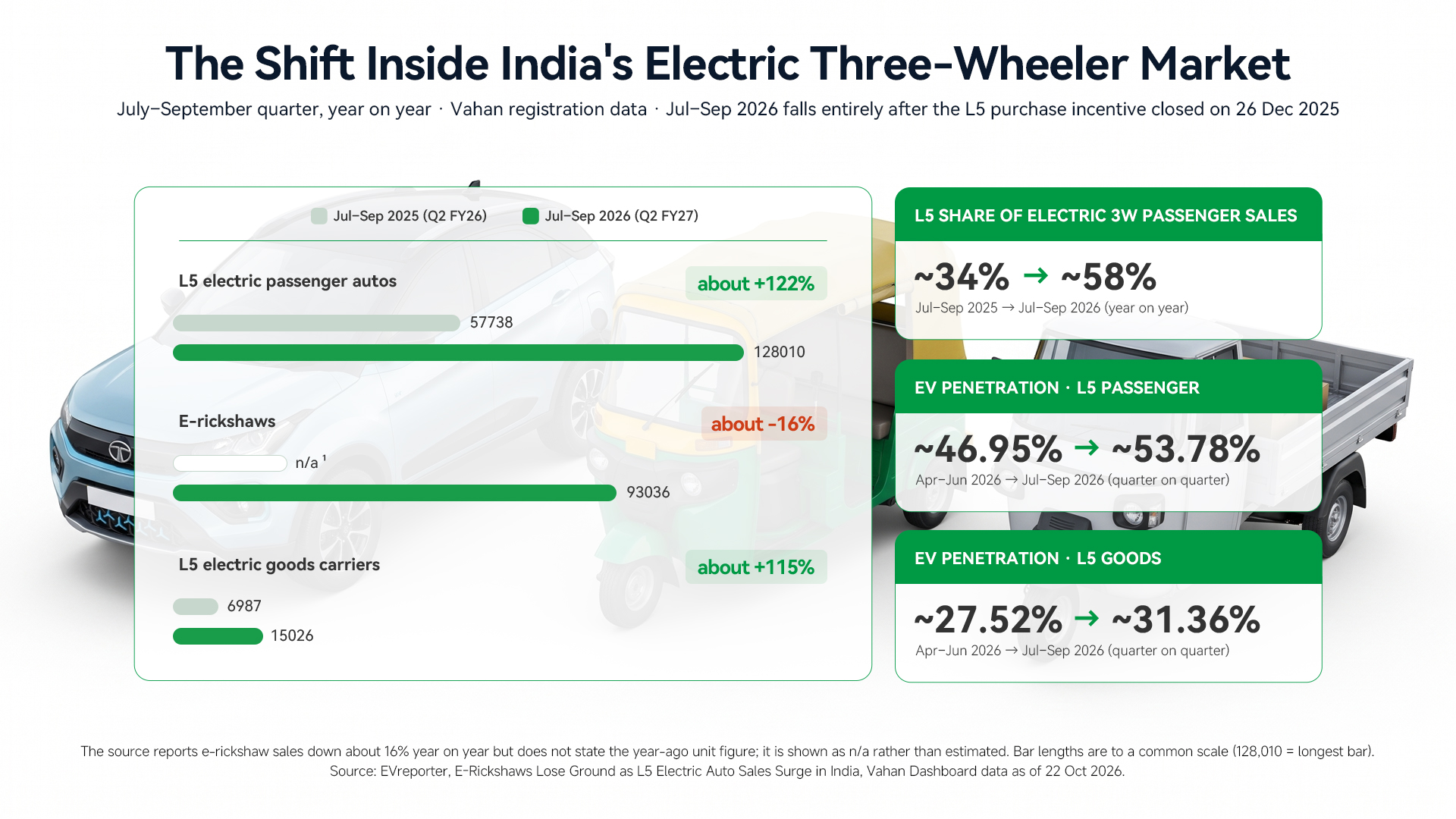
The shift inside India's electric three-wheeler market
What the end of the subsidy changed, and what it did not
The PM E-DRIVE scheme set aside ₹857 crore in demand incentives for L5 electric three-wheelers.12 When the target was reached, the Ministry of Heavy Industries closed that sub-component on 26 December 2025, while extending the wider scheme to 31 March 2028 for its other segments.1 The separate incentive line for e-rickshaws and e-carts was much smaller, with an outlay of ₹50 crore.12
Three things follow for anyone planning charging infrastructure.
First, vehicle demand no longer depends on a central subsidy. The July–September 2026 quarter reported above fell entirely after the L5 incentive closed, and it was compared with a year-earlier quarter in which the incentive was still being paid. That does not prove the subsidy was irrelevant; it had already done its work in building the segment. It does mean operators are now buying electric autos because the running-cost case holds on its own. Mahindra, for instance, markets the Treo to drivers on its running-cost savings against CNG autos.4
Second, state mandates are taking over from central incentives. The Delhi Electric Vehicles Policy, 2026, widely reported as Delhi's "EV Policy 2.0", came into force on 1 July 2026. It provides that from 1 January 2027, only electric three-wheelers in the L5 category may be newly registered in Delhi.13 Mandates of this kind remove the choice of fuel for new vehicles. They do not by themselves create anywhere to charge them.
Third, public charging is not arriving from the scheme on the timeline the vehicles are. PM E-DRIVE allocated ₹2,000 crore for public EV charging stations. By 28 September 2026, ₹851 crore of that had been approved for 8,147 chargers, to be deployed through three oil marketing companies and ten states.5 In a written reply to the Lok Sabha in August 2026, the Ministry of Heavy Industries confirmed that none of the 6,562 chargers approved by then had been installed as of 22 July 2026.6 The approved chargers may well be built later. A fleet buying vehicles this year cannot plan around them.
The practical conclusion is that for L5 fleets, charging is the operator's job, at the depot, the aggregator hub, or the dealer yard. That is where the hardware decision gets made, and where it is easiest to get wrong.
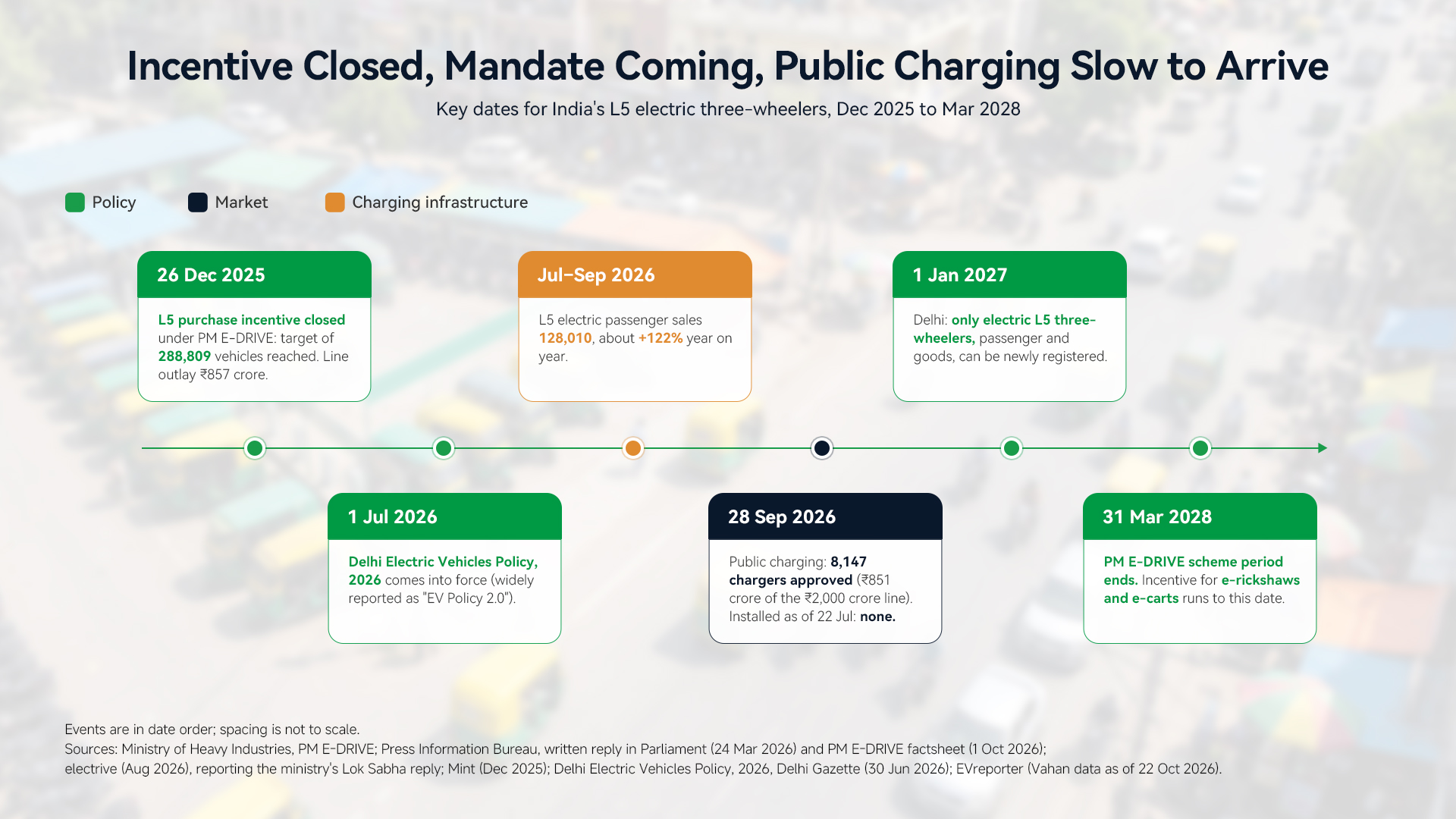
Policy timeline: incentive closed, mandate coming, public charging slow to arrive
Why home-socket charging stops working for fleets
Electric autos such as the Treo are supplied to charge from an ordinary socket, typically overnight. Mahindra quotes a full charge of the Treo's 7.4 kWh pack in about 3 hours 50 minutes from a standard household socket.4
For a single owner-driver who parks at home, that is fine. For a fleet it creates three problems.
-
One vehicle, one socket, four hours. A depot that charges every auto from a socket needs one socket per vehicle and a long dwell window. Vehicles that come back at different times, or need a top-up between shifts, have nowhere quick to go.
-
No midday recovery. A high-mileage auto running two shifts cannot recover meaningful range during a lunch break at socket speeds.
-
No control. A socket does not talk to the battery management system, does not record energy per vehicle, and cannot be scheduled against tariffs or shared intelligently across vehicles.
Fleets need DC charging that can add a substantial share of the pack in tens of minutes, talk to the BMS, meter each session and run unattended. The question is which DC charging.
Why car fast chargers are the wrong tool
The obvious answer, pointing an auto at the nearest car fast charger, does not work. On many car chargers voltage is one reason; the connector and the charging communication are the others.
Car DC fast chargers are built for traction batteries of several hundred volts. Eaton's Green Motion 50–150 kW DC fast charger for North America, for example, lists a DC output range of 200–1,000 V, and a 48 V-class lithium pack sits far below the bottom of that window.14 Some compact car chargers reach lower: Eaton's Green Motion DC 44/66 lists 50–500 V.14 Even then, a car charger is built around a car's connector and charging communication, not a light-EV pack and its BMS.
Light EVs need hardware designed from the outset for their voltage class. An international coupler standard for this voltage class, IEC 62196-6:2022, applies to vehicle connectors, vehicle inlets and cable assemblies for conductive charging systems that incorporate control means, rated up to 120 V DC and 100 A.15 India's national EV charging series, IS 17017, includes IS 17017 (Part 2/Sec 6):2021, on dimensional compatibility requirements for DC pin and contact-tube vehicle couplers intended to be used for DC EV supply equipment where protection relies on electrical separation, and IS 17017 (Part 2/Sec 7):2023, on dimensional compatibility and interchangeability requirements for a.c., d.c. and a.c./d.c. pin and contact-tube vehicle couplers intended to be used for a.c./d.c. EV supply equipment where protection relies on electrical separation.16 The standards infrastructure for low-voltage DC exists. What is missing in most depots is the charging hardware.
Why two-wheeler fast chargers are also the wrong size
The other tempting option is to reuse the fast chargers being rolled out for electric scooters. These do operate in the right voltage class. The mismatch is capacity.
An L5 auto pack is 7.4 kWh to 8.9 kWh in the two examples above.4,8 Public two-wheeler charging points are generally designed around scooter packs and short top-ups by private riders. They are not built for a fleet that needs to move a large amount of energy into many larger packs on a schedule.
A depot charger for L5 vehicles has to combine the low output voltage of a two-wheeler charger with the current capacity, metering and duty cycle of a commercial installation. That combination is exactly what three-phase low-voltage DC stations are for.
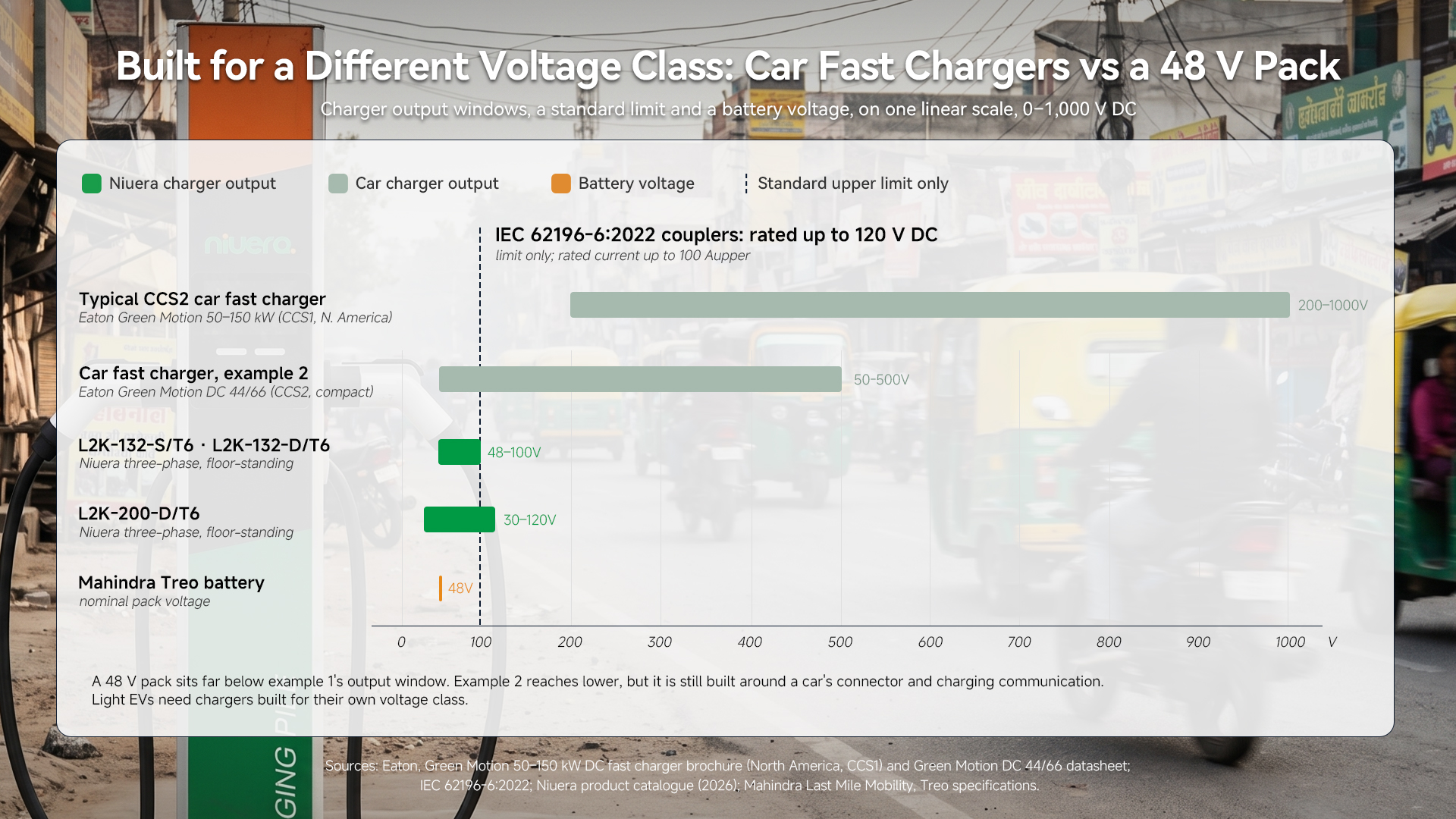
Voltage windows: car fast chargers are built for a different voltage class than a 48 V pack
The number that matters is current, not kilowatts
Here is the point most buyers miss when they compare light-EV chargers on headline power.
A DC charger's power rating is reached only at a particular combination of voltage and current. Below that voltage, the charger is limited by its maximum current, and its delivered power drops in proportion.
Take a three-phase station rated at 13.2 kW with a maximum output current of 160 A. Power equals voltage times current, so 13.2 kW at 160 A corresponds to 82.5 V. On a 48 V-nominal pack, the same 160 A can deliver at most about 7.7 kW, about 58% of the nameplate figure. Above 82.5 V the limit becomes the rated power instead, so the full 13.2 kW is only available towards the top of the output window. (These are arithmetic illustrations at nominal voltage; real charging voltage rises as the pack fills, and the BMS sets the actual current.)
Three consequences follow for 48 V-class fleets.
1. Compare chargers on maximum output current at your pack voltage, not on rated kW. Two chargers with the same kW rating can deliver very different power to a 48 V auto.
2. Check the C-rate on the battery side. A 7.4 kWh pack at 48 V works out to roughly 154 Ah. At 160 A that is about 1C. Whether the pack accepts that current, and over what temperature and state-of-charge window, is set by the battery maker, not the charger.
3. Check the connector rating against the current. IEC 62196-6:2022 covers couplers rated up to 100 A.15 A configuration that delivers more than 100 A through a single gun should be specified and documented on its own terms, with an interface rated for that duty, rather than assumed to be covered by the base standard.
None of this is specific to one manufacturer. It is how low-voltage DC charging works, and it is the main reason "kW per charger" is a poor way to size a three-wheeler depot.
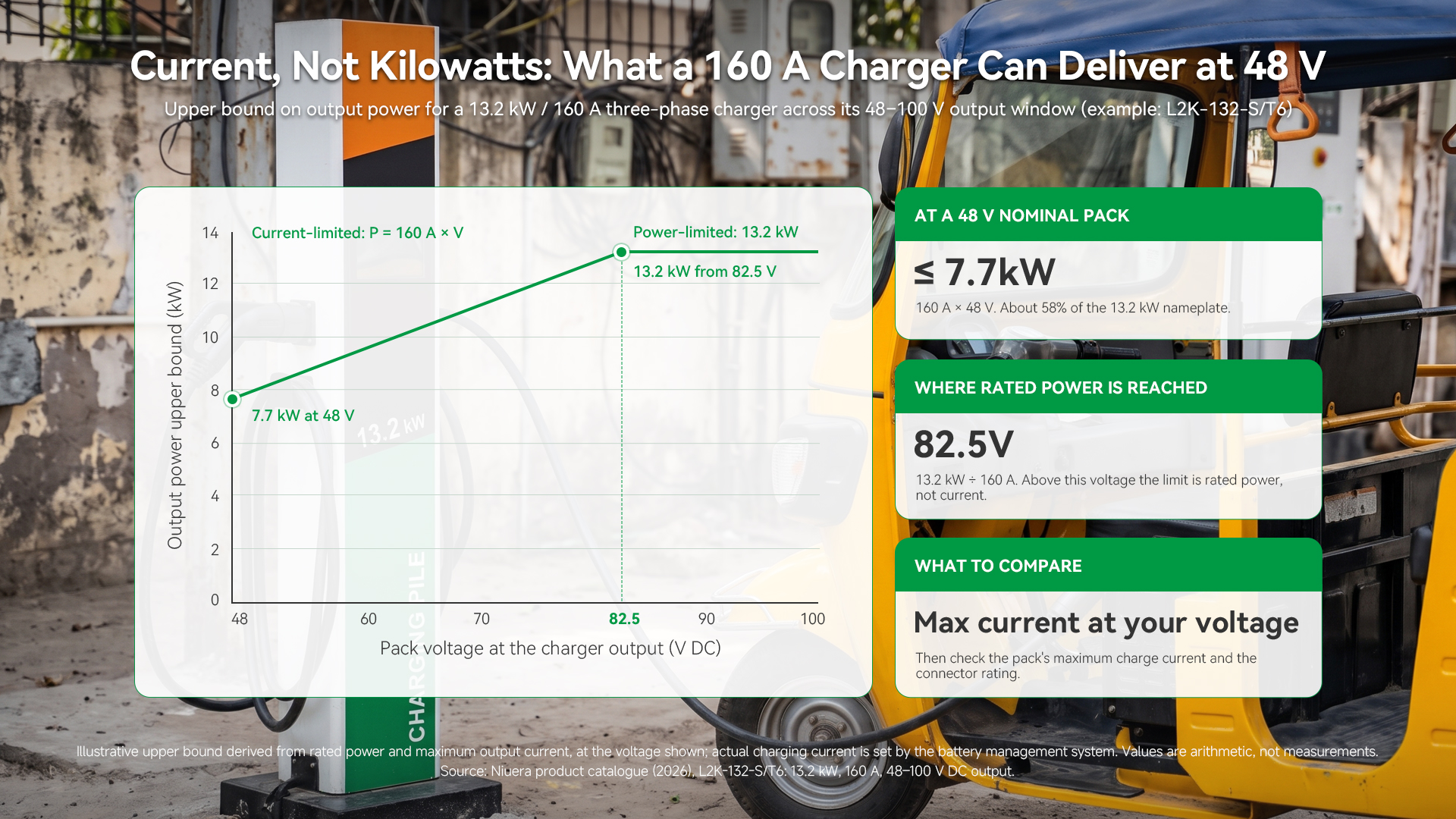
Current, not kilowatts: what a 160 A charger can deliver at 48 V vs 82.5 V
What a depot charger for L5 vehicles has to get right
Pulling the threads together, a charger intended for Indian L5 fleets needs to meet a short list of practical requirements.
Output voltage that covers 48 V to 72 V-class platforms with margin, including the charge voltage at the top of each pack's range, not just its nominal voltage.
Current capacity matched to the pack. At 48 V, current determines charging speed. The charger's maximum current per gun, the pack's maximum charge current and the connector's rating all have to line up.
Battery-capacity and C-rate windows that include your actual pack. Chargers for light EVs are typically specified for a range of battery capacities and charge rates. A fleet should check that its pack falls inside that window before purchase, not after.
BMS communication over CAN. Lithium fast charging is a negotiated process between charger and battery. The charger needs the vehicle's BMS protocol, and integration should be tested on a real pack before rollout.
Three-phase input with a known supply requirement. A depot's electrical connection is often the binding constraint. The charger's rated input current determines how many units a given supply can carry.
Protection for Indian conditions. Heat, dust and monsoon rain call for outdoor-rated enclosures. Grid voltage swings call for a wide input window.
Operational software. OCPP for remote management, per-session metering, and payment options where the depot serves owner-drivers rather than a single fleet.
Conformity for the Indian market. Operators should confirm the applicable IS 17017 requirements and the certification status of the specific model with the supplier for each project. This varies by deployment and should not be assumed from a product family.
Matching Niuera hardware to Indian three-wheeler depots
Niuera's light-EV DC fast-charging range includes two three-phase families that fit this brief. All specifications below are taken from the current Niuera product catalogue, and each one applies only to the models named.9
Floor-standing three-phase: L2K-132-S/T6, L2K-132-D/T6, L2K-200-D/T6
-
L2K-132-S/T6: 13.2 kW, single gun, three-phase 320–480 V AC input (rated 380 V AC), input current ≤24 A at 380 V AC, output 48–100 V DC, rated output current 160 A.
-
L2K-132-D/T6: 13.2 kW, dual gun, same input and output voltage window. Rated 80 A per gun with both guns in use, or 160 A to a single gun through power transfer. When one gun is idle, the catalogue notes it can supply a battery-swapping cabinet, which lets one station serve both plug-in vehicles and a swap operation.
-
L2K-200-D/T6: 20 kW, dual gun, three-phase 260–520 V AC input, input current ≤36 A at 380 V AC, output 30–120 V DC, rated output current 100 A, efficiency ≥94% at 380 V AC.
Across these three models the catalogue lists efficiency of ≥93% at 380 V AC for the two 13.2 kW units, power factor ≥0.97 at 380 V AC, IP55 protection, a 7-inch touch screen with multi-language support and QR, RFID and password payment, communication over 4G, OCPP, Ethernet and CAN 2.0B, and a Type 6 charging interface as an option. The applicable battery range listed is 30–100 Ah lithium at 1–3C.
For larger depots, the approach is to deploy multiple L2K-200-D/T6 units and size their number against the site's three-phase supply and the fleet's dwell pattern, rather than relying on a single large central unit.
Wall-mounted three-phase: G4K-132-S/T6, G4K-132-D/T6, G4K-200-D/T6
Where floor space is short, the G4K family mounts on a wall or a pedestal. The catalogue positions it for community car parks, commercial charging points and small delivery and express stations.
-
Output 48–100 V DC on all three models; three-phase input; efficiency ≥93% (13.2 kW models) and ≥94% (20 kW model) at 380 V AC; power factor ≥0.97.
-
Rated output current 160 A on G4K-132-S/T6; 80 A per gun or 160 A single-gun transfer on G4K-132-D/T6; 100 A per gun on G4K-200-D/T6.
-
IP54 protection, 450 × 255 × 600 mm cabinet, about 30–39 kg depending on model.
-
Applicable battery range listed as 50–150 Ah lithium at 1–1.5C.
Note that the two families are specified for different battery windows: 30–100 Ah at 1–3C for the floor-standing L2K three-phase models, and 50–150 Ah at 1–1.5C for the wall-mounted G4K models. The protection ratings also differ: IP55 for the floor-standing units and IP54 for the wall-mounted ones.
A pack check before you specify
This is where the battery-window check becomes concrete. As worked out above, a 48 V, 7.4 kWh pack is roughly 154 Ah. That sits above the 30–100 Ah window listed for the floor-standing L2K three-phase models and just past the 50–150 Ah window listed for the G4K models.4,9
We would rather say this plainly than leave a fleet to discover it on site. Pack capacity is a confirm-before-you-buy item. If your fleet runs packs in this size class, send us the pack's nominal voltage, capacity, maximum charge current and BMS protocol, and we will confirm the pairing before any configuration is quoted.
Sizing against the site supply
At many depot sites the binding constraint is the electrical connection rather than floor space or budget. The catalogue gives a rated input current for each three-phase model, which makes a first-pass check simple.
At 380 V AC, L2K-132-S/T6 and L2K-132-D/T6 each draw up to 24 A of input current, and L2K-200-D/T6 up to 36 A.9 As an illustration only: a three-phase supply with 100 A per phase available for charging could carry four 13.2 kW units at full input (4 × 24 A = 96 A), or two 20 kW units (2 × 36 A = 72 A) with headroom for other loads. This ignores the site's existing load, diversity between chargers, and local utility rules, all of which a proper electrical design must include. Its purpose is to show how quickly the supply, rather than the charger count, sets the size of a depot.
It also explains why dual-gun models are useful at constrained sites. On L2K-132-D/T6, two vehicles can connect at once and share the station's output, at 80 A each, or one vehicle can take the full 160 A. The site's input demand stays the same either way, so a depot can add connection points without adding supply.9
Single-phase sites
Small sites without a three-phase connection can use Niuera's single-phase floor-standing models, L2K-72-S/T6 and L2K-72-D/T6: 7.2 kW, single-phase 90–265 V AC input or DC input of 130–425 V DC (full load from 250 V DC), output 30–120 V DC, maximum output current 120 A (in single-gun mode on the dual-gun model), IP55, applicable battery range 30–100 Ah lithium at 1–2C.9 For L5 fleets they are a supplement for low-volume points rather than a depot solution.
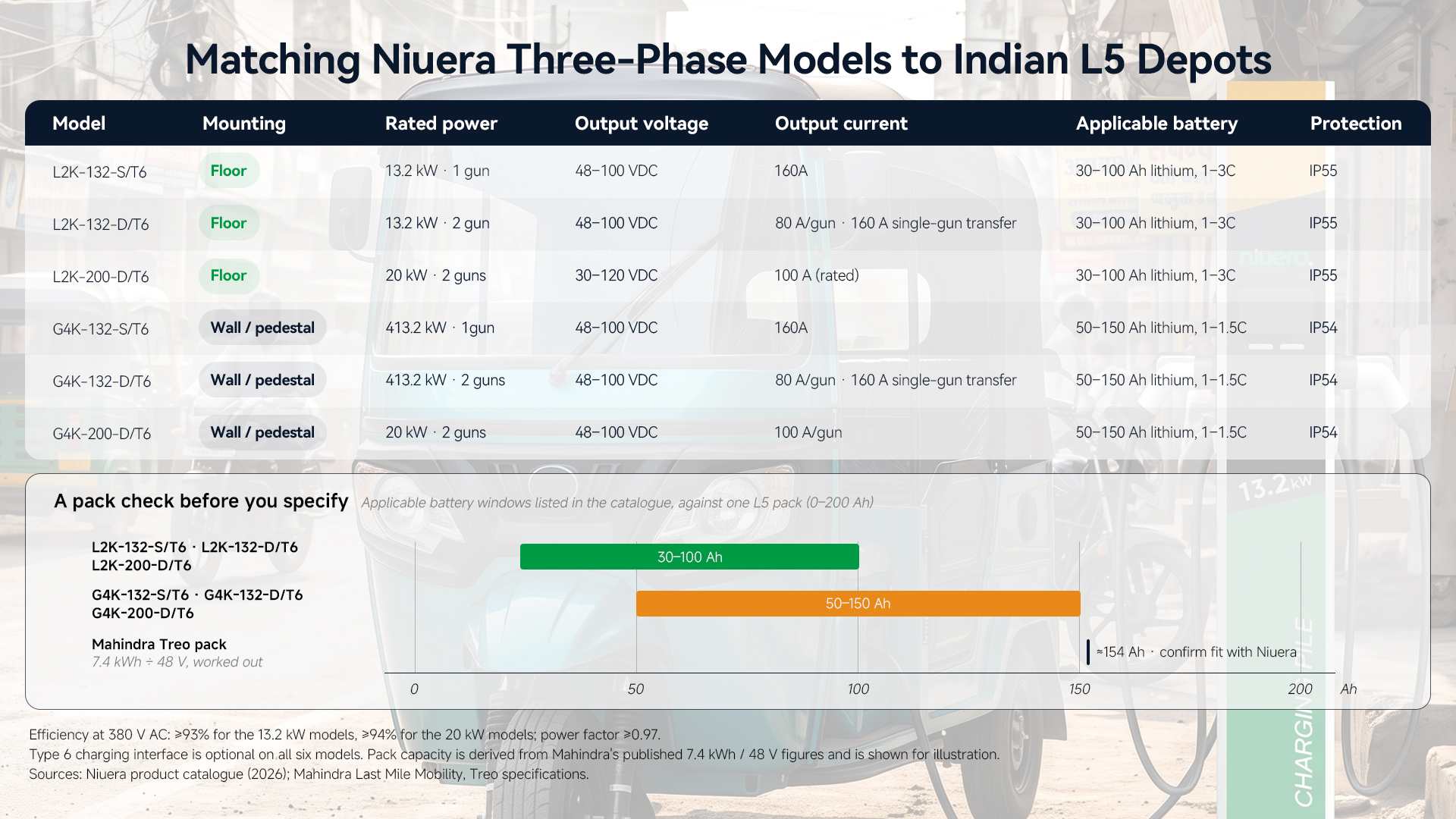
Matching Niuera three-phase models to Indian L5 depots
A deployment checklist for L5 fleet charging
Before committing to a charger model for an Indian three-wheeler depot, work through the following. Every item can be answered from a battery datasheet, a site survey or a supplier's specification sheet.
1. Pack voltage and capacity. Nominal voltage, capacity in Ah and kWh, and charge voltage limit for every vehicle model that will use the site.
2. Maximum charge current and C-rate. Taken from the battery maker, including any temperature or state-of-charge limits.
3. Charger current at your voltage. The maximum current per gun, and what it means in kW at your pack's nominal voltage.
4. Battery window on the charger datasheet. Confirm that your pack's capacity and C-rate fall inside the listed applicable range.
5. BMS protocol. Obtain the CAN protocol document and arrange a commissioning test on a real pack.
6. Connector and current rating. Agree the interface type, and if any gun runs above 100 A, specify the interface rating for that duty explicitly.
7. Site supply. Available three-phase capacity, and each charger's rated input current (Niuera's catalogue gives these at 380 V AC).
8. Environment. Outdoor exposure, shade, flood risk and ventilation, matched to the enclosure rating of each model.
9. Operations. OCPP back-end, metering, payment and tariff scheduling.
10. Conformity. The IS 17017 requirements that apply to your deployment and the certification status of the specific model, confirmed in writing.
Conclusion
India's L5 electric three-wheelers did not need the subsidy to keep growing. In the July–September 2026 quarter, the third full quarter after their incentive closed, passenger L5 sales more than doubled year on year and overtook the e-rickshaw as the larger passenger segment.3 Delhi will register only electric L5 three-wheelers from January 2027.13 The vehicles are arriving.
The charging is not, at least not from public programmes on the same timeline.6 For fleets, that leaves depot charging as the operator's decision, and the decision is more technical than it looks. Car chargers are built for a different voltage class, connector and protocol. Scooter chargers are the wrong size. On a low-voltage pack, the useful measure of a charger is current rather than kilowatts, and the useful question about a charger datasheet is whether your battery actually falls inside it.
Get those details right and three-phase low-voltage DC charging turns a three-wheeler fleet from one socket per vehicle and four-hour charges into a depot that can recover range between shifts. The hardware decision is smaller than a fleet purchase. It decides how many hours that fleet can earn.
Talk to Niuera
[Consideration] Planning depot charging for L5 autos or cargo three-wheelers in India? Send us your pack's nominal voltage, capacity, maximum charge current and BMS protocol, and we will check the fit against our three-phase range before recommending a configuration.
[Awareness] Request the Niuera light-EV DC fast-charging catalogue covering the L2K and G4K three-phase families.
[Decision] Ask for a depot configuration proposal based on your fleet size, dwell pattern and three-phase supply.
[Channel] Distributors and charge-point operators in India: ask about working with Niuera on light-EV charging projects.
Reach us at info@niuera.cn or +86 0512-68303879, or start a conversation at www.niueraenergy.com
Frequently asked questions
Why can't an electric auto use a car fast charger?
Car DC fast chargers are designed for batteries of several hundred volts; Eaton's North American Green Motion 50–150 kW unit, for example, lists 200–1,000 V DC.14 An L5 auto such as the Mahindra Treo runs on a 48 V pack.4 Car chargers with a lower voltage floor exist, but they are still built around a car's connector and charging communication.14
Did sales fall after the PM E-DRIVE incentive for L5 three-wheelers ended?
No. The incentive closed on 26 December 2025.1 In the July–September 2026 quarter, L5 electric passenger sales were up about 122% year on year, and L5 electric goods sales about 115%.3
Do Niuera's stations charge lead-acid e-rickshaws?
No. The stations are specified for lithium batteries only.9 WRI India estimated in January 2025 that about 90% of e-rickshaws in India ran on lead-acid batteries.7
Is a higher kW rating always faster for a three-wheeler?
Not on a 48 V pack. A charger reaches its rated kW only at a specific voltage; below it, output is limited by maximum current. A 160 A charger can deliver at most about 7.7 kW at 48 V, whatever its nameplate rating.
Which battery sizes are the Niuera three-phase models specified for?
The floor-standing L2K-132-S/T6, L2K-132-D/T6 and L2K-200-D/T6 list 30–100 Ah lithium at 1–3C. The wall-mounted G4K-132-S/T6, G4K-132-D/T6 and G4K-200-D/T6 list 50–150 Ah lithium at 1–1.5C.9 Packs outside these windows should be confirmed with Niuera before purchase.
Can one station serve both plug-in vehicles and a battery-swap cabinet?
The L2K-132-D/T6 can supply a battery-swapping cabinet from one gun when that gun is otherwise idle.9
Are Niuera's stations certified for India?
Certification requirements depend on the deployment and are specific to each model. Confirm the applicable IS 17017 requirements and the certification status of the exact model with Niuera for each project.
References
1. Ministry of Heavy Industries, Government of India — PM E-DRIVE: About the Scheme (accessed November 2026).
2. Mint — Govt Set to Exhaust ₹857-Crore Subsidy for Bigger Electric 3-Wheelers Three Months Early (December 2025).
3. EVreporter — E-Rickshaws Lose Ground as L5 Electric Auto Sales Surge in India (November 2026), based on Vahan Dashboard data as of 22 October 2026.
4. Mahindra Last Mile Mobility — Mahindra Treo: Features and Technical Specifications (accessed November 2026).
5. Press Information Bureau — PM E-DRIVE Scheme: A Step Towards a Sustainable Future, factsheet (1 October 2026).
6. electrive — India Approves Chargers, Awaits Deployment (5 August 2026), reporting the Ministry of Heavy Industries' written reply in the Lok Sabha.
7. WRI India — Powering Indian E-rickshaws: Toward Alternate Battery Technologies, blog (17 January 2025).
8. Financial Express (Express Mobility) — Bajaj Auto's Electric Three-Wheeler Range Revealed (2023).
9. Suzhou Niuera Energy Co., Ltd. — Electric Motorcycle / Low-Voltage Vehicle Fast Charging Stations product catalogue (2026). All Niuera product specifications in this article are drawn from this catalogue.
10. EVreporter — India ICE vs EV Sales for Top 2W, 3W, 4W OEMs in October 2026 (November 2026).
11. Federation of Automobile Dealers Associations (FADA) — Vehicle Retail Data, October 2026, as reported by The Hindu BusinessLine (November 2026).
12. Press Information Bureau, Ministry of Heavy Industries — Utilisation of Funds under PM E-DRIVE, written reply in the Lok Sabha (24 March 2026).
13. Government of NCT of Delhi, Transport Department — Delhi Electric Vehicles Policy, 2026, Delhi Gazette Extraordinary, Part IV (30 June 2026), clause 8.1.1.
14. Eaton — Green Motion 50–150 kW DC Fast Charger, brochure BR154002EN (January 2024), North American CCS1 model; and Green Motion DC 44/66 Technical Datasheet (accessed November 2026).
15. International Electrotechnical Commission — IEC 62196-6:2022, Plugs, socket-outlets, vehicle connectors and vehicle inlets — Conductive charging of electric vehicles — Part 6: Dimensional compatibility requirements for DC pin and contact-tube vehicle couplers intended to be used for DC EV supply equipment where protection relies on electrical separation (April 2022).
16. Ministry of Consumer Affairs, Food and Public Distribution, Government of India — Indian Standards on EV Charging, written reply to Lok Sabha Unstarred Question No. 2692 (11 December 2024), Annexure-A, listing Bureau of Indian Standards publications IS 17017 (Part 2/Sec 6):2021 and IS 17017 (Part 2/Sec 7):2023.
Market figures cited above are drawn from the published sources listed and are attributed to those sources. Sales figures from registration data are subject to revision as registrations are updated. Power, capacity and C-rate figures described as worked out or derived are arithmetic at nominal voltage, shown for illustration, and are not measured results. Product specifications are subject to change; please confirm current specifications with Niuera for any specific project.
Silicon Carbide in EV Charging Modules: What It Actually Changes — and What It Doesn't
Related blog