Scaling EV Charging Infrastructure Locally: Why Leading Operators Choose SKD Solutions(Part 1)
The global electric vehicle charging infrastructure market is experiencing unprecedented growth, but a new challenge has emerged: how to deploy charging equipment rapidly while navigating complex international trade barriers. As tariffs reach historic highs—100% in the United States and Canada, 17-45% in the European Union on Chinese-made EV equipment—charging network operators are discovering that traditional import models are no longer sustainable.
The solution localized manufacturing through Semi-Knocked Down (SKD) and Completely Knocked Down (CKD) assembly strategies. This approach is transforming how leading operators scale their networks, offering a pathway to bypass tariffs, accelerate deployment, and build resilient supply chains in target markets.
The Perfect Storm: Trade Barriers Reshape the Industry
The EV charging infrastructure industry faces an escalating tariff landscape that fundamentally changes deployment economics.
Current Tariff Reality
Recent trade actions have created substantial barriers: according to the U.S. Trade Representative's Section 301 review, the United States increased tariffs on Chinese-made EV equipment from 25% to 100% in May 2024. Canada followed suit in August 2024, raising its tariff from 6.1% to 100% under its Accelerated Investment Incentive. The European Union imposed countervailing duties of 17% to 45% on top of its existing 10% tariff following its anti-subsidy investigation concluded in October 2024. Brazil is gradually increasing EV equipment tariffs to reach 35% by 2026 under its industrial policy framework, while India maintains tariffs between 70-100%, with exceptions for companies investing at least $500 million in local manufacturing under the Production Linked Incentive (PLI) scheme.

These aren't temporary measures. The Biden administration's Section 301 tariffs on Chinese battery imports increased from 7.5% to 25% in 2024, with potential additional trade actions under consideration that could add up to 150% in total tariffs according to industry analysts.
Beyond Tariffs: The Localization Imperative
Trade barriers represent only part of the equation. Several markets, including India, now require that 50% of EV components must be sourced or manufactured locally under their Phased Manufacturing Programme. In the United States, the Bipartisan Infrastructure Law mandates that all charging infrastructure eligible for federal grants must be manufactured in America using domestically produced iron and steel, with chargers funded by federal money required to source the majority of their components from American manufacturers starting July 2024 under the Build America, Buy America Act provisions.
The message is clear: successful expansion requires local production capabilities, not just import relationships.
The Economic Case for Localized Assembly
For charging network operators targeting international expansion, SKD and CKD solutions offer compelling economic advantages that extend far beyond tariff avoidance.
Quantifying the Savings
Consider a mid-sized charging network operator planning to deploy 1,000 DC fast charging stations in the U.S. market:

Traditional Import Model (1,000 stations × $50K each):
- Base equipment cost: $50 million
- Import tariffs (100% on Chinese origin): $50 million
- Ocean freight (40ft containers): $4 million
- Customs brokerage and compliance: $1 million
- U.S. warehousing (6 months average): $2 million
- Final mile logistics: $1 million
- Total landed cost: $108 million
SKD Local Assembly Model:
- Core modules and components (CIF U.S. port): $40 million
- Applicable tariffs on components (averaging 20%): $8 million
- Local assembly labor and facilities: $5 million
- Domestic logistics (significantly reduced): $2 million
- Total cost: $55 million
Net savings: $53 million (49% reduction)
Key Assumptions:
- Equipment sourced from China (subject to Section 301 tariffs)
- Average station cost: $50,000 per unit
- Current U.S. tariff rates (as of December 2024)
- No Foreign Trade Zone (FTZ) benefits or duty drawback
- Assembly performed at leased U.S. facility
- Actual savings vary by project specifics, supplier agreements, and regulatory changes
These figures align with industry observations reported by the Alliance for Automotive Innovation and charging infrastructure trade associations. Companies implementing localized manufacturing strategies report cost reductions of 20-40% through tariff savings and 30-50% reductions in logistics costs.
Time-to-Market Advantages
Speed matters in this rapidly evolving market. Traditional container shipping from Asian manufacturers typically requires 6-8 weeks ocean transit, plus customs clearance (1-2 weeks), warehousing, and distribution—often totaling 90-120 days from order to installation.
Local assembly from pre-positioned component inventory can reduce this timeline to 30-45 days, enabling operators to:
- Respond quickly to emerging market opportunities
- Accelerate revenue generation by 2-3 months per site
- Capture first-mover advantages in competitive territories
- Meet aggressive government deployment timelines under grant programs
The U.S. federal government alone has invested over $7.5 billion in charging infrastructure grants through the National Electric Vehicle Infrastructure (NEVI) Formula Program, creating urgent demand for rapid deployment capabilities. Grant recipients typically face strict deadlines, with projects required to be operational within 2-3 years of award.
Understanding SKD vs CKD: Choosing the Right Model
Not all localization strategies are created equal. The choice between Semi-Knocked Down (SKD) and Completely Knocked Down (CKD) approaches depends on several factors.

Semi-Knocked Down (SKD): The Balanced Approach
SKD involves importing major sub-assemblies—such as complete power modules, control systems, and cooling assemblies—that are then integrated locally into finished charging stations. This model offers:
Advantages:
- Preserved system-level efficiency and quality (critical for maintaining 97%+ power conversion efficiency)
- Lower local technical expertise requirements (assembly vs. manufacturing)
- Faster ramp-up to volume production (typically 3-4 months vs. 12+ months for full manufacturing)
- Reduced risk of assembly errors affecting performance (pre-tested modules)
- Typically qualifies for 40-60% local content under most regulations
Ideal For:
- Markets requiring 97%+ power conversion efficiency for operational economics
- High-power installations (150kW to 480kW) where performance is non-negotiable
- Operators prioritizing rapid market entry (sub-6-month deployment)
- Regions with developing technical workforces
Typical SKD Content:
- Manufactured abroad: Power modules, control boards, specialized semiconductors
- Assembled locally: Enclosures, pedestals, cable assemblies, cooling fans, user interfaces
Completely Knocked Down (CKD): Maximum Localization
CKD involves importing individual components and fully assembling the charging system locally, including power electronics integration, cooling system assembly, and complete quality testing.
Advantages:
- Maximum local content percentage (70-90% achievable)
- Deeper technology transfer and skill development
- More local job creation (2-3x more than SKD)
- Potential for subsequent local sourcing of components
- Stronger compliance with stringent local content mandates
Ideal For:
- Markets with strong local content requirements (50%+ mandated)
- Regions offering significant incentives for local manufacturing (e.g., India's PLI scheme)
- Operators with long-term market commitments (5+ year horizon)
- Areas with established electronics manufacturing ecosystems
Challenges to Consider:
- Higher initial setup costs ($2-5M vs. $500K-1M for SKD)
- Longer time to operational proficiency (8-12 months)
- Greater quality control requirements
- Higher risk of performance variation if not properly managed
The Hybrid Strategy
Many successful operators implement a hybrid approach: SKD for critical, high-efficiency power modules where performance cannot be compromised, combined with CKD for secondary systems like enclosures, cable assemblies, and mounting hardware.
This approach optimizes the trade-off between local content compliance, production efficiency, and performance assurance. For most operators deploying 100+ stations annually, this hybrid SKD-CKD model offers the optimal balance of speed, cost, and risk.
What Makes SKD Solutions Successful: Critical Components
Implementing localized assembly isn't simply about shipping parts instead of finished products. Success requires comprehensive support across the entire value chain.
1. Product Adaptation and Certification Support
Charging equipment must comply with diverse regional standards:
- North America: UL 2202/2594 (safety), FCC Part 15 (EMC), NEVI specifications (performance), OCPP 2.0.1 (communications)
- Europe: CE marking, Low Voltage Directive (2014/35/EU), MID (Measuring Instruments Directive 2014/32/EU), AFIR requirements
- China: CCC certification, GB/T 27930 (connector standard), GB/T 34657/34658 (communication protocols)
- India: BIS certifications (IS 17017-1/2), Automotive Research Association of India (ARAI) approval
Manufacturers must navigate complex domestic content requirements, with different rules for components sourced from various regions. Effective SKD providers offer pre-certified module designs adaptable to local requirements, dramatically shortening time-to-market from 12-18 months to 3-6 months.
2. Complete Bill of Materials (BOM) Management
Successful SKD programs include comprehensive BOM management covering 2,000-5,000+ individual components:
- Sourcing strategies balancing cost, quality, and supply security
- Supplier qualification and ongoing performance management
- Quality control protocols with statistical process control
- Just-in-time inventory optimization to minimize working capital
- Export documentation and compliance (HS codes, country of origin, trade agreements)
This eliminates the burden of managing complex electronics supply chains from operators, allowing them to focus on network deployment and operations. A typical 120kW charging station contains components from 30-50 different suppliers across 8-12 countries.
3. Assembly Process Transfer
Technology transfer is where many localization efforts fail. Effective SKD solutions provide:
Standard Operating Procedures (SOPs):
- Detailed assembly sequences with quality checkpoints every 5-10 steps
- Testing and validation protocols at component, subassembly, and system levels
- Calibration procedures for power modules ensuring ±2% accuracy
- Safety and ESD (electrostatic discharge) handling protocols
- Troubleshooting decision trees for common assembly issues
Training Programs:
- Hands-on assembly training for production teams (2-3 weeks intensive)
- Quality inspector certification with written and practical exams
- Troubleshooting and fault diagnosis workshops
- Continuous improvement methodologies (Kaizen, Six Sigma basics)
- Train-the-trainer programs for scaling workforce
Tooling and Fixtures:
- Specialized assembly jigs and fixtures (typically $50K-150K investment)
- Testing equipment specifications (power analyzers, insulation testers, function testers)
- Recommendations for local sourcing of standard tools
- Custom tooling for unique assembly requirements
4. Ongoing Technical Support
Post-deployment support separates successful SKD partnerships from transactional component sales:
- Field installation guidance via remote video support or on-site technical advisors
- Remote diagnostics and troubleshooting (24/7 hotline for critical issues)
- Performance optimization recommendations based on field data analytics
- Warranty support and parts replacement with defined SLAs (typically 48-72 hour response)
- Software and firmware updates via OTA (over-the-air) or controlled rollout procedures
Leading SKD providers offer multi-year support agreements with clearly defined service levels, ensuring operators can maintain performance and uptime as their networks scale.
Real-World Implementation: Deployment Scenarios
SKD solutions demonstrate their value across diverse deployment scenarios, each with unique requirements.
Scenario 1: Highway Corridor Fast-Charging Network
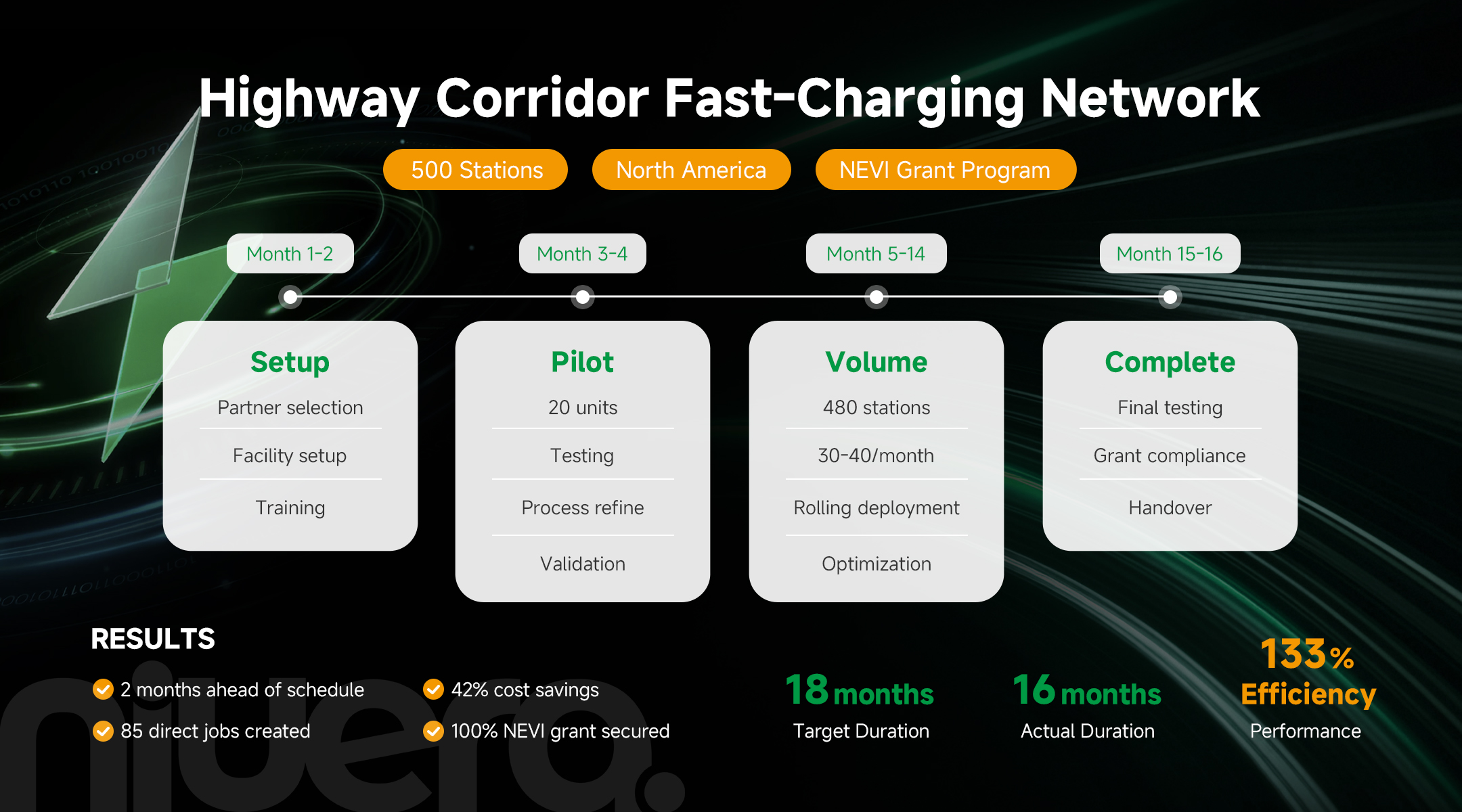
Challenge: A North American operator needed to deploy 500 fast-charging stations along major interstate highways within 18 months to meet NEVI grant requirements and capture federal funding totaling $125 million.
SKD Solution:
- Core 120kW-240kW power modules manufactured and tested in Asia, shipped as pre-integrated units
- Local assembly of cooling systems, power cabinets, and pedestals at three regional facilities
- Component inventory pre-positioned at strategic locations synchronized with installation schedules
- Rolling deployment model: 30-40 stations per month at peak
Implementation Timeline:
- Month 1-2: Partner selection, facility setup, initial team training
- Month 3-4: Pilot production (20 units), certification validation, process refinement
- Month 5-14: Volume production and installation (480 stations)
- Month 15-16: Final testing, grant compliance verification, punch-list completion
Results:
- Project completed February 2025, 2 months ahead of original 18-month schedule
- 42% cost savings vs. fully imported systems ($83M actual vs. $143M projected for imports)
- Qualified for 100% of available NEVI grants due to 58% domestic content compliance
- Created 85 direct jobs (assembly, quality control, logistics) plus 200+ indirect jobs (installation, electrical, civil)
- First stations operational in Month 6 vs. Month 9+ with traditional imports
- Average assembly time optimized to 3.5 days per station by Month 10
Scenario 2: Urban Fleet Charging
Challenge: A European logistics company required 200 overnight charging stations for its electric delivery fleet across six countries (Germany, France, Netherlands, Belgium, Spain, Italy), each with different certification requirements and varying technical standards.
SKD Approach:
- Standardized 60kW-80kW charging modules with country-specific communication protocols (OCPP with local calibration law compliance)
- Local integration of metering systems (MID-certified), access control (RFID/app-based), and fleet management interfaces
- Distributed assembly at four existing company service facilities (reducing facility investment)
- Centralized technical training at headquarters, then regional cascade training
Implementation Timeline:
- Month 1-3: Design standardization, certification planning (simultaneous applications)
- Month 4-6: Facility preparation, equipment installation, team training
- Month 7-12: Phased deployment by country based on certification completion
Results:
- Single standardized BOM managed across all locations (98% parts commonality)
- Local compliance achieved in all six markets within 12 months
- 38% lower total cost of ownership over 10 years ($4.2M savings)
- Equipment cost: 22% lower
- Maintenance: 45% lower (internal capability)
- Energy: 8% lower (97%+ efficiency modules)
- Internal technical capability established for system expansion to 500+ stations planned by 2027
- Zero reliance on external service providers for routine maintenance
Scenario 3: Emerging Market Deployment
Challenge: A Southeast Asian nation (Thailand) mandated 50% local content requirements while lacking established EV charging manufacturing infrastructure. A local energy company needed to deploy 300 stations to meet government targets and secure $50M in incentives.
CKD Implementation:
- Complete technology transfer including power module assembly from component level
- Establishment of local testing and certification laboratory (investment: $2.5M)
- Development of local supply chain for enclosures (sheet metal), wiring harnesses, and mounting hardware
- Comprehensive 6-month workforce training program for 120 workers
Implementation Timeline:
- Month 1-6: Facility construction, equipment procurement, extensive training program
- Month 7-9: Pilot production (30 units), local certification, supply chain validation
- Month 10-18: Volume production ramp (270 units)
- Month 19-24: First expansion to 500 total units with 80% local content
Results:
- Full compliance with 50% local content requirement achieved (initially 52%, reaching 78% by Year 2)
- Development of domestic charging equipment industry with 3 local suppliers now capable of serving regional export markets
- 1,200 new technical jobs created (direct manufacturing, supply chain, installation, service)
- Foundation established for potential export to neighboring ASEAN countries (Vietnam, Malaysia, Indonesia)
- Government incentive payments received totaling $50M over 3 years
- Per-unit cost decreased 35% from initial pilot to mature production (Month 24)
Scaling EV Charging Infrastructure Locally: Why Leading Operators Choose SKD Solutions(Part 2)
EV Charging Infrastructure 2026: Market Trends and Technology Evolution