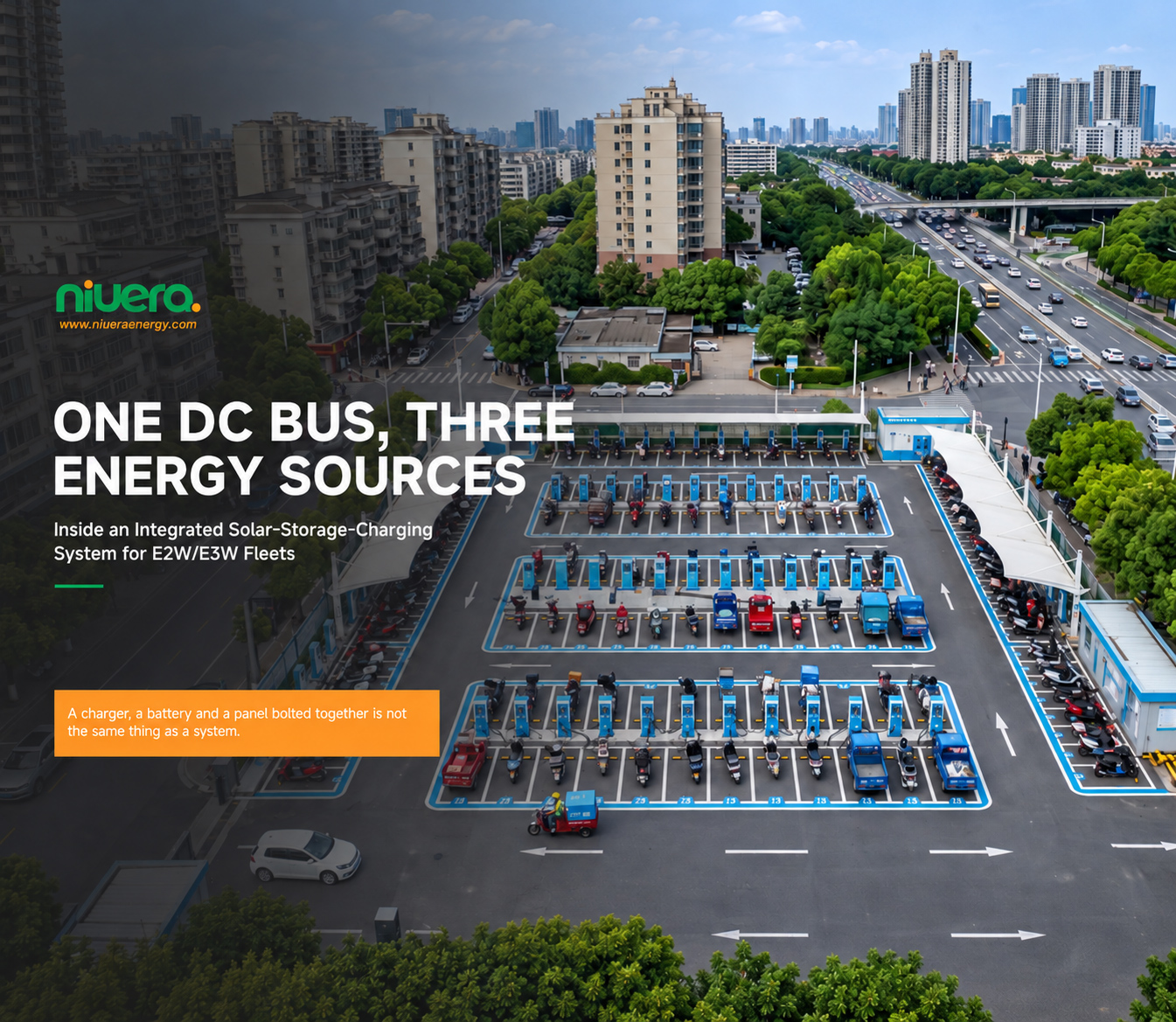
The $15 Billion Two-Wheeler EV Charging Gap: Industry Estimates Point to Massive Infrastructure Opportunity in Asia-Pacific
Frequently Asked Questions
How big is the two-wheeler EV charging market?
Industry estimates suggest Asia-Pacific needs $12-15 billion in two-wheeler charging infrastructure investment by 2030, requiring 4-4.5 million charging points across emerging markets.
What does a motorcycle charging station cost?
A typical 5kW two-wheeler charging point costs $1,500-$2,500 installed, compared to $150,000-$250,000 for a four-wheel DC fast charger—making it 60-100x more capital efficient.
How long does it take for a charging point to pay back?
Early deployments show payback periods of 18-36 months in optimal locations, with some dedicated fleet hubs achieving 12-18 month payback under favorable conditions.
Which countries have the biggest two-wheeler EV markets?
China leads with 250M electric two-wheelers (mature market), followed by India (35M, rapid growth), and Southeast Asia (12M, early stage but accelerating). IEA projects almost 1 in 3 two-wheelers sold in Southeast Asia will be electric by 2030.
Introduction
$300,000 can build one Tesla Supercharger station serving 50-80 cars daily.
Or it can build 100-150 motorcycle charging points serving 500+ riders daily.
Same capital. 10x the users. 2x the returns.
Welcome to the $15 billion two-wheeler charging opportunity hiding in plain sight across Asia-Pacific.
While the world obsesses over Tesla and Rivian, a parallel revolution 7x larger is accelerating on two wheels. Over 450 million electric motorcycles, scooters, and three-wheelers will be on roads by 2030. They'll need 4.5 million charging points. Today, barely 500,000 exist.
The disconnect is stark: Southeast Asia and South Asia account for 85% of global two-wheeler sales, but less than 5% of charging infrastructure investment.
For charging infrastructure providers, equipment manufacturers, and investors willing to look beyond passenger cars, the two-wheeler electrification wave represents one of the decade's most compelling opportunities. And new solutions designed specifically for these emerging markets are beginning to emerge—addressing the unique challenges of cost, durability, and payment integration that have held back deployment. More on these innovations later in this article.
Here's why this market is about to explode—and who's positioned to win.
The Scale of Two-Wheeler Electrification
Market Size: Bigger Than You Think
According to the International Energy Agency's Global EV Outlook 2025, electric two-wheelers already represent the largest category of electric vehicles globally by unit count, with two- and three-wheelers accounting for more than 9% of the global fleet and 15% of sales in 2024.[^1] The numbers tell a powerful story:
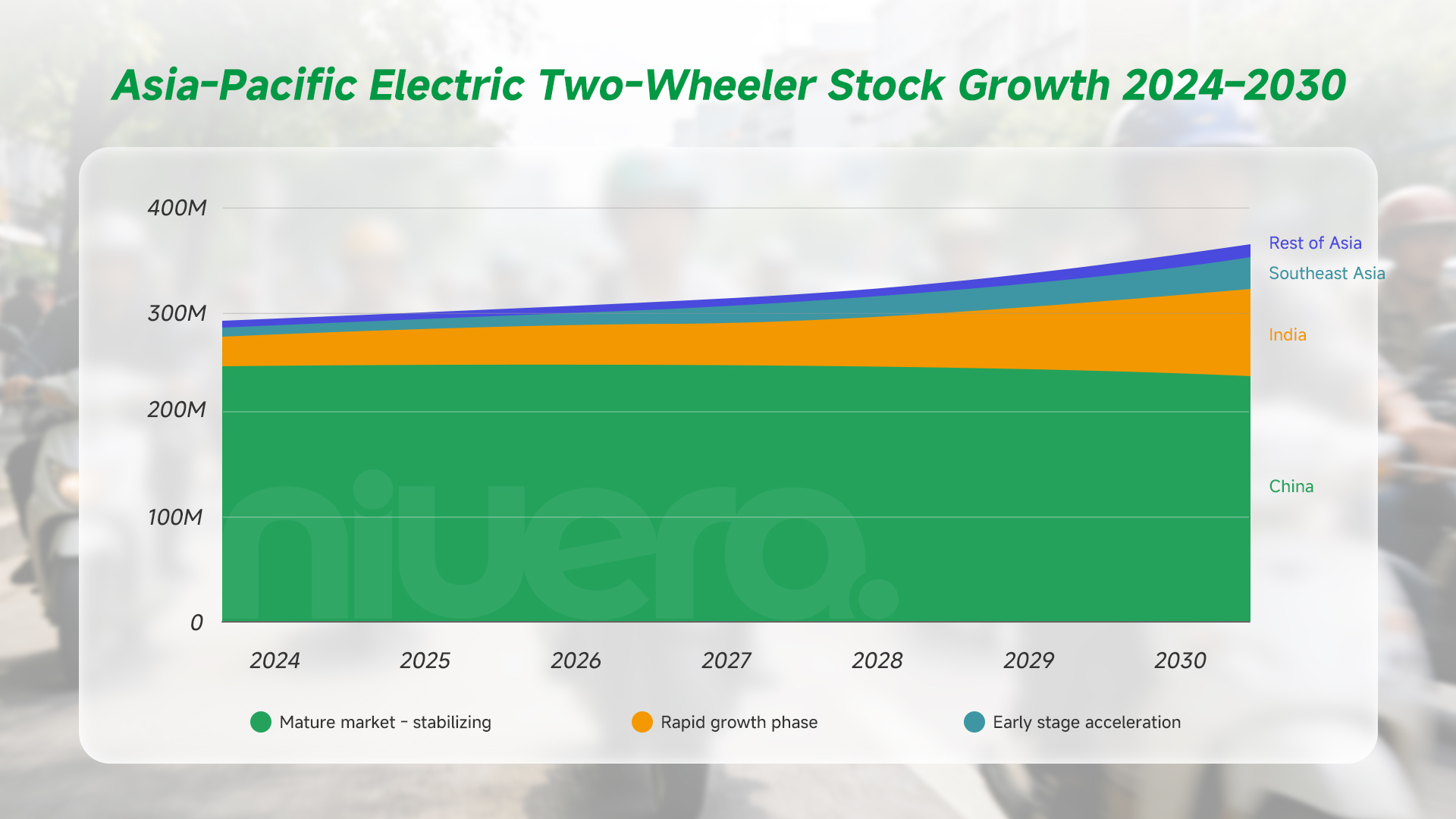
Asia-Pacific Electric Two-Wheeler Stock (2026 estimates):
- China: 250 million units (mature but stabilizing market; Chinese OEMs now expanding overseas)
- India: 35 million units (rapid growth phase, approximately 8% of total two-wheeler fleet)
- Southeast Asia: 12 million units (early stage, 3-5% penetration but accelerating)
- Rest of Asia: 8 million units
By comparison, global electric passenger car stock stands at approximately 40 million units. The two-wheeler EV market is already 7-8 times larger by vehicle count—yet receives a fraction of the infrastructure investment and media attention.
"By 2030, Southeast Asia will have more electric two-wheelers than North America and Europe have electric cars—combined."
Growth Trajectory:
Industry analysts project that electric two-wheeler sales will reach 45-50 million units annually by 2030, with the vast majority concentrated in Asia-Pacific markets. This represents a compound annual growth rate of 35-40% through the end of the decade, far outpacing four-wheel EV growth rates of 15-20%. The IEA projects that by 2030, almost one in three two- and three-wheelers sold in Southeast Asia will be electric.[^1]

The $15 Billion Infrastructure Gap
Charging Demand vs. Current Supply: The Math Behind the Opportunity
Here's where the opportunity becomes clear. Industry analysis suggests that to adequately serve the projected 2030 two-wheeler EV fleet, Asia-Pacific (excluding mature China market) needs approximately 4.5-5 million public and semi-public charging points. As of early 2026, fewer than 500,000 dedicated two-wheeler charging points exist across these emerging markets.
The Infrastructure Math (Industry Estimates):
- Required charging points by 2030: 4,500,000-5,000,000
- Current infrastructure: ~500,000
- Gap to fill: 4,000,000-4,500,000 charging points
- Average cost per charging point: $800-$3,000 (depending on power level, features, and installation complexity)
- Estimated total infrastructure investment needed: $12-15 billion
This calculation focuses on high-growth markets—India, Indonesia, Vietnam, Thailand, Philippines, and emerging markets in Africa and Latin America—where infrastructure buildout is still in early stages.
Why Two-Wheeler Charging Is 10x More Capital Efficient
Unlike four-wheel fast charging infrastructure—which requires expensive power electronics, high-capacity grid connections, and significant real estate—two-wheeler charging infrastructure is remarkably capital-efficient:
"One Tesla Supercharger station = 100 motorcycle charging points. Same capital. 10x the users. 2x the returns."
Quick Take: Why Two-Wheeler Charging Is Different
| Dimension | Four-Wheeler | Two-Wheeler |
| Power | 50-350kW | 2-10kW |
| Cost/Point | $150K-250K | $1.5K-2.5K |
| Users/Day | 50-80 | 300-500 |
| Payback | 4-7 years | 1.5-3 years |
| Grid Impact | High (MW-scale) | Low (kW-scale) |
| Site Footprint | 2-4 parking spaces | Wall-mounted, <0.5㎡ |
Bottom line: 10x capital efficiency, 2x faster returns

Regional Market Breakdown: Where the Growth Is
Southeast Asia: The Immediate Opportunity
Southeast Asia represents the most dynamic two-wheeler EV market outside China, with several factors converging to create ideal conditions. The IEA notes that Southeast Asian markets saw electric two-wheeler sales nearly double in 2024, with continued acceleration expected.[^1]
Vietnam
With over 70 million motorcycles and scooters for 100 million people, Vietnam is one of the world's most motorcycle-dependent societies—walk through Hanoi during rush hour and you'll see why. Motorcycles aren't just transportation here; they're the backbone of the economy.
Electric two-wheeler sales surged in 2024-2025, with the government supporting adoption through various incentive programs including import duty exemptions and license plate priority.
Current challenge: Charging infrastructure concentrated in Hanoi and Ho Chi Minh City, leaving secondary cities underserved.
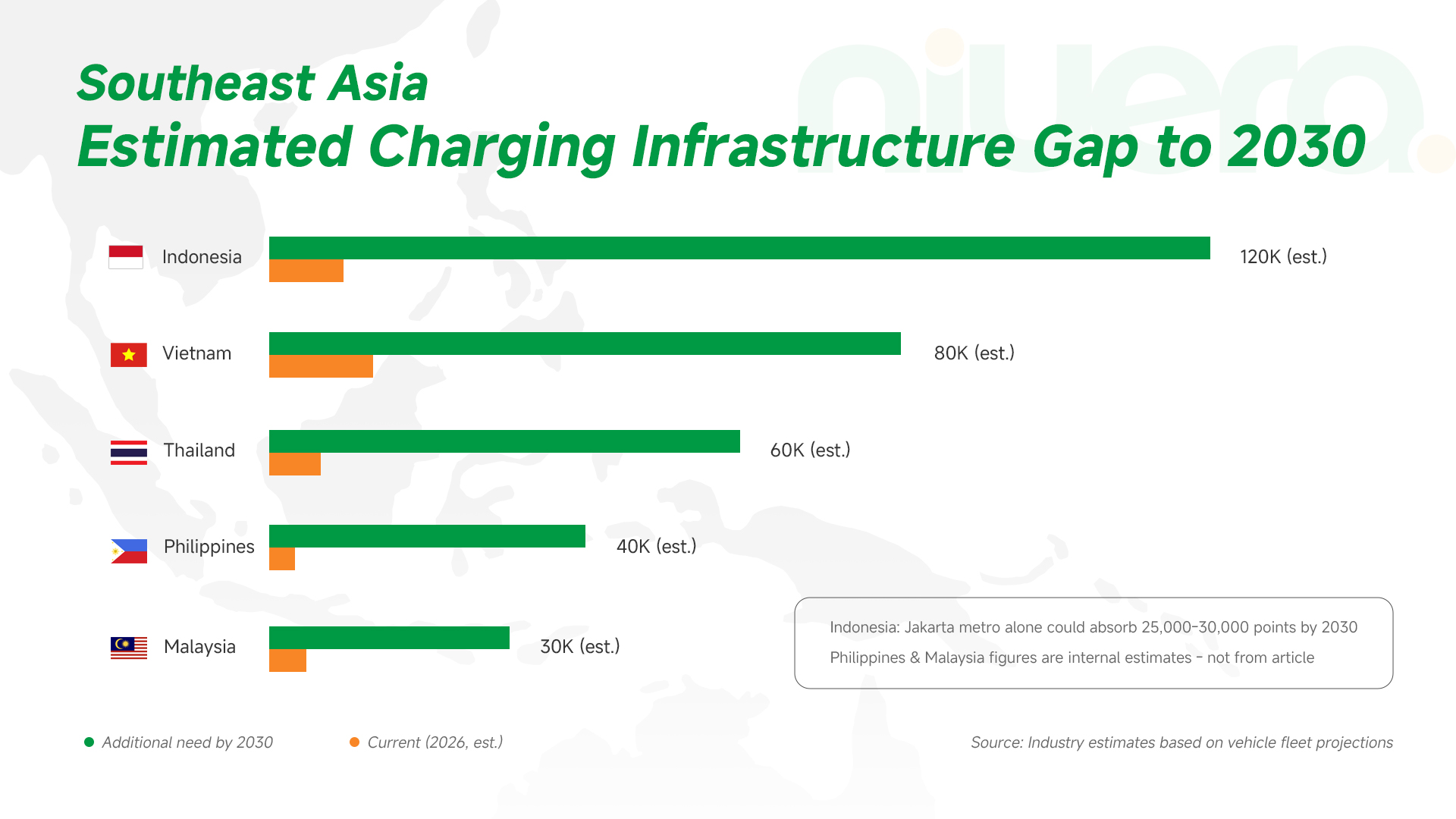
Estimated market opportunity: 50,000-80,000 new charging points needed by 2030. Key deployment locations include convenience stores, gas station conversions, apartment complexes, and delivery company hubs.
Indonesia
As the world's fourth most populous country spread across 17,000 islands, Indonesia faces unique last-mile logistics challenges that motorcycles are uniquely positioned to solve. Growing electric motorcycle interest is being driven by ride-hailing and delivery companies.
Grab and Gojek have initiated pilot programs for electric two-wheeler fleets, though progress has been gradual as companies address infrastructure gaps and driver adoption issues. Gojek announced a 2030 electrification commitment in 2021, while Grab continues to expand its sustainability initiatives across Southeast Asian markets.
Current challenge: Grid reliability in tier-2 and tier-3 cities requires robust, offline-capable charging solutions.
Estimated market opportunity: 80,000-120,000 charging points needed. Jakarta metropolitan area alone could absorb 25,000-30,000 points by 2030.
Thailand
Government incentives including purchase subsidies and an 8-year corporate income tax exemption for EV manufacturers are accelerating adoption. Thailand aims to position itself as Southeast Asia's EV manufacturing hub, creating a favorable environment for charging infrastructure investment.
Estimated market opportunity: 40,000-60,000 charging points, with particular opportunities in tourist areas (Phuket, Chiang Mai) and Bangkok's dense urban core.
South Asia: India's Massive Scale and Complex Policy Landscape
India presents the world's largest two-wheeler market and potentially the most complex charging infrastructure challenge. With over 350 million two-wheelers on roads and ambitious electrification targets, industry estimates suggest India needs to add 500,000-700,000 charging points by 2030 to support government EV adoption goals.
Policy Evolution:
India's incentive landscape has evolved significantly. The FAME II (Faster Adoption and Manufacturing of Electric Vehicles) scheme, which offered subsidies of ₹15,000 per kWh battery capacity, concluded in March 2024. It was replaced by a transitional EMPS (Electric Mobility Promotion Scheme) offering reduced subsidies, and subsequently by the PM E-DRIVE scheme launched in late 2024.
Current Policy (2026):
Under PM E-DRIVE, electric two-wheeler buyers receive ₹5,000 per kWh of battery capacity, capped at 15% of vehicle price or ₹10,000, whichever is lower. The program also includes enhanced support for commercial three-wheelers and aims to promote charging infrastructure development through the Production-Linked Incentive (PLI) scheme for advanced battery manufacturing.[^2]
Key segments:
- Shared mobility: Electric rickshaws and three-wheelers (current deployment accelerating from 150,000 units toward 2030 targets)
- Delivery fleets: E-commerce and food delivery creating dense charging demand in urban centers
- Private ownership: Growing middle-class adoption of electric scooters
Unique factors:
- Power grid challenges in tier-2/3 cities require smart load management
- Price sensitivity demands affordable charging solutions ($500-$1,500 per point)
- Local manufacturing incentives (PLI scheme) favor domestic assembly
Estimated market opportunity: $3-4 billion infrastructure investment through 2030, with 60-70% expected from private operators rather than government funding.
Emerging Markets: Africa and Latin America
While smaller in absolute terms, African and Latin American markets offer first-mover advantages and higher margins:
East Africa (Kenya, Uganda, Tanzania):
Boda-boda (motorcycle taxi) electrification is accelerating. Companies like Ampersand—which operates over 5,700 electric motorcycles and targets 40,000 by year-end 2026—and Kenya-based Roam are deploying electric motorcycles with supporting charging and battery swap infrastructure. As of 2025, electric motorcycles represented approximately 10% of Kenya's growing motorcycle market, with strong momentum continuing into 2026.[^3][^4]
Infrastructure needs: These markets are estimated to need 15,000-25,000 charging points by 2030, with battery swap playing a significant complementary role.
Latin America (Colombia, Brazil, Mexico):
Urban delivery and last-mile logistics driving early adoption. Estimated market needs 30,000-50,000 charging points by 2030.
What's Driving This Growth?
Four Converging Forces
1. Economic Pressure: Fuel Costs Make Electric Compelling
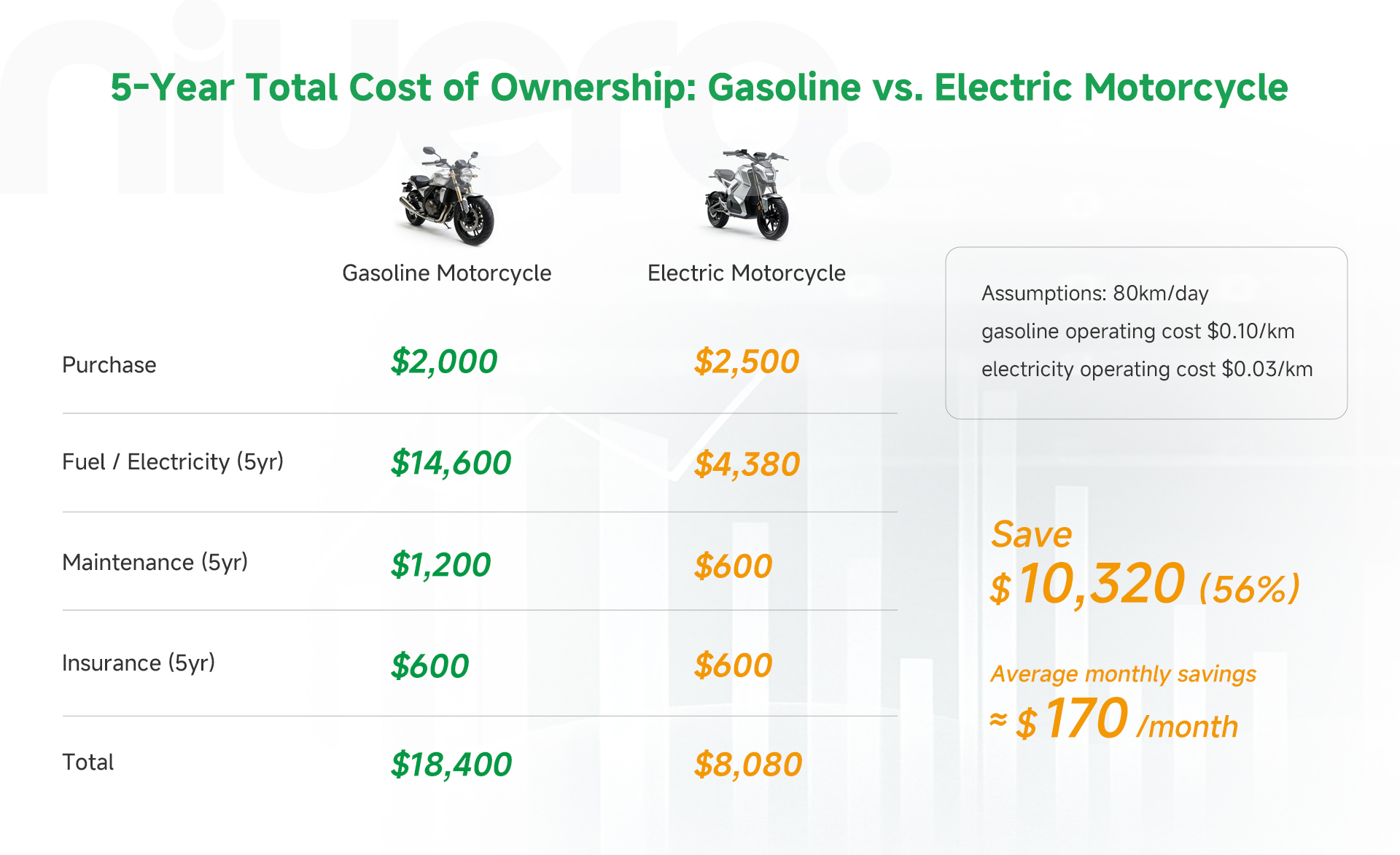
In many Asian markets, fuel represents 30-50% of a motorcycle rider's operating costs. With gasoline prices ranging from $1.20-$1.80 per liter across Southeast Asia and India, the economics of electric two-wheelers are compelling:
Typical operating cost comparison (per kilometer):
- Gasoline motorcycle: $0.08-$0.12
- Electric motorcycle: $0.02-$0.04
"For delivery riders covering 100km daily, switching to electric saves $200/month—40% of take-home income."
For delivery riders covering 80-120 kilometers daily, switching to electric can save $150-$250 monthly—often 30-40% of take-home income. This economic incentive drives adoption faster than any government policy.
2. Policy Incentives: Government Support Accelerating
Governments across Asia are deploying subsidies and mandates:
- India: PM E-DRIVE subsidies of ₹5,000 per kWh (capped at ₹10,000 or 15% of vehicle price)
- Indonesia: Tax exemptions and 40% local content requirements
- Vietnam: Import duty exemptions and license plate priority
- Thailand: Purchase subsidies and manufacturing tax holidays through Board of Investment (BOI)
These policies are specifically designed to accelerate two-wheeler electrification as a faster path to emissions reduction than passenger cars.
3. Technology Maturation: Better Products at Lower Costs
Battery costs have fallen below $100/kWh in volume applications, making electric motorcycles cost-competitive with gasoline equivalents. Charging times have improved to 30-60 minutes for a full charge at 3-5kW power levels—acceptable for most urban use cases.
Importantly, two-wheeler charging avoids the "chicken and egg" problem that plagued early four-wheel EVs. With smaller batteries (2-5 kWh vs. 60-100 kWh), two-wheelers can charge at home on standard outlets, reducing initial infrastructure dependence. Public charging becomes a convenience rather than necessity, lowering the barrier to adoption.
4. Commercial Fleet Demand: Guaranteed Utilization
The strongest near-term demand comes from commercial operators with predictable usage patterns:
- Food delivery platforms (Grab, Gojek, Swiggy, Zomato)
- E-commerce logistics (JD.com, Lazada, Shopee)
- Ride-hailing services
- Postal and courier services
These operators offer guaranteed utilization for charging infrastructure, de-risking early investments. A single delivery hub with 200 electric motorcycles can support 10-20 dedicated charging points with 70-80% daily utilization—achieving positive ROI in 18-24 months under favorable conditions.
The Infrastructure Challenge: Why Existing Solutions Don't Work
Two-Wheeler Charging Requires Different Technology
The two-wheeler charging market cannot simply scale down four-wheel infrastructure. The requirements are fundamentally different:
Power Levels: 2-10kW (vs. 50-350kW for cars)
Form Factor: Wall-mounted, compact, outdoor-rated (vs. large cabinets)
Connectivity: Mobile payment integration essential (vs. credit card typical)
Durability: IP65+ protection for exposed locations (vs. protected parking)
Cost: Target $500-$2,000 per unit (vs. $30,000-$250,000)
Why Everyone Gets Two-Wheeler Charging Wrong
Conventional wisdom: Two-wheeler charging is just scaled-down car charging.
Reality: It's a completely different business model.
Car charging in the West is about convenience—drivers charge while shopping or eating. Two-wheeler charging in Asia is about economics—riders charge because it saves $200/month in fuel costs.
This changes everything:
- Location selection: Near workplaces and delivery hubs, not shopping malls
- Pricing strategy: Low margins, high volume (not premium pricing)
- Payment integration: Mobile wallets (UPI, GoPay, MoMo), not credit cards
- Reliability requirements: 99%+ uptime or riders lose income
"Most solutions fail because they're designed for European car drivers, not Asian delivery riders. The winners will be those who understand this fundamental difference."
Environmental Challenges Unique to Two-Wheeler Markets:
Most electric two-wheeler growth is happening in tropical and subtropical climates with harsh conditions:
- Operating temperatures: -10°C to 50°C
- Monsoon rainfall and high humidity
- Dust and air pollution
- Unreliable grid power (voltage fluctuations, outages)
These conditions demand ruggedized equipment designed specifically for emerging market deployment—not repurposed European or North American designs.
The Deployment Models That Work
Field experience from early deployments suggests three successful models:
1. Retail Partnerships (35-40% of deployments)
Convenience stores, gas stations, and retail chains install 2-5 charging points to attract customers. Riders spend 30-45 minutes charging, creating footfall and purchase opportunities.
Estimated ROI: 24-36 months, driven by combined charging revenue and increased retail sales.
2. Dedicated Hubs (30-35% of deployments)
Fleet operators and delivery companies build dedicated charging facilities with 20-50 points serving their own vehicles.
Estimated ROI: 18-24 months, with tight utilization management and predictable demand.
3. Residential/Workplace (25-30% of deployments)
Apartment complexes, office parks, and universities install charging as an amenity, often with lower utilization but strong value-add for tenant retention.
Estimated ROI: 36-48 months, longer payback but stable long-term demand.
The Business Case: Why Operators Are Paying Attention
Real-World Economics: What Charging Points Actually Earn
Analysis of early charging networks reveals potentially attractive unit economics:
Typical 5kW charging point in urban Southeast Asia (estimated model):
Revenue:
- Charging sessions: 8-12 per day
- Average session: 4kWh × $0.40/kWh = $1.60
- Daily revenue: $12-$20
- Monthly revenue: $360-$600
Costs:
- Electricity: $150-$250/month
- Maintenance: $30-$50/month
- Network fees: $20-$30/month
- Total monthly OpEx: $200-$330
Estimated monthly profit: $130-$300 per charging point
Estimated annual profit: $1,560-$3,600 per point
Simple payback estimate: 8-18 months (depending on installation cost and actual utilization)
The Economics in 60 Seconds
One 5kW charging point:
- Setup cost: $1,500-$2,500
- Monthly revenue: $360-$600
- Monthly costs: $200-$330
- Monthly profit: $130-$300
- Payback: 8-18 months
Scale it: 100 points = $15K-$30K monthly profit (estimated)
These estimated returns compare favorably to four-wheel DC fast charging, which often requires 4-7 years for payback in many markets. However, actual results vary significantly based on location, utilization, and local electricity rates.
Scalability Advantages
Two-wheeler charging scales more efficiently than car charging:
Capital efficiency: 10x more units deployed per dollar invested
Site flexibility: Smaller footprint enables more locations
Permitting: Faster, simpler approvals for low-power installations
Grid impact: Lower power draw reduces utility upgrade requirements
A charging operator can deploy 100 two-wheeler charging points across 15-20 locations for the same capital as a single 4-station DC fast charging hub—creating broader network coverage and multiple revenue streams.
What's Holding Back Investment?
Despite compelling economics, two-wheeler charging infrastructure investment lags four-wheel EVs for several reasons:
1. Perception Gap
Institutional investors and charging companies are more familiar with passenger car infrastructure. Two-wheeler markets require localized knowledge and comfort with emerging market risk.
2. Fragmentation
Lack of standardization across vehicle models, connectors, and payment systems creates deployment complexity. Unlike the relative standardization of CCS or CHAdeMO for cars, two-wheeler charging still has multiple competing standards.
3. Technology Availability
Until recently, purpose-built two-wheeler charging solutions were limited. Most early deployments used adapted four-wheel technology—overbuilt and overpriced for the application.
But the Technology Gap Is Closing
However, 2026 marks an inflection point. Purpose-built two-wheeler charging solutions—compact, ruggedized, and affordable—are entering the market from companies focused specifically on emerging market needs rather than adapting four-wheel technology.
These new solutions address the core requirements:
- Cost target: $500-$1,500 per point (vs. $3,000+ for adapted solutions)
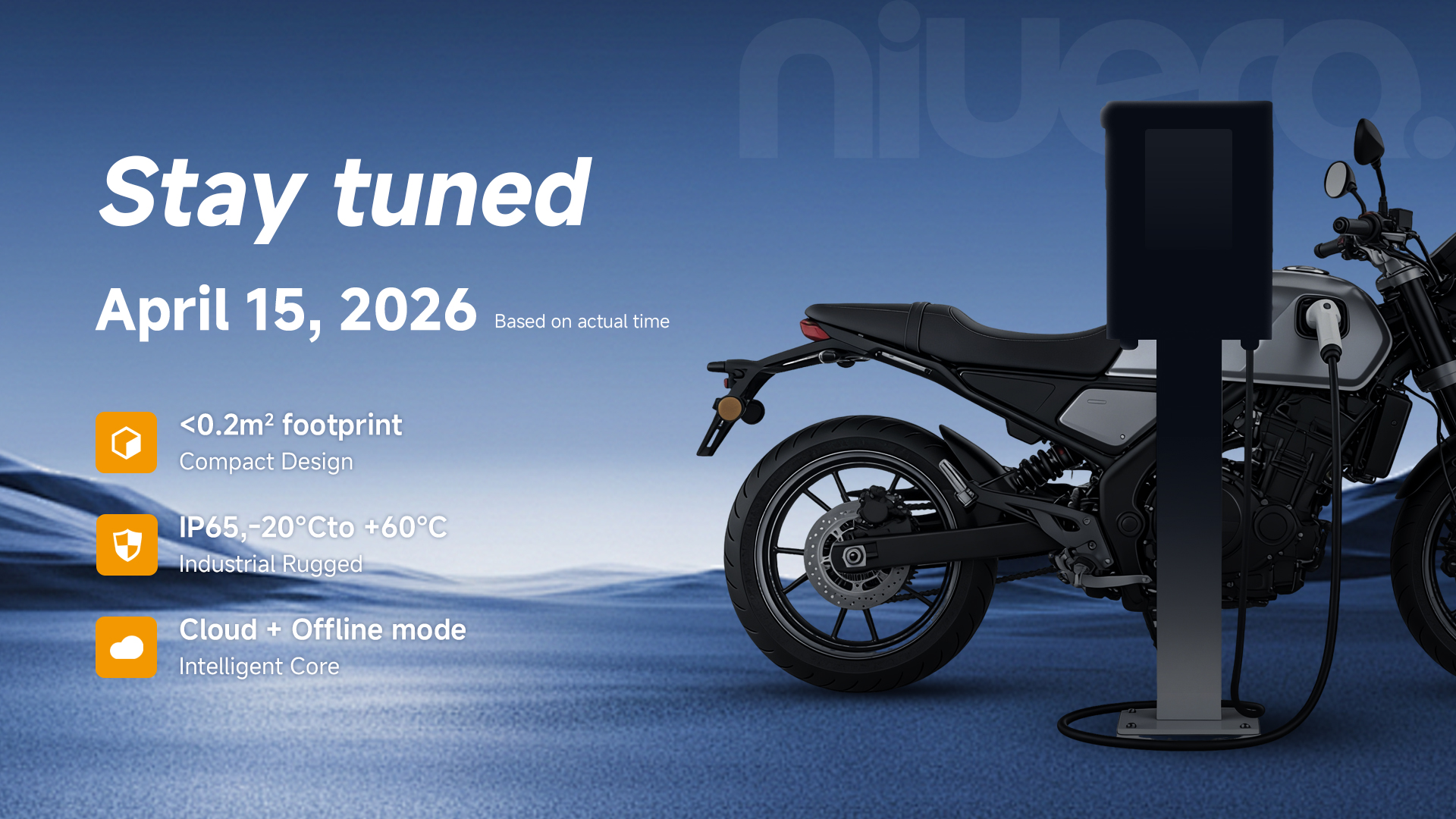
- Durability: IP65+ protection, -20°C to +60°C operation
- Payment: Native mobile wallet integration (UPI, GoPay, MoMo, etc.)
- Connectivity: Cloud management with offline capability
- Deployment: Wall-mounted, rapid installation (<2 hours)
Niuera Energy is among the companies preparing to launch solutions in this category—purpose-built for the unique demands of Southeast Asia, South Asia, and Africa. Watch this space for announcements in Q2 2026.
As commercial deployments prove the business model and new purpose-built products enter the market, institutional capital is beginning to flow. In 2025, venture funding for two-wheeler charging and related mobility companies showed strong growth, with increasing investor recognition of the market opportunity.
Launching a Two-Wheeler Charging Solution Soon?
Get early access to new product announcements, beta testing opportunities, and deployment partnerships.
[Subscribe for Launch Updates] — April 15, 2026 announcement coming
Be among the first 100 subscribers to receive VIP launch pricing
Looking Ahead: The Infrastructure Buildout
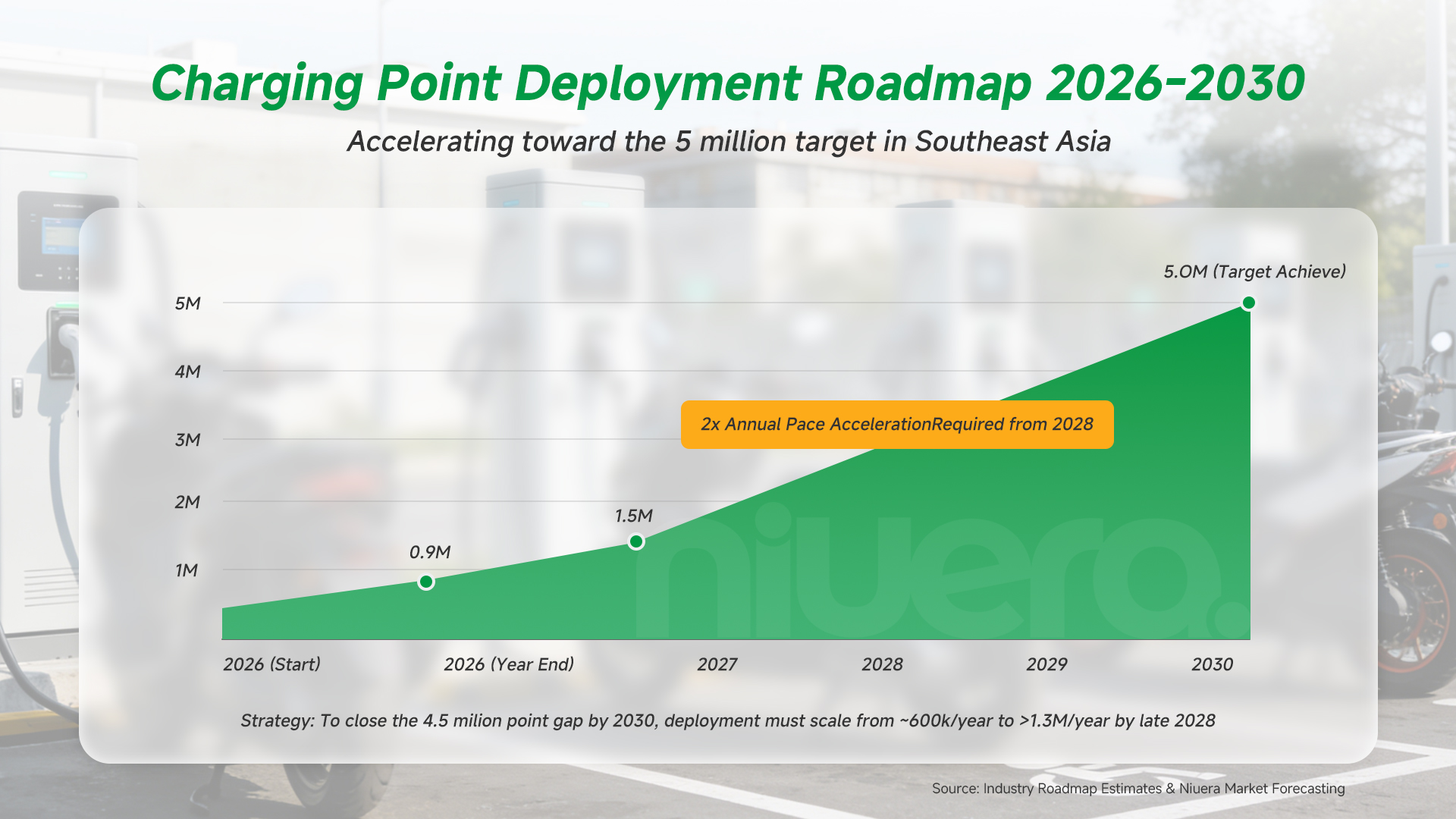
2026-2030 Investment Roadmap
To close the estimated 4-4.5 million charging point gap by 2030, the industry needs to scale dramatically:
Estimated installation pace required:
- 2026: 400,000 new points
- 2027: 600,000 new points
- 2028: 900,000 new points
- 2029-2030: 2.6 million new points
Estimated capital deployment:
- 2026-2027: $2-3 billion annually
- 2028-2030: $4-5 billion annually
This infrastructure buildout will require diverse participants:
Charging network operators: Building multi-location networks with 500-5,000 charging points
Fleet operators: Deploying dedicated infrastructure for captive fleets
Retail partners: Installing 2-10 points per location at scale
Real estate developers: Integrating charging into new residential and commercial projects
Utilities: Deploying charging as load-building infrastructure investment
The Role of Technology Innovation
Success will require continued innovation in several areas:
Smart charging management: Optimizing grid load, managing peak demand, enabling vehicle-to-grid potential
Payment integration: Seamless mobile wallet and QR code payment across markets
Remote monitoring: Predictive maintenance and fault detection to maintain uptime
Modular design: Scalable solutions that work from 1 to 100 charging points per location
Ruggedization: IP65+ protection, wide temperature operation, grid instability tolerance
"Companies bringing purpose-built, emerging market-ready solutions will capture disproportionate market share as the buildout accelerates."
Companies bringing purpose-built, emerging market-ready solutions will capture disproportionate market share as the buildout accelerates.
What This Means for Stakeholders
For Charging Infrastructure Providers
The two-wheeler market offers a potentially faster path to scale and profitability than competing for saturated four-wheel charging corridors. Geographic expansion into Asia-Pacific's high-growth markets provides diversification and access to government incentives.
Strategic priorities:
- Develop or source compact, cost-effective charging hardware ($500-$1,500 per point target)
- Build partnerships with local retail, real estate, and fleet operators
- Invest in mobile-first software platforms for emerging market users
- Prepare for rapid scale: target production capacity of 10,000+ units annually
For Investors
Two-wheeler charging infrastructure represents an emerging segment with potentially attractive risk-adjusted returns. The combination of demonstrated demand (IEA projects 450 million vehicles by 2030), favorable estimated unit economics (18-36 month paybacks in optimal scenarios), and government policy support creates compelling investment opportunities.
"The $15 billion question: Why is 85% of global two-wheeler sales getting 5% of charging infrastructure investment?"
Investment themes:
- Charging network operators with multi-country expansion capability
- Technology providers offering purpose-built two-wheeler solutions
- Vertically integrated fleet operators deploying captive infrastructure
- Software platforms enabling aggregation and interoperability
For Policymakers
Targeted support for two-wheeler charging infrastructure delivers faster emissions reductions and broader economic benefits than exclusive focus on passenger cars. Recommended policies:
- Charging infrastructure subsidies (30-50% of installation cost)
- Streamlined permitting for low-power installations (<10kW)
- Local manufacturing incentives to build domestic supply chains
- Mandates for charging infrastructure in new residential and commercial construction
The Road Ahead: Solutions Are Emerging
The two-wheeler charging infrastructure gap represents both a challenge and an extraordinary opportunity. As the industry matures and purpose-built solutions emerge, the pace of deployment is expected to accelerate dramatically.
Early movers are already seeing results. Charging networks in Vietnam, Indonesia, and India are achieving utilization rates above 60% in optimal locations and demonstrating business model viability when execution is right. Companies like Ampersand in East Africa have shown that with proper technology and business models, electric two-wheeler infrastructure can scale profitably.
The question is no longer whether the two-wheeler charging market will scale, but who will capture the largest share of this estimated $12-15 billion infrastructure opportunity.
For those watching this space: The next few months will bring significant developments. Purpose-built charging solutions designed specifically for the demands of emerging markets—compact, affordable, durable, and smart—are launching this quarter.
Niuera Energy will unveil its two-wheeler charging platform on April 15, 2026—a solution engineered from the ground up for the unique demands of Southeast Asia, South Asia, and Africa. The platform addresses the critical gaps that have held back deployment: affordability (sub-$1,500 per point target), ruggedization (IP65, -20°C to +60°C operation), payment integration (native mobile wallet support), and cloud management with offline capability.
Early access and beta testing opportunities will be announced to subscribers first.
Stay tuned. The two-wheeler charging revolution is just getting started.
Take Action: Choose Your Next Step
Just Exploring?
→ [View Interactive Market Opportunity Map]
→ [Read: SKD Solutions for EV Charging] (Related article)
Serious About Two-Wheeler Charging?
→ [Subscribe for April 15 Product Launch] (Early bird pricing for first 100)
→ [Download Full Asia-Pacific Market Report] (PDF, 45 pages)
Ready to Deploy?
→ [Apply for Beta Testing Program] (Limited slots, launching April 2026)
→ [Distributor Partnership Inquiry] (Regional partnership opportunities)
References
[^1]: International Energy Agency (2025). Global EV Outlook 2025. IEA, Paris. Available at: //www.iea.org/reports/global-ev-outlook-2025
[^2]: Ministry of Heavy Industries, Government of India (2024). PM Electric Drive Revolution in Innovative Vehicle Enhancement (PM E-DRIVE) Scheme. Press releases and scheme documentation, 2024.
[^3]: CleanTechnica (2025). "Ampersand Reaches 5,700 Electric Motorcycles, Eyes 40,000 by Year End." May 2025.
[^4]: Kenya National Bureau of Statistics (2025). Leading Economic Indicators Report, August 2025. Motorcycle market analysis.
Additional Sources:
- Bloomberg NEF. Electric Vehicle Outlook (various editions 2024-2025)
- ASEAN Centre for Energy. ASEAN Energy Database (2025)
- Reuters, Nikkei Asia, various trade publications (2024-2026)
- Company press releases: Ampersand, Roam, Grab, Gojek (2021-2026)
Note: Market estimates and projections cited in this article represent industry analysis based on available data and trends. Actual market developments may vary. Investment decisions should be based on comprehensive due diligence.
About Niuera
Niuera Energy develops advanced charging infrastructure solutions for the global electric vehicle transition. With deep expertise in modular power electronics and emerging market deployment, Niuera supports charging operators, fleet managers, and infrastructure providers in scaling EV adoption efficiently and profitably.
Upcoming: April 15, 2026 — Two-Wheeler Charging Platform Launch
Learn more at www.niueraenergy.com
Compact, Smart, Affordable: Niuera Energy Introduces Its Electric Motorcycle Charging Station Line
Scaling EV Charging Infrastructure Locally: Why Leading Operators Choose SKD Solutions(Part 2)