Trade Barriers and Local Assembly: How Tariff Shifts in 2026 Are Changing EV Charging Economics
The Trade Environment Has Fundamentally Changed

What the Tariff Stack Actually Looks Like in 2026
Before examining the economics, it is necessary to be precise about which tariffs apply to which products — because the most consequential misunderstanding in this space concerns the 100% tariff on Chinese electric vehicles.
EV Vehicles vs. EV Charging Equipment: A Critical Distinction
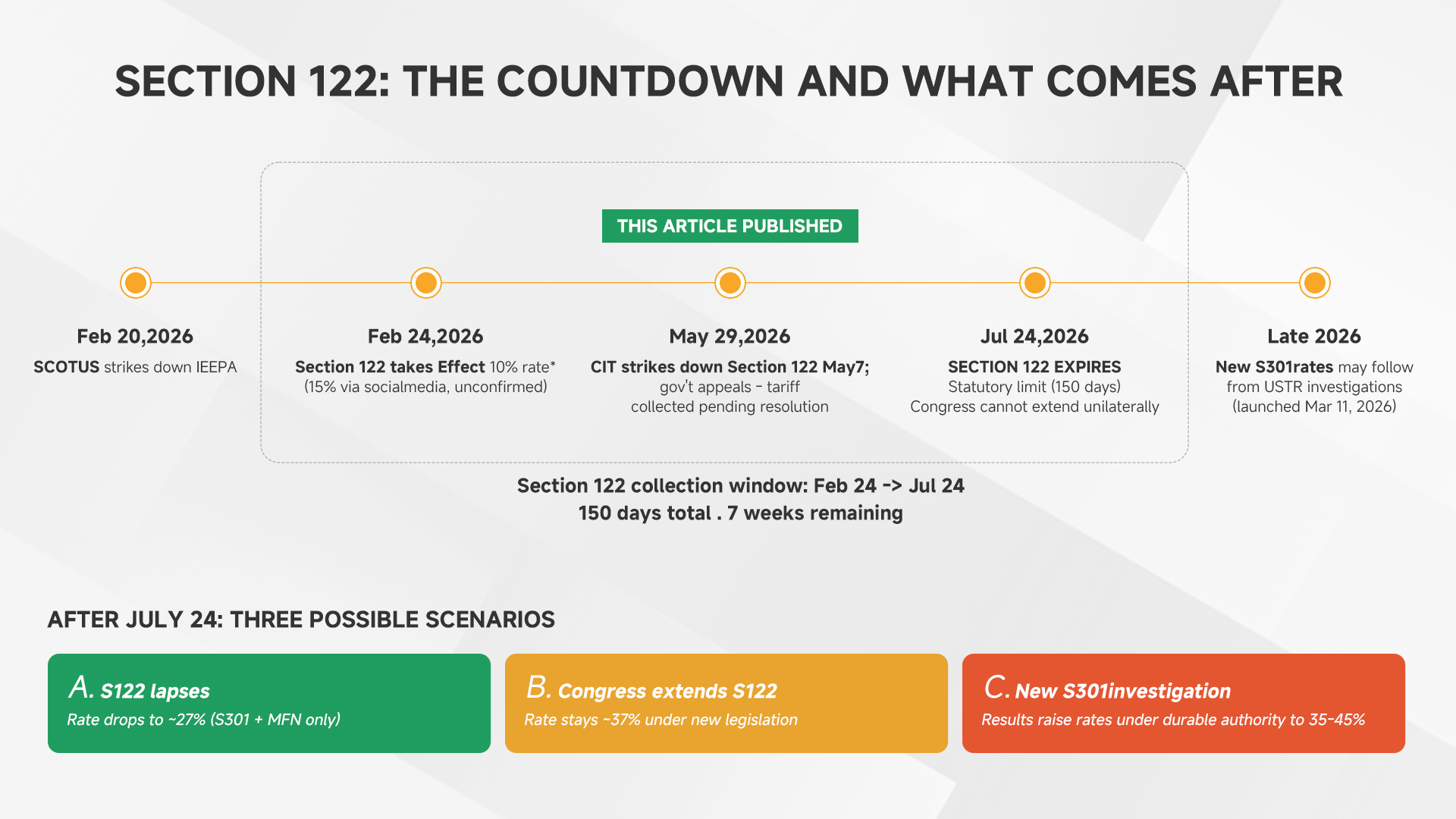
The Actual Tariff Stack on Chinese EV Charging Equipment (as of Late May 2026)

How This Compares: US vs. EU
How SKD Assembly Changes the Tariff Equation
-
Pre-assembled charging modules (power conversion, control electronics)
-
Pre-wired cabinet components (breakers, meters, connectors, cables)
-
Structural enclosure elements (sheet metal, mounting hardware)
-
HMI and connectivity components (touchscreen, payment terminal, communication module)
The Cost Difference in Practice

Consider a DC fast charging station with a CIF value of USD 8,000 imported from China into the United States:
| CBU Import (China-origin) | SKD Assembly (US/Mexico) | |
| CIF hardware value | USD 8,000 | USD 8,000 (kit) |
| Section 301 tariff (25%) | USD 2,000 | USD 0 (if origin qualified) |
| Section 122 surcharge (10%) | USD 800 | USD 0 (if origin qualified) |
| Base MFN duty (~2.1%) | USD 168 | USD 168 (on components at applicable rate) |
| Local assembly labour | — | ~USD 200–400 |
| Total landed cost | ~USD 10,968 | ~USD 8,368–8,568 |
| Tariff-driven premium | +~28% vs. assembled | — |
The Emerging Market Case: A Different Logic
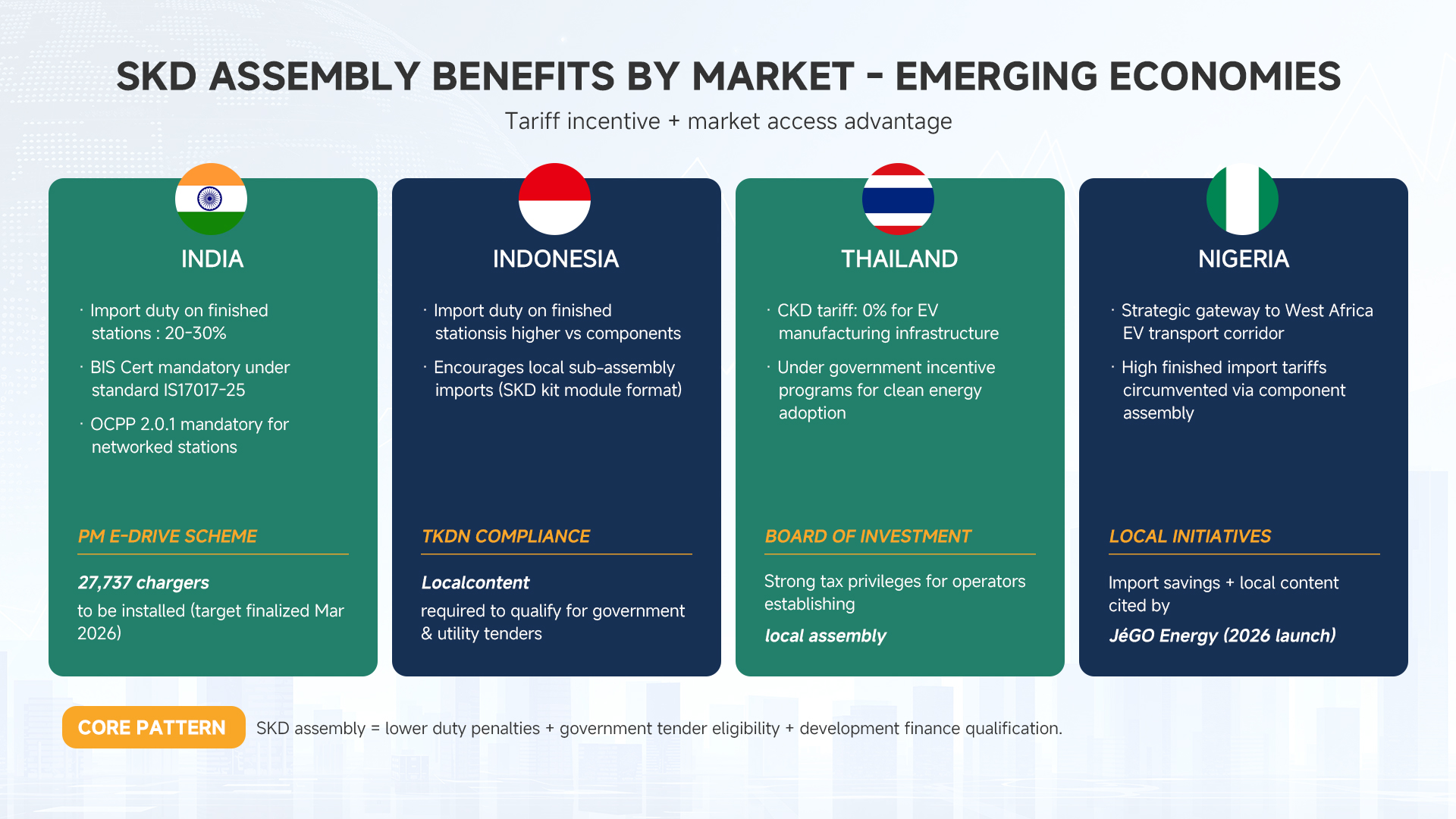
India provides a clear illustration. Under the current tariff structure, fully assembled EV charging stations imported into India face import duties that can reach 20–30% depending on product classification, while imported components for local assembly attract significantly lower rates — particularly when the assembled product incorporates qualifying domestic content under Make in India criteria.
What SKD Assembly for EV Charging Stations Requires
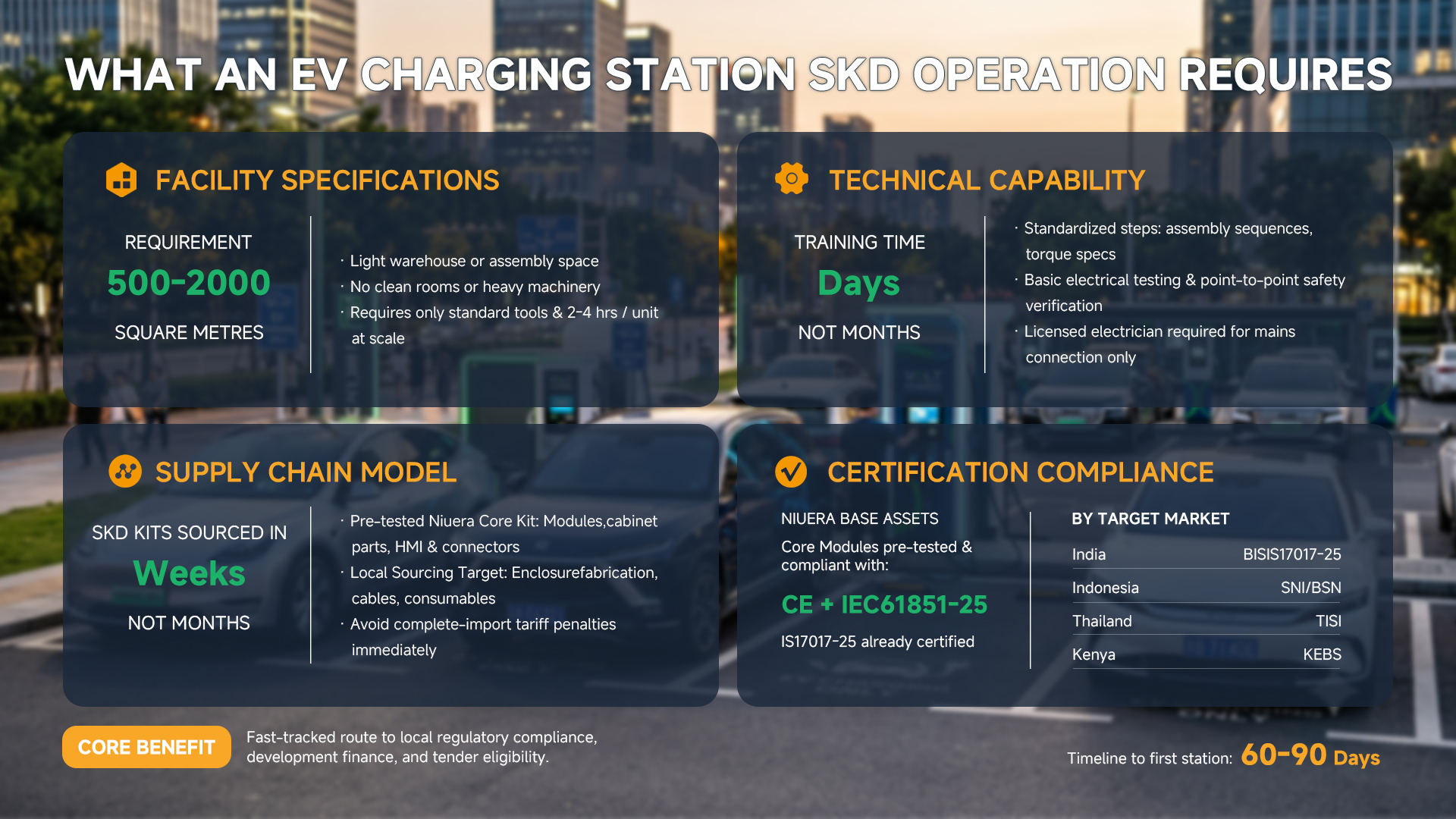
Facility. A standard warehouse or light manufacturing space of 500–2,000 square metres is sufficient for EV charging station SKD assembly at volumes of several hundred to a few thousand units per year. No clean room, no heavy machinery, no complex tooling. The physical requirements are modest compared to most manufacturing categories.
What Operators Who Have Run the Numbers Are Doing
Niuera's SKD Programme: How It Works
Conclusion: The Durable Case for Local Assembly
The case for SKD assembly has two components, and it is important to distinguish them.
The first is the tariff arbitrage case. For operators assembling in Mexico under USMCA, both the Section 301 (25%) and Section 122 (10%) components are avoidable — a combined saving of approximately USD 2,800 per station on an USD 8,000 CIF kit, or USD 280,000 across a 100-station deployment. For operators assembling in non-USMCA third countries, the Section 301 saving (USD 2,000 per station, USD 200,000 per 100 stations) is the durable component: it persists regardless of what happens to Section 122 on July 24. Section 301 tariffs on EV charging equipment have survived two administrations, multiple legal challenges, and three USTR reviews. They are not going away on any near-term horizon.
The second is the market access case — the growing requirement in India, Indonesia, Thailand, Kenya, and other emerging markets for locally assembled products to qualify for government procurement, incentive programmes, and development finance. This case is completely independent of US tariff policy. It reflects a structural trend toward local content requirements that is accelerating across the markets where new charging infrastructure investment is most active.
Together, these two arguments make the case for SKD assembly not as a tactical response to a transient tariff environment, but as a strategic positioning for the competitive landscape of EV charging infrastructure deployment over the next five years.
For operators who have been modelling SKD but deferring the decision: the Section 122 expiry on July 24 removes one component of the current tariff stack, but it does not change the Section 301 calculus. And the new Section 301 investigations launched in March 2026 may restore or exceed the current combined rate under more durable legal authority by year-end. Waiting for the tariff environment to "settle" before committing to local assembly is, in this context, an indefinite deferral.
Request a Niuera SKD kit specification and cost model → Contact our SKD programme team → Download the SKD deployment guide →
Frequently Asked Questions
Q: Is the Section 122 surcharge rate 10% or 15%?
References
[^1]: USTR. Section 301 Four-Year Review: Final Modifications to China Tariffs. September 13, 2024. //ustr.gov/about-us/policy-offices/press-office/press-releases/2024/september/ustr-finalizes-2024-china-tariff-review
[^2]: CBP Ruling N324397. Classification of the "Boost Charger" DC fast charging station — HTS 8504.40.9550. US Customs and Border Protection. //rulings.cbp.gov/ruling/n324397; also: yd-evcharger.com. Import EV Chargers from China: 2026 Guide. April 2026. //www.yd-evcharger.com/industry-news/import-ev-chargers-from-china/
[^3]: USITC. Electric Vehicle Supply Equipment (EVSE) in the United States. Working Paper ID-081. //www.usitc.gov/publications/332/working_papers/id-081_ev_charger_working_paper_compliant.pdf
[^4]: First Link Partners. Section 301 Tariffs: China — Current Rates, Legal Status, 2026 Outlook. May 2026. //firstlinkpartners.com/section-301-tariffs-china/
[^5]: Troutman Pepper Locke. Supreme Court Strikes Down IEEPA Tariffs; Trump Responds with Section 122 Global Surcharge. February 25, 2026. //www.troutman.com/insights/supreme-court-strikes-down-ieepa-tariffs-trump-responds-with-section-122-global-surcharge/
[^6]: Covington & Burling. IEEPA Tariffs Terminated, Replacement Section 122 Tariffs Take Effect. February 27, 2026. //www.cov.com/en/news-and-insights/insights/2026/02/ieepa-tariffs-terminated-replacement-section-122-tariffs-take-effect
[^6a]: FreightFigures. Section 122 Tariff Raised to 15%: What US Importers Need to Recalculate. March 23, 2026. //www.freightfigures.com/articles/section-122-tariff-raised-15-percent-2026; USTariffRates. 2026 US Tariff Tracker — All Current Tariff Rates. Updated weekly. //ustariffrates.com/tariff-tracker; Peacock Tariff Consulting. Section 122 Tariff Guide 2026. //www.peacocktariffconsulting.com/section-122-tariff-guide/ (confirms USMCA-qualifying goods from Canada and Mexico are exempt from Section 122 surcharge)
[^7]: Snell & Wilmer. Tariffs Redux: What Importers Should Know About IEEPA Refunds and Section 122. April 13, 2026. //www.swlaw.com/publication/tariffs-redux-what-importers-should-know-about-ieepa-refunds-and-section-122/
[^8]: Skadden. US Trade Court Strikes Down Section 122 Tariffs, but Ruling's Fate Is Uncertain. May 2026. //www.skadden.com/insights/publications/2026/05/us-trade-court-strikes-down-section-122-tariffs
[^9]: Tax Foundation. Tariff Tracker: 2026 Trump Tariffs & Trade War by the Numbers. Updated weekly. //taxfoundation.org/research/all/federal/trump-tariffs-trade-war/
[^10]: European Commission. Commission Implementing Regulation (EU) 2024/2754 — Definitive countervailing duties on BEVs from China. October 29, 2024. //trade.ec.europa.eu/access-to-markets/en/news/eu-commission-imposes-countervailing-duties-imports-battery-electric-vehicles-bevs-china
[^11]: European Commission / Access2Markets. Combined Nomenclature and Common Customs Tariff applicable from 1 January 2026. //trade.ec.europa.eu/access-to-markets/en/news/combined-nomenclature-and-common-customs-tariff-applicable-eu-1-january-2026
[^12]: Drishti IAS. Government Revises PM E-DRIVE Scheme. March 30, 2026. //www.drishtiias.com/daily-updates/daily-news-analysis/government-revises-pm-e-drive-scheme
[^13]: Electrive.com. India approves nearly 4,900 EV chargers under PM E-Drive scheme. May 13, 2026. //www.electrive.com/2026/05/13/india-approves-nearly-4900-ev-chargers-under-pm-e-drive-scheme/
[^14]: IMARC Engineering. How to Set Up EV Charging Infrastructure in India 2026. February 6, 2026. //www.imarcengineering.com/blog/setting-up-ev-charging-infrastructure-in-india-a-step-by-step-guide
[^15]: KAMA Auto. SKD/CKD Automotive Assembly: Strategic Advantages for Global Exporters. //www.kamaauto.cn/news/skd-ckd-automotive-assembly-strategic-advantages-for-global-exporters/
[^16]: ThisDayLive. 2026 Energy Solutions: JéGO Presents EVs, Customised Charging Solutions. January 9, 2026. //www.thisdaylive.com/2026/01/10/2026-energy-solutions-jego-presents-evs-customised-charging-solutions-2/

3.6 kW or 6.6 kW? A Practical Deployment Guide for Electric Motorcycle Charging Operators
Indonesia's Electric Two-Wheeler Market: Navigating Policy Volatility and Infrastructure Opportunity