Indonesia's Electric Two-Wheeler Market: Navigating Policy Volatility and Infrastructure Opportunity
Published: May 26, 2026 Estimated Read Time: 11 minutes
From the Show Floor in Jakarta
This week, Niuera Energy is participating in EV Indonesia 2026 (Jakarta, May 20–22) — one of Southeast Asia's leading electric vehicle industry events. The conversations happening on the floor of this exhibition reflect something broader: Indonesia is at an inflection point for electric two-wheeler adoption, and the infrastructure question is increasingly central to how the market develops.
After approximately 18 months of policy uncertainty that cost the industry dearly, Indonesia's government has confirmed that a new electric motorcycle subsidy program will launch in June 2026. The announcement, made by Finance Minister Purbaya Yudhi Sadewa in early May 2026 — first reported by the Jakarta Post on May 5 following a government briefing on EV incentives, and subsequently confirmed with specific motorcycle subsidy figures (Rp 5 million per unit, initial 100,000 units) at the APBN KITA press conference on May 7 — signals the clearest government commitment to the sector since the previous program concluded in December 2024.[^1]
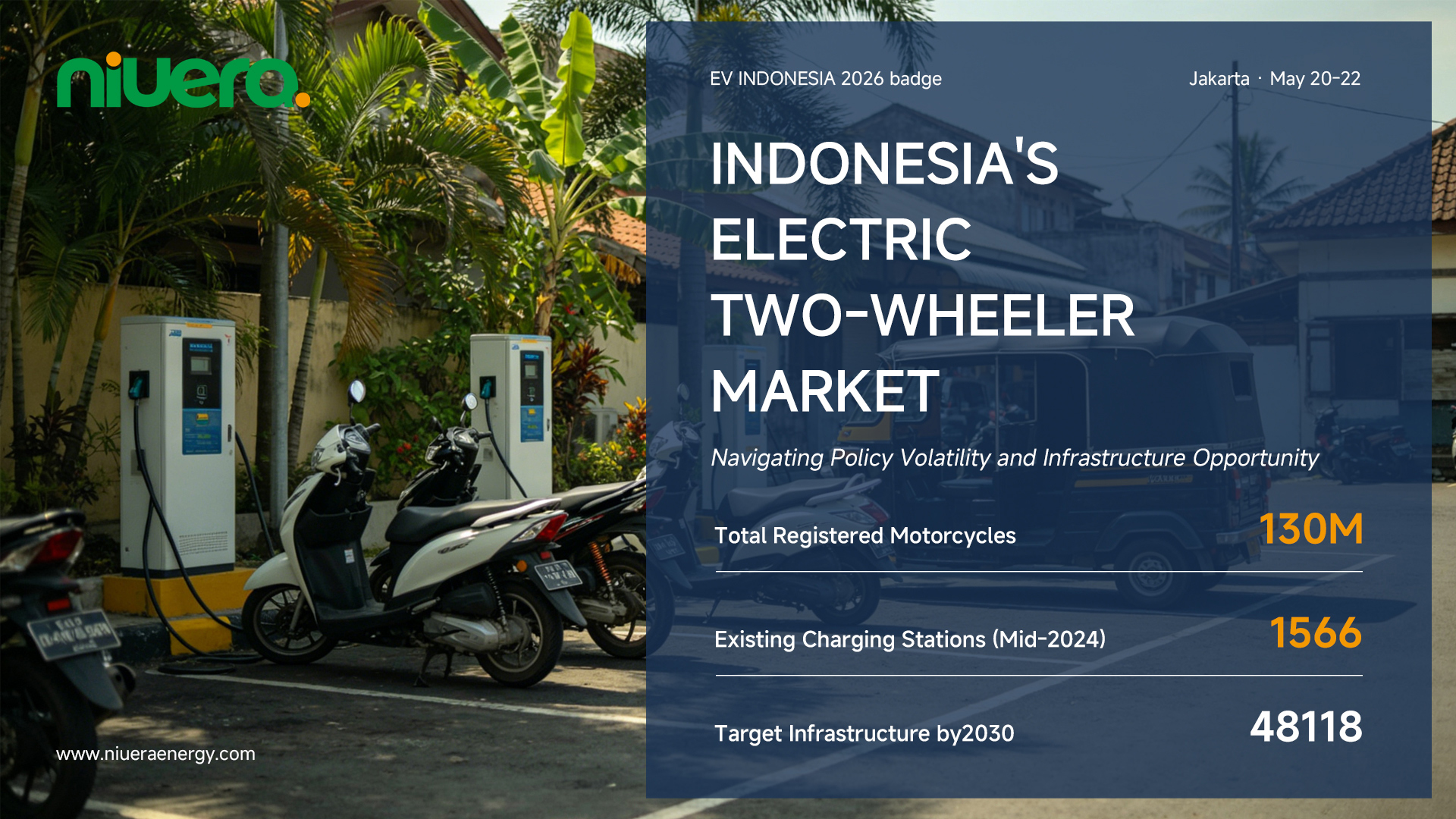
The timing matters. Indonesia has 130 million registered motorcycles — the world's second-largest motorcycle fleet — and an official target of 13 million electric motorcycles on the road by 2030 (part of a total 15 million EV target that also includes 2 million electric cars).[^2] As vehicle adoption is set to re-accelerate, charging infrastructure is the constraint. There are currently approximately 1,566 public charging stations across the entire country (as of mid-2024, the latest available government data), against a government target of 48,118 by 2030.[^3] That gap — a 30-fold increase required in four years — represents one of the largest charging infrastructure build-out imperatives in Southeast Asia.
This article examines what the Indonesian market looks like today, how it arrived here, and what the infrastructure opportunity means for operators and investors.
The Scale of the Market
To understand why Indonesia commands attention in the electric two-wheeler space, start with the numbers.
Annual sales of motorcycles reached over 6 million units in 2024, with over 130 million motorcycles and scooters registered nationwide. In a country of 281 million people spread across 17,000 islands, the motorcycle is not merely a preference — it is the primary mode of motorized transport for the majority of the population. Every major Indonesian city is shaped around two-wheeler mobility in a way that has no equivalent in North American or European transportation patterns.
This context makes Indonesia's electric transition structurally different from most markets. The question is not whether Indonesians will adopt electric two-wheelers; the economic case is clear once the upfront cost gap closes. The question is how fast the policy and infrastructure environment can enable that adoption at scale.
The government aims to reach 2 million electric cars and 13 million electric two-wheelers by 2030 — a combined target of 15 million EVs. Independent scenario analysis suggests, however, that current policies are insufficient to reach this target: one study using system dynamics simulation projects that without more aggressive interventions — including extended subsidies, carbon taxes, and electricity incentives — the 2030 goal would fall well short, potentially achievable only by the early 2030s at best.[^9] The gap between ambition and trajectory is precisely where the policy story of the last 18 months becomes relevant.
The Policy Rollercoaster: A Chronology
Understanding Indonesia's electric motorcycle market today requires a clear-eyed look at the policy history, because that history has directly shaped consumer and investor behavior.
2023 — Subsidies launch, market responds immediately
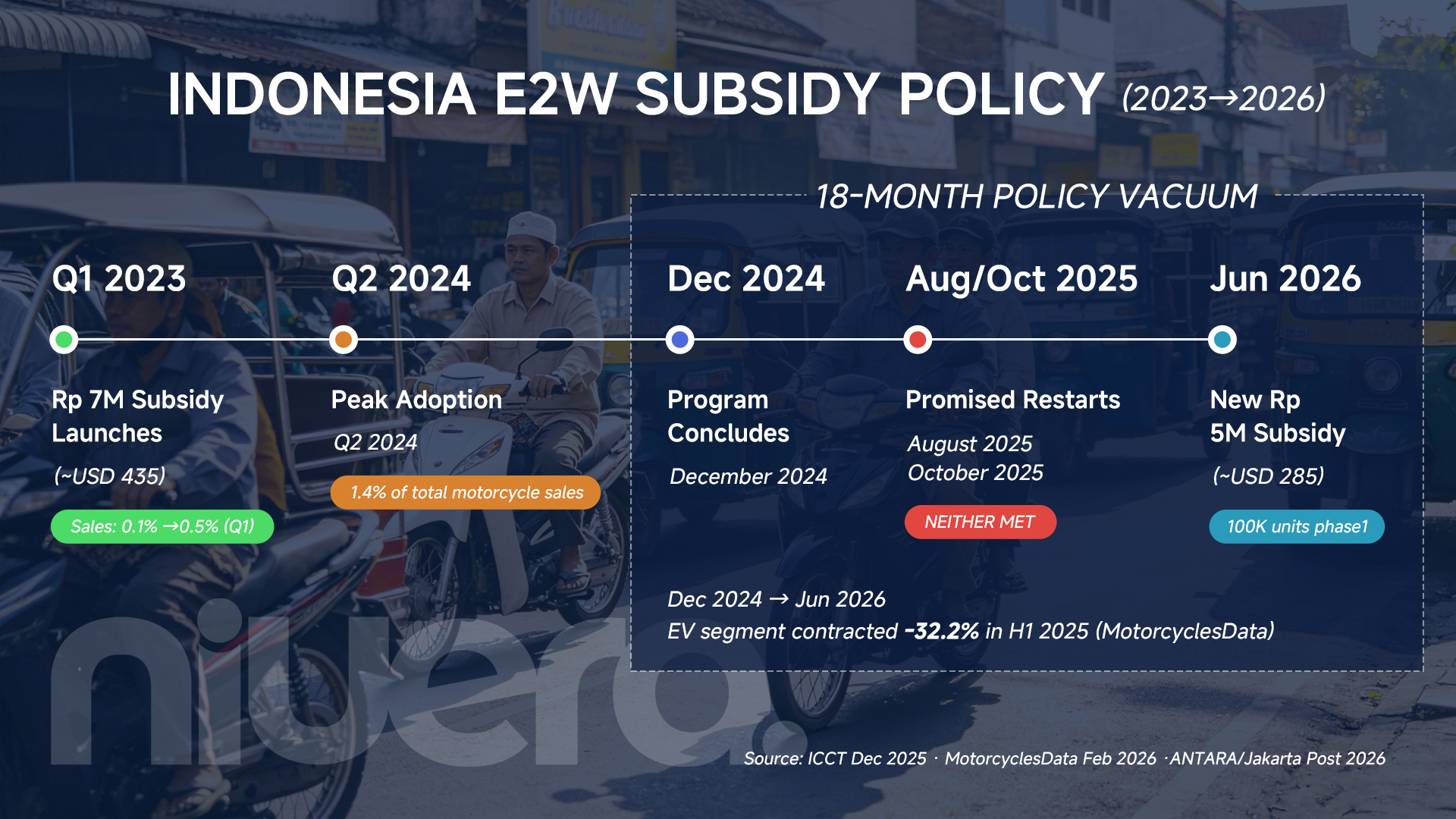
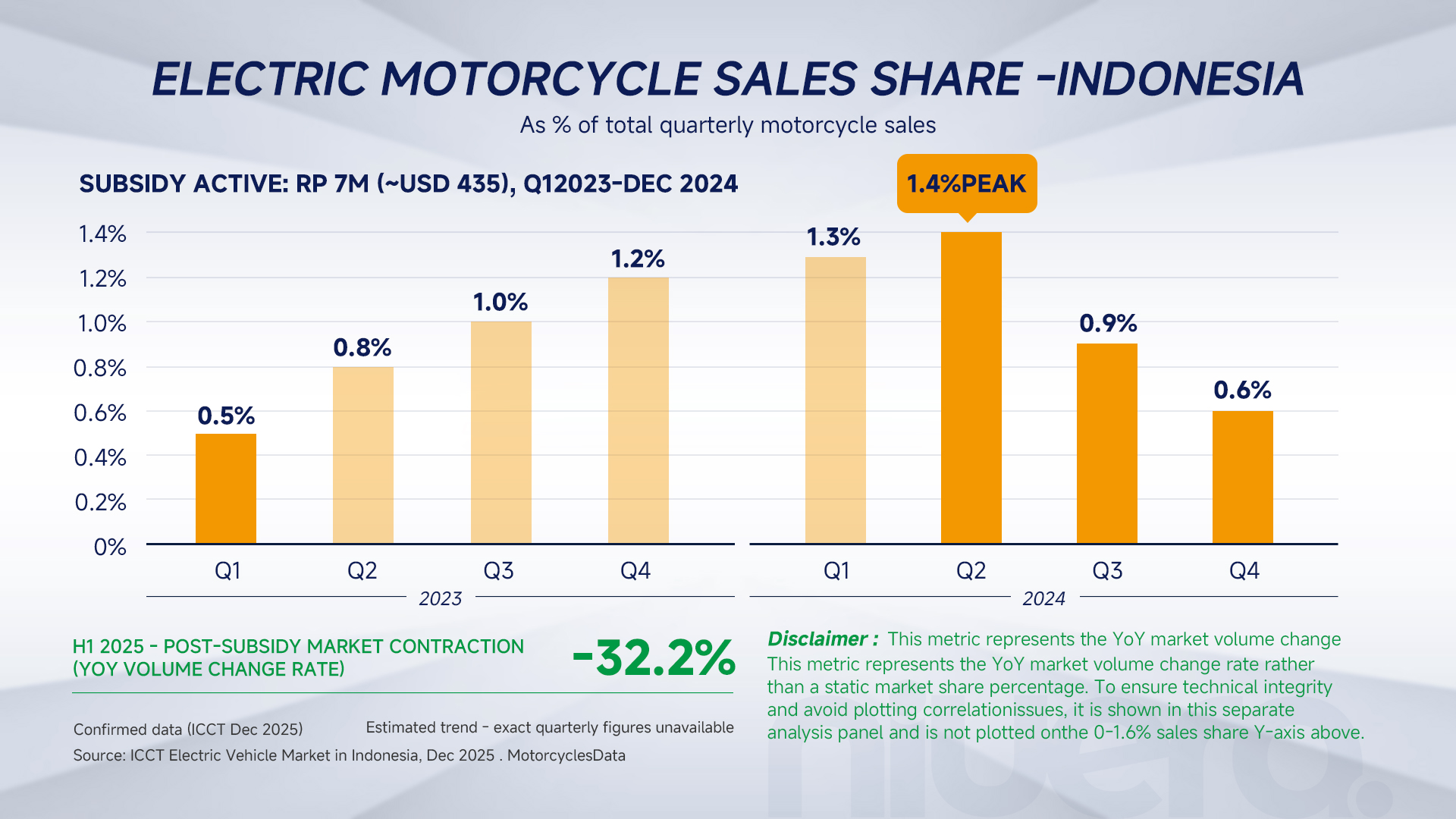
In Q1 2023, the Indonesian government introduced a direct purchase subsidy of Rp 7 million (~USD 435) per electric motorcycle. The policy effect was immediate: a subsidy introduced by the Indonesian Government in Q1 2023 helped to boost electric motorcycle sales from 0.1% to 0.5% in that quarter. Sales momentum built through 2023 and into 2024, as the subsidy made electric motorcycles accessible to price-sensitive buyers for the first time.
2024 — Peak, then decline
In April 2024, the Indonesian government committed USD 455 million to subsidize the purchase of electric motorcycles aiming to cover the purchase of 800,000 new electric motorcycles and the conversion of 200,000 combustion engine motorcycles into electric ones. In Q2 2024, electric motorcycles reached their highest-ever sales share in Indonesia. The share of electric motorcycles peaked in Q2 2024, reaching around 1.4% of total motorcycle sales before falling to 0.9% in Q3 2024 and to 0.6% in Q4 2024.
In 2024 the EV segment grew 62.9%, but starting from a very low level, hitting the 100,000 sales milestone for the first time.
December 2024 — Program concludes
Following the October 2024 elections, the incoming administration chose not to continue the subsidy program. The subsidy concluded at end of December 2024. Despite subsequent public commitments to launch a replacement scheme, authorities cited ongoing "studies" to justify delays, postponing the relaunch first to August and then to October 2025. Neither deadline was met, and no replacement scheme was implemented in the intervening period.
H1 2025 — Market collapse
The consequences were immediate and severe. The market contracted by 32.2% during this period. The Indonesian Electric Motorcycle Industry Association (Aismoli) provided a more granular perspective, reporting that sales of subsidized electric motorcycles plummeted by 30% to 40% year-on-year in the first six months of the year.
The primary catalyst for this market disruption was the prolonged policy vacuum created by the government's decision to halt its direct purchase subsidy program in late 2024. This lack of a clear, active policy prompted a widespread "stop buying" phenomenon among price-sensitive consumers, who chose to delay their purchases while awaiting the program's reinstatement.
The consequences for the industry have been damaging. Manufacturers — particularly EV startups — have incurred substantial losses amid prolonged regulatory uncertainty, while consumers have been left with a clear signal of policy inconsistency.
May 2026 — Subsidy confirmed for June restart
The approximately 18-month gap appears to be closing. The Indonesian government is preparing a new electric vehicle incentive program covering 200,000 units starting in June 2026 to boost demand and reduce fuel consumption. For electric motorcycles, the government confirmed a direct subsidy of Rp 5 million (~USD 285) per unit during the initial phase.
This represents a lower subsidy value than the previous program (Rp 5 million / ~USD 285 vs. Rp 7 million / ~USD 435 previously) but a more focused initial target of 100,000 units. The highest level of tax support will be directed towards vehicles that use nickel-based batteries — a strategic decision tied to Indonesia's position as one of the world's largest nickel producers.
The critical question the industry is asking in Jakarta this week is whether this commitment will hold. Given the history, credibility must be rebuilt through consistent execution rather than announcement.
Why Infrastructure Is the Right Investment Now
The policy volatility described above has understandably made some infrastructure investors cautious. But a careful reading of the situation points to the opposite conclusion: the infrastructure gap is actually the more stable and predictable investment opportunity compared to the vehicle market itself.


Here is the logic:
Infrastructure investment is less sensitive to short-term policy cycles. A charging station installed today serves whatever vehicles are on the road, regardless of whether a subsidy program is active or paused. The 130 million existing combustion motorcycles are not electrifying on any timeline, but the 100,000+ electric motorcycles already sold — plus new units entering the market from June 2026 — need charging infrastructure that does not currently exist at adequate scale.
The infrastructure deficit is structural, not cyclical. Indonesia has established 1,566 charging stations and 1,772 battery swap facilities (as of mid-2024). The government plans to increase these numbers to 48,118 charging stations and 196,179 battery swap units by 2030. This 30-fold expansion in charging infrastructure — required in less than four years — cannot be delivered by top-down government procurement alone. The trajectory of other markets suggests it will require distributed investment from private operators, fleet managers, and small entrepreneurs who see the business case at the station level.
The June 2026 subsidy restart will accelerate vehicle adoption. A new cohort of electric motorcycle buyers will enter the market in H2 2026. Each new vehicle requires access to charging. The operators who have infrastructure ready when this demand materialises will capture early market position.
Java leads and will lead. Java, home to over half of Indonesia's population and its highest concentration of urban residents, is widely regarded as the country's leading EV adoption region, driven by higher income levels and a more developed existing charging network. Jakarta, Surabaya, Bandung, and the broader Java corridor represent the highest-density opportunity for early infrastructure deployment — with geography and income distribution both pointing in the same direction.
What the Market Looks Like from the Ground Up
Understanding which deployment models actually work in Indonesia requires looking beyond national statistics to the operational realities of specific rider segments.
Urban delivery and logistics riders represent the most commercially predictable segment for charging infrastructure operators. Contigo Mobility (CoMo) has been supplying electric two-wheelers and operating battery swapping stations at Lazada Logistics Indonesia hubs since 2024, under an arrangement that also includes converting the platform's existing ICE fleet to electric — an example of the B2B fleet electrification model gaining traction across Indonesia's logistics sector.[^10] Platform-managed fleets have defined charging windows, predictable utilization rates, and a single commercial counterpart for the infrastructure operator — making the business model more legible than public charging.
Daily commuters and small business owners form the largest potential volume. The 4 kWh battery tier — the most popular model category, claiming ranges of 120 kilometres or more, making it suitable for daily commuting needs and occasional longer trips — is precisely the segment that benefits most from convenient, affordable public charging. An operator running a kiosk-adjacent charging point in a high-footfall urban location can serve this segment with 3.6 kW charging, which replenishes a standard 72V battery in a commercially viable session time.
Informal transport operators — ojek (motorcycle taxi) drivers who have not yet converted to app-based platforms — represent a segment that has been slower to electrify but whose economics would benefit significantly from lower operating costs. The infrastructure model that serves this segment is the community hub: a small cluster of 4–8 charging outlets serving a neighborhood where informal motorcycle taxi operations concentrate.
Industrial and logistics parks on Java's north coast corridor and around Jakarta's industrial satellite cities are an emerging B2B opportunity. Yadea's announced production investment in Indonesia signals that domestic manufacturing capacity is scaling. Factories and parks with fleets of electric utility vehicles and motorcycles will need depot charging infrastructure at a scale that individual public stations cannot serve.
The Technical Requirements Indonesia's Market Places on Charging Hardware
The Indonesian deployment environment places specific requirements on charging hardware that are worth making explicit, because not all charging solutions designed for other markets transfer effectively.
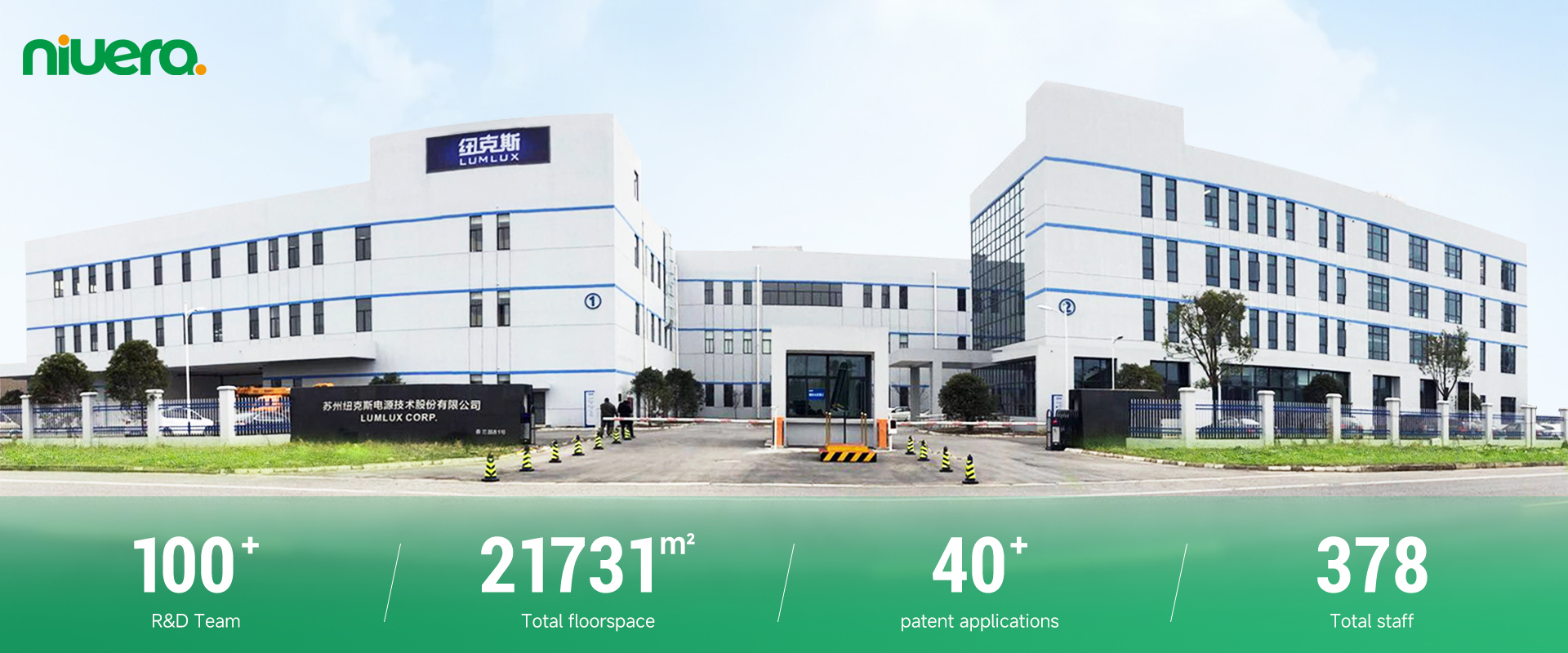
About Niuera Energy Suzhou Niuera Energy Co., Ltd. designs and manufactures EV charging modules and infrastructure solutions for global markets. Niuera participated in EV Indonesia 2026 (Jakarta, May 20–22, 2026). The company's electric motorcycle and low-voltage vehicle fast charging station line — formally launched at the 139th Canton Fair in April 2026 — includes four models (G1K-36-S/T6, G1K-72-D/T6, L2K-66-S/T6, L2K-132-D/T6) suited to the full range of commercial deployment contexts described in this article, alongside photovoltaic DC charging and distributed depot charging solutions.
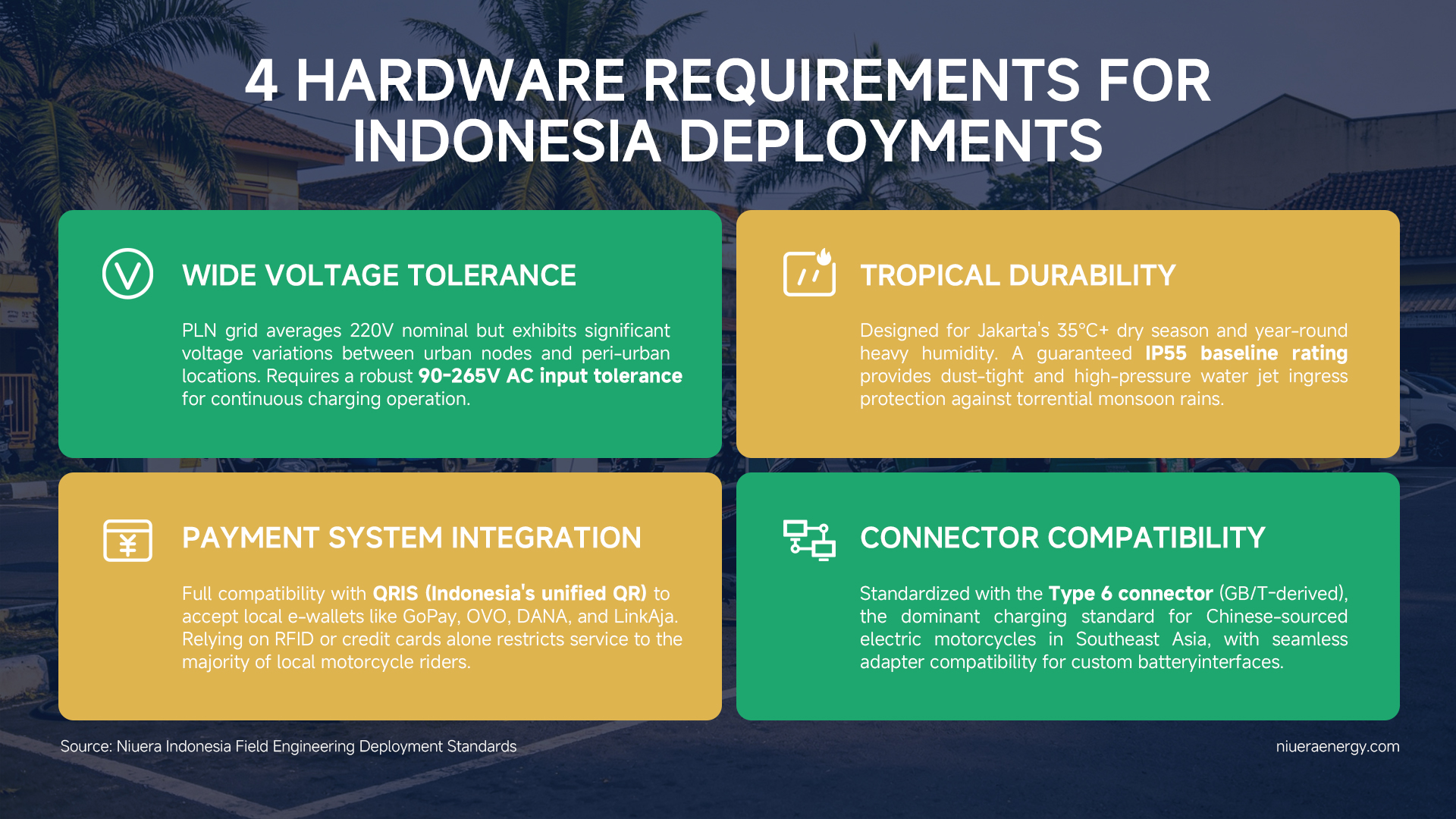
Grid voltage variability. PLN (Indonesia's state electricity utility) supplies at nominally 220V, but voltage stability varies significantly between urban and peri-urban locations. Hardware with wide input voltage tolerance — accepting 90–265V AC on single-phase supplies — operates reliably across the range of supply quality encountered in real deployment locations, without requiring external voltage conditioning.
Tropical climate durability. Jakarta averages 35°C+ in the dry season; humidity is consistently high year-round. Hardware rated to IP55 provides full dust protection and water jet resistance appropriate for outdoor installations in these conditions. The combination of high temperature and high humidity is the most demanding thermal environment for air-cooled charging equipment, and products not designed for this combination degrade more rapidly in field conditions than laboratory specifications suggest.
Payment system integration. GoPay and OVO are the dominant mobile payment platforms in urban Indonesia, with significant market share also held by DANA and LinkAja. A charging station that accepts only credit cards or proprietary RFID is functionally inaccessible to the majority of urban riders. QR code payment support — either through QRIS (Indonesia's unified QR standard) or the major platform wallets — is a deployment requirement, not an enhancement.
Connector compatibility. The Indonesian electric motorcycle market uses Type 6 connectors (GB/T-derived, common in Chinese-manufactured vehicles entering SEA markets) alongside various proprietary charging interfaces. Hardware supporting Type 6 with compatibility for mainstream adapter types covers the preponderance of vehicles currently operating in the market.
The Infrastructure Build-Out: A Practical Deployment Framework
For operators considering infrastructure investment in Indonesia, the following framework maps deployment context to practical hardware requirements.
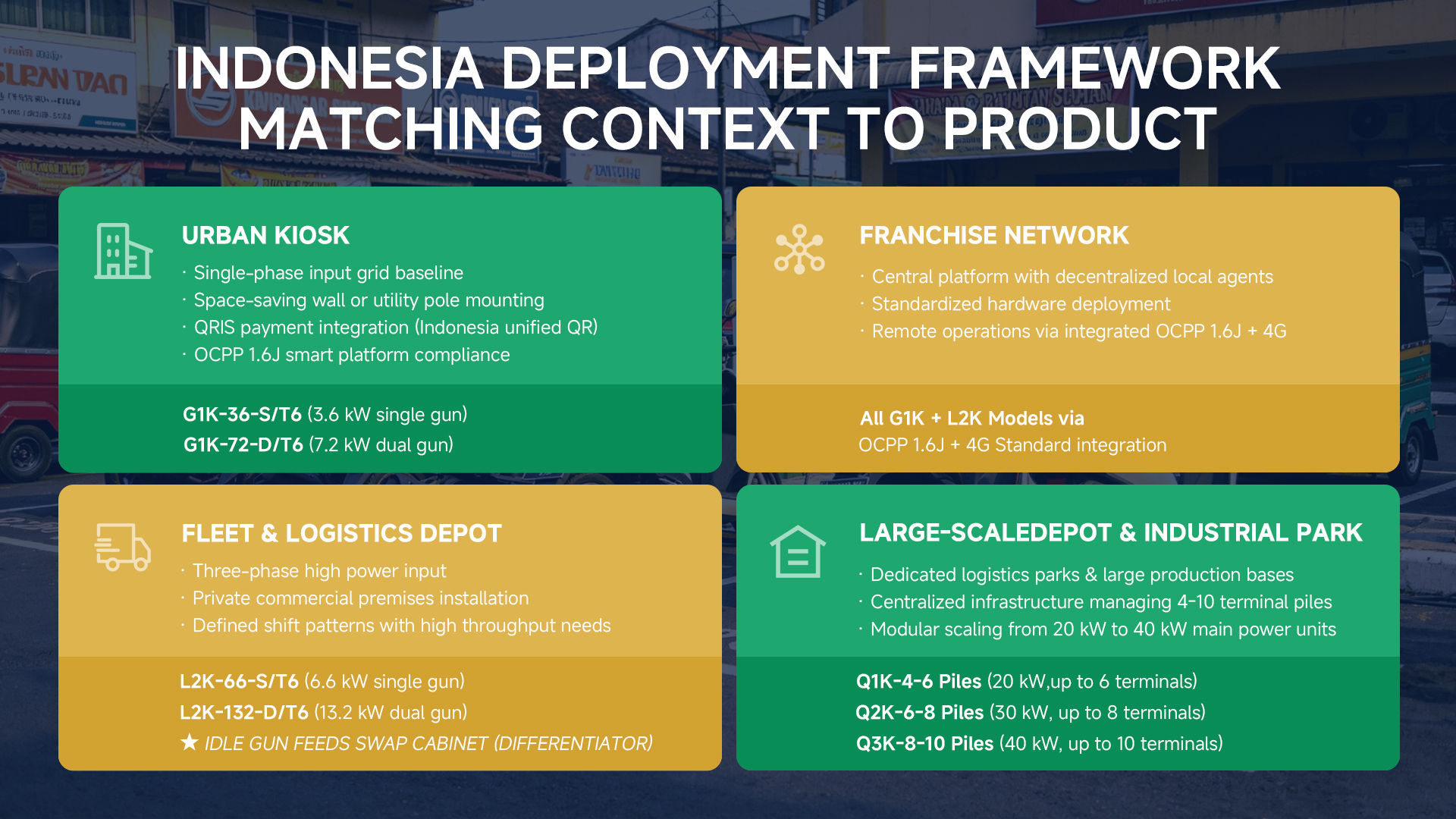
Urban kiosk deployment (3.6 kW / 7.2 kW) The most accessible entry point. A single-phase electrical connection — available at virtually any commercial premises — supports a 3.6 kW or 7.2 kW charging station. The G1K-36-S/T6 (single gun) or G1K-72-D/T6 (dual gun) fits this context: compact cabinet form factor suitable for wall or pole mounting alongside an existing business, multi-language touchscreen, QRIS-compatible payment integration, and OCPP 1.6J remote monitoring. A dual-gun station serving 8–12 sessions per outlet per day at this power level generates meaningful incremental revenue for an operator whose primary business is retail or food service.
Fleet and logistics depot charging (6.6 kW / 13.2 kW) Platform-managed delivery fleets operate on defined shift patterns that create predictable charging demand. The L2K-66-S/T6 (6.6 kW single gun) reduces per-session charge time for higher-capacity batteries, increasing throughput at fixed capital cost. The L2K-132-D/T6 (13.2 kW dual gun) serves simultaneous multi-vehicle charging at depot locations and includes the capability to supply a battery swap cabinet from an idle gun — relevant for operators running hybrid charging and swapping operations. Three-phase supply (320–480 VAC) is typically available at commercial industrial premises where depot charging is deployed.
Multi-site network or franchise deployment (all models) The combination of OCPP 1.6J, 4G/Ethernet connectivity, and QRIS payment integration across the G1K and L2K product lines supports the franchise-style deployment model gaining traction in Indonesian cities: a central platform provider supports local agents who own and operate individual stations. Standardized hardware simplifies the operational model and training requirements for agents who are not technical specialists.
Large-scale depot and industrial (Distributed Charging Pile) For logistics parks, EV production facilities, and institutional buyers deploying charging at scale, the Q-series Distributed Charging Pile (20–40 kW main unit, 4–10 terminal piles) provides centralized power management with intelligent load scheduling across multiple simultaneous charging points. This product is relevant for Indonesia's growing industrial EV ecosystem — including Yadea's manufacturing investment and associated fleet operations.
Looking Forward: What H2 2026 and Beyond Holds
The Indonesian market in the second half of 2026 will be shaped by three converging dynamics:
Subsidy implementation quality. The Rp 5 million subsidy announced for June 2026 is less generous than the previous Rp 7 million program, but its effectiveness will depend far more on implementation consistency than on the subsidy value itself. Analysts have cautioned that without sustained incentives, adoption rates may slow, particularly among middle income consumers who are sensitive to upfront costs. If the June 2026 program launches on schedule and operates without the bureaucratic friction that plagued earlier iterations, the market response should be measurable within two to three months.
Domestic manufacturing scale-up. Yadea's Indonesian production investment, combined with domestic manufacturers including Alva, Polytron, and Electrum scaling production, should reduce the price gap between electric and ICE motorcycles through local content cost advantages and TKDN compliance for incentive eligibility. More affordable, locally produced vehicles lower the effective subsidy requirement per unit.
Infrastructure as the binding constraint. As vehicle adoption re-accelerates, the infrastructure gap — currently 1,566 stations as of mid-2024 against a 48,118 target — will become increasingly visible as a constraint on rider adoption decisions. Range anxiety and charging access are already cited by Indonesian consumers as adoption barriers alongside price. Infrastructure operators who are positioned before the next demand wave, rather than after it, capture better location economics and first-mover network advantages.
The trajectory of other high-density two-wheeler markets — Vietnam, India, Kenya — suggests that once a credible policy foundation is in place, infrastructure investment follows rapidly from private operators who see the unit economics. Indonesia's foundation has been unstable for approximately 18 months. The June 2026 subsidy commitment is the clearest signal yet that it is stabilising.
Conclusion
Indonesia's electric two-wheeler market has spent approximately 18 months demonstrating what happens when policy support disappears abruptly: vehicle sales collapse, manufacturers incur losses, and consumer confidence erodes. It has also demonstrated, in the 2023–2024 period, what happens when a coherent subsidy is in place: adoption accelerates meaningfully even from a low base.
With the Rp 5 million subsidy program confirmed for June 2026, a returning demand signal is emerging. The infrastructure, however, is not building itself. The gap between 1,566 current charging stations (as of mid-2024) and 48,118 required by 2030 is an opportunity that requires private operators, fleet managers, and infrastructure investors to act — and to act before the demand wave, not after it.
For operators considering Indonesia, the entry economics are accessible, the market context is improving, and the competitive landscape for charging infrastructure remains wide open. The conversations happening this week at EV Indonesia 2026 in Jakarta are the beginning of that build-out, not the end.
Request a product specification for Indonesia-compatible charging stations → Contact Niuera's Southeast Asia business development team → Download our Indonesia market deployment guide →
Frequently Asked Questions
Q: What is the current status of Indonesia's electric motorcycle subsidy as of May 2026?
The previous subsidy program (Rp 7 million per unit) concluded in December 2024 following the October 2024 elections, with the incoming administration choosing not to continue it. Government commitments to launch a replacement program in August 2025 and October 2025 were not fulfilled. In May 2026, Finance Minister Purbaya Yudhi Sadewa confirmed that a new subsidy program will launch in June 2026, providing Rp 5 million per electric motorcycle in an initial phase covering 100,000 units.[^1] The program is still being finalised with the Ministry of Industry, and implementation details — including eligible models, TKDN requirements, and disbursement mechanisms — are subject to final confirmation.
Q: What connector types and payment systems are required for Indonesia deployments?
Type 6 connectors (widely used in Chinese-manufactured electric two-wheelers entering Southeast Asian markets) are the most prevalent interface in Indonesia's current electric motorcycle fleet, alongside various proprietary charging ports used by domestic manufacturers. For payment systems, QRIS (Indonesia's unified QR code standard, which encompasses GoPay, OVO, DANA, and LinkAja) is the most practical integration for public charging infrastructure. RFID card support is useful for fleet and B2B deployment contexts.
Q: How does the 2026 subsidy compare to the 2023–2024 program?
The new Rp 5 million (~USD 285) subsidy is lower in value than the Rp 7 million (~USD 435) provided under the previous program. The initial phase covers 100,000 electric motorcycle units, with government statements suggesting the program could expand beyond this initial quota if demand is strong. The previous program's structure required buyers to meet specific income eligibility criteria (KUR, BPUM recipients, wage subsidy and electricity subsidy beneficiaries); details on the 2026 program's eligibility framework are pending confirmation from the Ministry of Industry.
Q: What certification is required to sell charging hardware in Indonesia?
Charging equipment for the Indonesian market requires SNI (Standar Nasional Indonesia) certification from BSN (Badan Standardisasi Nasional — the National Standardization Agency). CE marking is widely accepted by institutional and fleet buyers as a quality signal even where it is not mandatory. Products that also carry IEC 61851-25 certification (the international standard specifically applicable to EV DC charging equipment for light electric vehicles) meet the technical baseline referenced in Indonesian regulatory frameworks. Operators planning commercial deployment should confirm current certification requirements with local regulatory counsel, as the framework is evolving alongside the market.
References
[^1]: Indonesia Business Post. Indonesia prepares new EV tax incentives and motorcycle subsidies starting June 2026. May 2026. //indonesiabusinesspost.com/6597/energy-and-resources/indonesia-prepares-new-ev-tax-incentives-and-motorcycle-subsidies-starting-june-2026
[^2]: ICCT. Electric Vehicle Market in Indonesia. December 2025. //theicct.org/publication/electric-vehicle-market-in-indonesia-dec25/
[^3]: Business Indonesia / Ministry of Energy and Mineral Resources. Indonesia allocates USD 455 million for electric motorcycle subsidy. 2024. //business-indonesia.org/news/indonesia-allocates-us-455-million-for-electric-motorcycle-subsidy
[^4]: MotorcyclesData.com. Indonesia Electric Motorcycles — Facts & Data 2026. February 2026. //www.motorcyclesdata.com/2026/01/04/indonesia-electric-motorcycles/
[^5]: The Jakarta Post. Sales slump slows electric motorcycle production. August 19, 2025. //www.thejakartapost.com/business/2025/08/19/sales-slump-slows-electric-motorcycle-production.html
[^6]: ANTARA News. Minister proposes electric motorcycles incentive starting 2026. April 24, 2026. //en.antaranews.com/news/413589/minister-proposes-electric-motorcycles-incentive-starting-2026
[^7]: iMotorbike News. Indonesia EV Incentives Launch 2026. May 2026. //news.imotorbike.com/en/2026/05/indonesia-vat-ev-incentive
[^8]: Livingwithgravity.com. Indonesia New EV Motorcycle Sales Plummeted 30–40% in H1 2025: Why? August 20, 2025. //livingwithgravity.com/indonesia-new-ev-motorcycle-sales-plummeted-30-40-in-h1-2025-why/
[^9]: ScienceDirect / Sustainable Futures. Scenario analysis of subsidy policies on electric motorcycle market in Indonesia using system dynamics simulation. June 2025. //www.sciencedirect.com/science/article/pii/S2590198225001666
[^10]: The Jakarta Post. CoMo, Lazada Logistics partner up to drive sustainable mobility solutions. August 5, 2024. //www.thejakartapost.com/adv/2024/08/05/como-lazada-logistics-partner-up-to-drive-sustainable-mobility-solutions.html
All market data cited from third-party sources as referenced. Product specifications are sourced from Niuera Energy product documentation. Nothing in this article constitutes investment advice or a guarantee of market performance.
About Niuera Energy Suzhou Niuera Energy Co., Ltd. designs and manufactures EV charging modules and infrastructure solutions for global markets. Niuera participated in EV Indonesia 2026 (Jakarta, May 20–22, 2026). The company's electric motorcycle and low-voltage vehicle fast charging station line — formally launched at the 139th Canton Fair in April 2026 — includes four models (G1K-36-S/T6, G1K-72-D/T6, L2K-66-S/T6, L2K-132-D/T6) suited to the full range of commercial deployment contexts described in this article, alongside photovoltaic DC charging and distributed depot charging solutions.
www.niueraenergy.com | info@niuera.cn | +86-512-68303879
Published May 26, 2026.
Trade Barriers and Local Assembly: How Tariff Shifts in 2026 Are Changing EV Charging Economics
Thermal Management in EV Charging Modules: Maintaining Peak Performance in Extreme Climates
Related blog