EV Charging Infrastructure 2026: Market Trends and Technology Evolution
The electric vehicle revolution is accelerating at an unprecedented pace. In 2024, global EV sales surpassed 17 million units—a historic milestone representing 20% of all new car sales worldwide for the first time. Looking toward 2026, the International Energy Agency (IEA) projects EV sales will exceed 20 million units, with electric vehicles accounting for one in every four new cars sold globally. This remarkable growth is fundamentally reshaping the charging infrastructure landscape, driving technological innovation, and creating new market opportunities.
For charging infrastructure providers, equipment manufacturers, and industry stakeholders, 2026 represents a pivotal year. Emerging technologies are maturing, new standards are gaining traction, and business models are evolving to meet the demands of an increasingly electrified transportation system. This article examines five critical trends that will define the EV charging infrastructure landscape in 2026 and beyond.
Global Market Overview: Sustained Growth Amid Regional Variations
Market Scale and Trajectory
The global charging infrastructure market continues its robust expansion. According to market research from 2024, the EV charging equipment market reached approximately $35-44 billion, with projections indicating growth to $125-200 billion by 2030—representing a compound annual growth rate (CAGR) of 22-27%. This growth trajectory reflects not just increasing EV adoption, but also the shift toward higher-powered charging solutions and smart infrastructure deployment.
Public charging infrastructure has doubled over the past two years to keep pace with EV sales growth. However, significant regional disparities persist. China and the European Union have maintained steady charger deployment relative to their EV fleets, while the United States and United Kingdom face challenges in scaling public charging infrastructure quickly enough to meet growing demand.
Regional Market Dynamics
China continues to dominate both EV sales and charging infrastructure deployment. In 2024, electric vehicles accounted for nearly half of all car sales in China—over 11 million units, equivalent to total global EV sales in 2022. The country's charging network has expanded proportionately, with both public and private infrastructure supporting this massive fleet.
Europe experienced market stagnation in 2024, with EV sales maintaining approximately 20% market share but showing limited growth in several major markets, including Germany and France. This plateau was largely attributed to the phase-out of subsidies and the design of EU CO2 standards, which set targets at five-year intervals rather than annually. However, 2025 brings stricter emissions standards expected to push EV sales share to 25% in Europe, with projections reaching 60% by 2030.
The United Kingdom stands out as a European success story, achieving nearly 30% EV sales share in 2024—up from 24% in 2023—driven by the Vehicle Emissions Trading Scheme, which requires 22% of new registrations to be battery electric or fuel cell electric vehicles.
The United States saw EV sales grow approximately 10% year-over-year in 2024, though growth has been more modest than in other major markets. The National Electric Vehicle Infrastructure (NEVI) program, which allocates $5 billion for charging infrastructure development, is beginning to show results, although deployment has been slower than anticipated.
Emerging markets present the most dynamic growth story. Southeast Asia, Latin America, and parts of Africa saw EV sales surge by more than 60% in 2024. In Thailand, EV sales share reached 9%, while Brazil saw sales more than double to 125,000 units. These markets are becoming increasingly important for global charging infrastructure deployment, with Chinese manufacturers and charging equipment providers leading the expansion.

Policy Landscape
Government policies remain the primary driver of EV adoption and charging infrastructure development:
European Union: The Alternative Fuels Infrastructure Regulation (AFIR) requires member states to ensure fast-charging stations with at least 150kW capacity every 60 kilometers along major highways by 2025, increasing to every 60 kilometers by 2030.
United States: The NEVI program allocates $5 billion specifically for EV charging infrastructure along designated Alternative Fuel Corridors, with requirements for stations to offer at least four 150kW DC fast charging ports.
China: The country's 14th Five-Year Plan continues to prioritize charging infrastructure development, targeting complete coverage of urban areas and major highways by 2030, with emphasis on intelligent, interconnected charging networks.

Five Critical Technology Trends Shaping 2026

Trend 1: Ultra-Fast Charging and the Rise of Megawatt Systems
The charging power race continues. Ultra-fast chargers—defined as those delivering 150kW or above—grew by approximately 50% in 2024 and now account for nearly 10% of all public fast chargers globally. This trend is accelerating as automakers and charging providers race to deliver charging experiences that rival the convenience of traditional refueling.
For light-duty vehicles, 350kW charging systems are becoming standard for new highway corridor installations. These systems can add 200-300 kilometers of range in 10-15 minutes, addressing range anxiety and making long-distance EV travel increasingly practical.

Technical Challenges: Implementing these extreme power levels presents significant engineering challenges. Cable and connector thermal management becomes critical—a 1MW charging cable can carry currents exceeding 1,000 amperes. Cooling systems, whether liquid-cooled cables or advanced air-cooling designs, must prevent overheating while maintaining safety and user-friendliness.
Grid integration represents another challenge. A single MCS charging station could draw more power than a small neighborhood. This requires coordination with utility providers, potential battery energy storage systems to buffer demand, and sophisticated power management systems.
2026 Outlook: While widespread MCS deployment remains several years away, 2026 will see pilot installations and field testing expand significantly. Major truck manufacturers, including Daimler, Volvo, and BYD, are aligning their next-generation electric trucks with MCS capabilities. For light-duty charging, 350-400kW systems will become commonplace at highway stations in developed markets.
Trend 2: High-Voltage Architectures Become Mainstream
The industry's transition from 400V to 800V electrical architectures represents one of the most significant technical shifts in EV development. Pioneered by Porsche's Taycan in 2019, 800V systems are now being adopted by Hyundai's E-GMP platform, BYD's e-platform 3.0, and increasingly by other manufacturers.
Technical Advantages: Higher-voltage systems offer multiple benefits:
- Faster charging: An 800V vehicle can charge at the same power level with half the current compared to 400V, reducing heat generation and improving efficiency
- Reduced weight: Lower currents allow thinner, lighter cables throughout the vehicle
- Better efficiency: Lower resistive losses in power transmission improve overall vehicle efficiency
- Thermal management: Reduced heat generation simplifies cooling system requirements
For charging infrastructure, supporting 800V vehicles requires modules capable of delivering higher voltages while maintaining efficiency. Modern charging modules must support wide voltage ranges—typically 200-1000V—to accommodate both legacy 400V vehicles and new 800V platforms without requiring separate charging stations.
Looking further ahead, some commercial vehicle platforms are adopting 1000V+ systems, pushing the boundaries of current power electronics capabilities.
Market Penetration: Industry analysts project that 800V platforms will account for approximately 30% of new vehicle sales by 2026, rising to 50% by 2028. Premium and performance segments are leading adoption, but the technology is rapidly moving downmarket as cost premiums decrease.
Infrastructure Implications: Charging equipment must evolve to maximize the benefits of high-voltage architectures. This requires power modules with:
- Broad voltage range support (200-1000V minimum)
- Dynamic voltage adjustment capabilities
- Maintained high efficiency (97%+) across the full voltage spectrum
- Backward compatibility with 400V vehicles
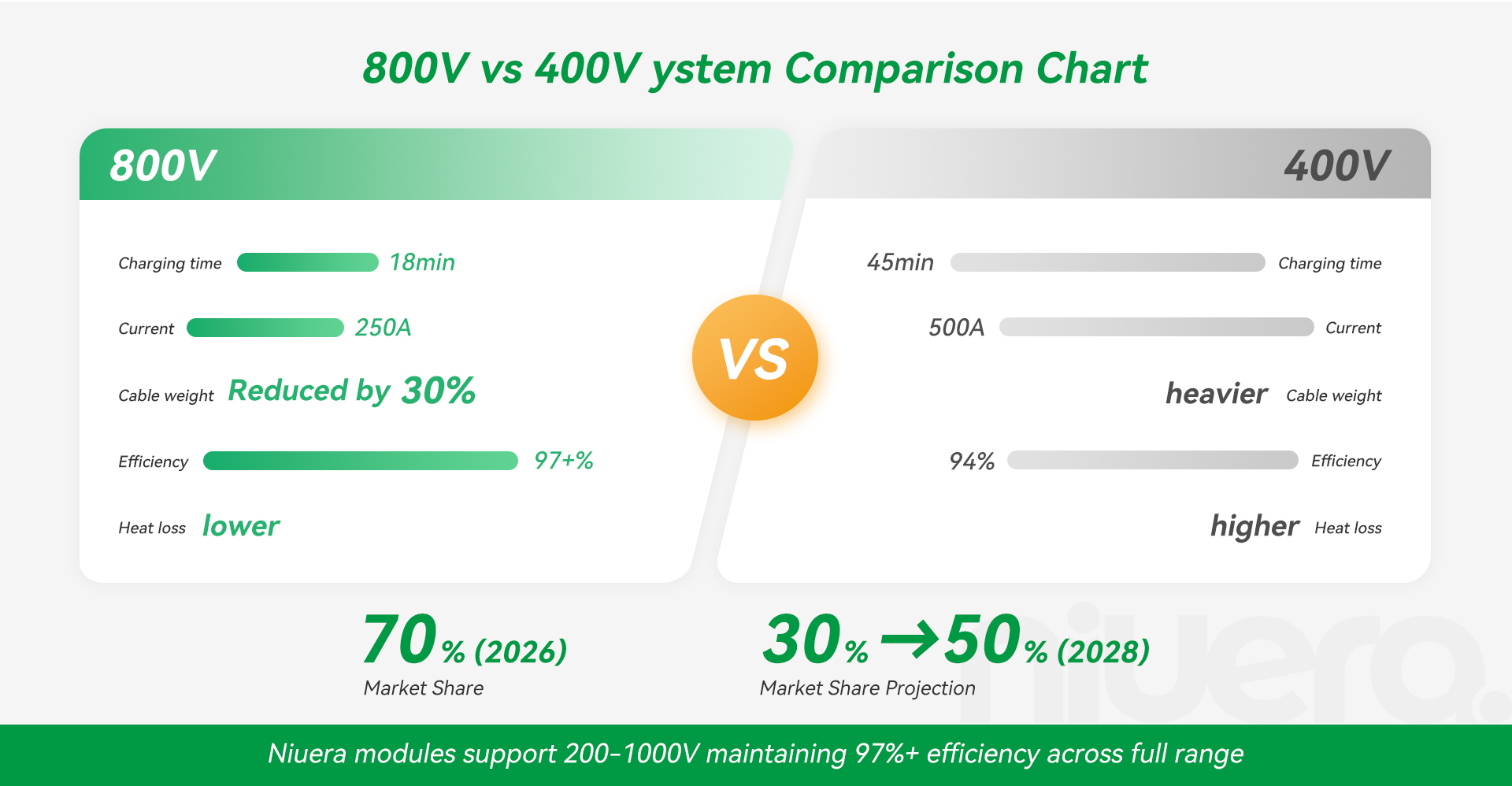
Companies like Niuera have designed their charging module portfolios to address this requirement, with products supporting the full 200-1000V range while maintaining 97%+ efficiency across all voltage levels.
Trend 3: Vehicle-to-Grid (V2G) Transitions from Concept to Reality
Bidirectional charging technology—enabling electric vehicles to not only draw power from the grid but also supply power back—has long been discussed as a theoretical capability. In 2026, V2G is finally entering practical deployment at meaningful scale.
Technology Maturity: All major charging standards now support bidirectional power flow. CHAdeMO was the first to implement V2G, followed by GB/T and more recently CCS. On the vehicle side, an increasing number of models support bidirectional charging, including the Hyundai Ioniq 5 and 6, Kia EV6, Ford F-150 Lightning, and various Chinese EV models.
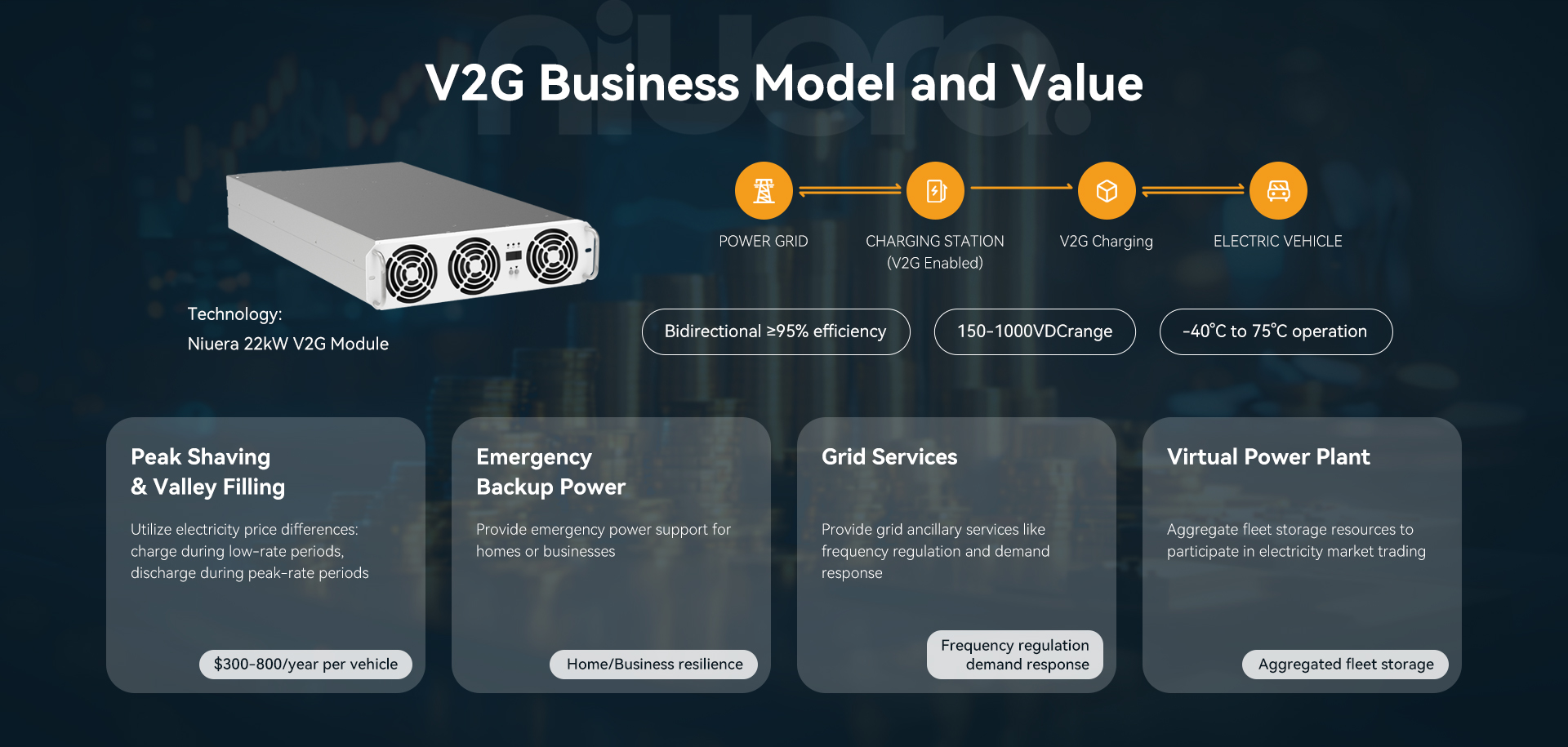
Business Models and Applications:
The economics of V2G are becoming increasingly compelling:
- Peak shaving and valley filling: Vehicle owners can charge during off-peak hours when electricity is cheap and discharge during peak hours when prices are high, earning $300-800 annually depending on regional electricity markets
- Emergency backup: EVs can serve as backup power sources for homes or businesses during grid outages
- Grid services: Aggregated EV fleets can participate in frequency regulation and demand response programs, providing valuable grid stability services
- Virtual power plants: Large fleets of EVs can be aggregated to function as distributed energy storage, compensating for the intermittency of renewable energy sources
Challenges: Several hurdles remain:
- Battery degradation concerns: Though research shows minimal impact (<5% additional degradation) with proper management
- Regulatory frameworks: Many markets lack clear regulations governing V2G operations and compensation
- Standardization: Interoperability between different vehicles, chargers, and grid management systems needs improvement
- Consumer awareness: Most EV owners are unaware of V2G capabilities and benefits
2026 Trajectory: The UK and China lead in V2G deployment, with hundreds of pilot projects and increasingly supportive regulatory frameworks. Europe is following with trials in the Netherlands, Denmark, and Germany. By 2026, V2G is expected to transition from pilot projects to commercial deployments in progressive markets, with thousands of installations enabling vehicle owners to monetize their battery assets.
Trend 4: Smart Charging and Deep Grid Integration
The evolution from "dumb" charging—simply plugging in and drawing maximum power—to intelligent, grid-integrated charging represents a fundamental shift in how we think about EV charging infrastructure.
Technology Enablers:
Modern smart charging systems leverage several key technologies:
- ISO 15118: This standard enables Plug & Charge functionality, allowing automatic authentication and payment without user interaction, while also facilitating sophisticated communication between vehicle and charging station
- OCPP 2.0.1: The Open Charge Point Protocol provides standardized communication between charging stations and back-end management systems, enabling remote control and monitoring
- AI and machine learning: Advanced algorithms optimize charging schedules based on electricity prices, grid conditions, renewable energy availability, and user preferences
- Edge computing: Local processing capabilities enable real-time decision-making without constant cloud connectivity

Grid Services and Benefits:
Smart charging enables multiple value streams:
- Load management: Dynamically adjusting charging power based on grid capacity prevents overloads and reduces need for grid infrastructure upgrades
- Demand response: Charging stations can reduce or pause charging during grid stress events, earning payments for providing this flexibility
- Renewable integration: Scheduling charging to align with solar and wind generation maximizes renewable energy utilization
- Price optimization: Automatically shifting charging to low-price periods reduces costs for users while flattening grid demand profiles
Real-World Implementation:
California's Smart Charging initiative offers time-variant electricity rates that encourage off-peak charging. European utilities are implementing similar programs, with some offering discounts of 30-50% for participating in smart charging programs.
In China, major charging networks are integrating with grid operators to provide coordinated charging management across thousands of stations, optimizing both user experience and grid stability.
2026 Expectations: By 2026, an estimated 50% of newly installed public charging stations will have smart charging capabilities as standard. The combination of V2G technology with smart charging will create bidirectional, grid-responsive charging ecosystems that benefit users, grid operators, and society through reduced infrastructure costs and better renewable energy integration.
Trend 5: Localized Manufacturing and Supply Chain Restructuring
The global charging infrastructure supply chain is undergoing fundamental restructuring, driven by geopolitical tensions, trade policies, and the need for supply chain resilience.
Driving Forces:
Several factors are accelerating this shift:
- Trade barriers: Tariffs on imported charging equipment in the US (under the Infrastructure Investment and Jobs Act) and Europe (various national measures) favor domestic production
- Local content requirements: Many countries require minimum local content percentages for subsidized or government-procured charging infrastructure
- Supply chain resilience: The COVID-19 pandemic exposed vulnerabilities in global supply chains, driving demand for regional manufacturing capabilities
- Delivery speed: Local production dramatically reduces lead times, enabling faster project deployment
Emerging Manufacturing Models:
Rather than building complete manufacturing facilities in every market, a more flexible approach is emerging:
Semi-Knocked Down (SKD) and Completely Knocked Down (CKD) solutions enable manufacturers to establish local assembly operations without massive capital investment. In this model:
- Core power modules and sophisticated components are manufactured centrally where expertise and economies of scale exist
- These components are exported as kits
- Local assembly facilities complete final assembly, testing, and customization
- This approach reduces tariffs (since components often face lower duties than finished goods), cuts logistics costs, and enables faster delivery while maintaining quality standards
Service providers offering comprehensive SKD/CKD solutions—including product design, component procurement, assembly process documentation, and training—enable charging providers and OEMs to quickly establish local production capabilities in target markets.
Regional Developments:
- North America: "Made in USA" requirements under NEVI are pushing manufacturers to establish US production. Several major charging equipment providers have announced new US factories or assembly facilities
- Europe: Similar pressures exist, with emphasis on European manufacturing to qualify for various incentive programs
- Southeast Asia: Thailand, Vietnam, and Indonesia are emerging as regional manufacturing hubs, serving both domestic markets and exports to neighboring countries
- Latin America: Brazil and Mexico are developing local charging equipment industries, initially focused on assembly but increasingly on component manufacturing
Economic Impact: Companies successfully implementing local manufacturing strategies report:
- 20-40% reduction in landed costs through tariff savings and lower logistics expenses
- Lead time reductions from 120+ days to 45-60 days
- Better responsiveness to local market requirements and standards
- Enhanced service and support capabilities
2026 Forecast: By 2026, an estimated 30% of charging equipment will be produced through localized manufacturing models, with this percentage growing rapidly. Regional supply chain ecosystems will increasingly replace the current model of centralized manufacturing in China with global exports.
Technical Challenges and Solution Pathways
Grid Capacity Constraints
As EV adoption accelerates and charging power levels increase, grid capacity becomes a critical bottleneck, particularly for urban fast charging installations.
Solutions emerging:
- Battery Energy Storage Systems (BESS): Co-locating battery storage with charging stations buffers peak demand, reduces grid connection costs, and enables charging station operation even where grid capacity is limited
- Dynamic load management: Intelligent systems distribute available power across multiple charging points based on real-time demand and grid conditions
- Renewable energy integration: On-site solar and wind generation, paired with storage, reduces grid dependence
- Vehicle-to-Grid integration: As discussed earlier, V2G can help balance grid loads
Standardization and Interoperability
The charging industry continues to struggle with fragmentation across multiple dimensions:
Connector standards: CCS (Combined Charging System) dominates in Europe and North America, CHAdeMO maintains a presence particularly in Japan, GB/T is standard in China, and Tesla's NACS (North American Charging Standard) is gaining adoption after Tesla opened the standard. While this fragmentation creates complexity, the industry is slowly converging, with NACS gaining significant traction in North America as Ford, GM, and other manufacturers adopt it.
Communication protocols: ISO 15118 standardization is progressing but deployment remains inconsistent. Roaming agreements between charging network operators are improving but still incomplete, creating friction for users traveling across networks.
Payment systems: The lack of unified payment standards frustrates users. Progress is being made through initiatives like Hubject's Plug & Charge platform and various roaming consortia, but seamless, universal payment remains an unfulfilled promise.
Cost Pressures and Business Model Evolution
Charging infrastructure deployment requires significant capital investment with extended payback periods, typically 5-7 years for public fast charging stations.
Strategies for improved economics:
- Technology cost reduction: Advances like SiC power electronics improve efficiency and reduce operational costs. Modular designs enable incremental capacity expansion, reducing initial investment
- Utilization optimization: Site selection analytics, dynamic pricing, and reservation systems improve asset utilization
- Diversified revenue: Adding energy storage for grid services, advertising, retail partnerships, and other revenue sources beyond charging fees
- Total cost of ownership focus: While upfront equipment costs matter, efficiency, reliability, and maintenance costs increasingly drive purchasing decisions
User Experience Enhancement
Despite progress, charging remains less convenient than refueling conventional vehicles.
Improvements on the horizon:
- Ultra-fast charging: Power levels of 350-400kW and eventually higher will reduce charging times to 5-15 minutes for meaningful range addition
- Predictive intelligence: Apps that show real-time availability, predict charging spot availability, and enable reservations
- Unified payment and authentication: Plug & Charge and cross-network roaming will eliminate the need for multiple apps and accounts
- Reliability improvements: Predictive maintenance using AI and IoT sensors will reduce charger downtime and improve user confidence
Looking Ahead: 2026 and Beyond
As we progress through 2026, the EV charging infrastructure industry stands at an inflection point. Several key predictions and expectations emerge from current trends:
Market Size and Deployment Scale
By the end of 2026:
- Global public fast charging points will likely surpass 3 million units
- Average charging power for highway corridor charging will exceed 200kW
- Ultra-fast chargers (150kW+) will represent 15-20% of public fast charging infrastructure
- V2G-capable charging installations will reach tens of thousands globally
Technology Maturation
- 800V vehicle platforms will account for 30%+ of new EV sales
- Bidirectional charging will transition from niche to mainstream offering
- Plug & Charge and seamless roaming will become expected features rather than differentiators
- AI-driven charging optimization will be standard in smart charging systems
Business Model Evolution
The charging industry will increasingly move beyond simple charging services:
- Energy services: Charging operators will participate in grid services markets, with V2G enabling new revenue streams
- Integrated mobility: Charging stations will become multimodal transportation hubs, combining EV charging, micromobility services, and other transportation options
- Data monetization: Anonymized charging behavior data will inform grid planning, vehicle development, and infrastructure deployment
- Vertical integration: More OEMs will develop proprietary charging networks while maintaining interoperability with third-party networks
Sustainability Integration
The environmental benefits of EVs depend heavily on charging infrastructure powered by clean energy:
- Direct DC coupling of charging stations with on-site solar and wind generation will accelerate
- Smart charging algorithms will increasingly prioritize renewable energy, automatically shifting charging to periods of high renewable generation
- Whole lifecycle carbon accounting will become standard, considering manufacturing, operation, and end-of-life impacts
Conclusion
The year 2026 represents a critical juncture for EV charging infrastructure. The technologies enabling faster, smarter, more efficient charging are maturing. Business models are evolving beyond simple charging fees to encompass energy services, grid integration, and diverse revenue streams. Manufacturing and supply chains are restructuring to support regional production and faster deployment.
For stakeholders across the industry—equipment manufacturers, charging network operators, grid operators, policymakers, and investors—the imperative is clear: infrastructure must scale rapidly while simultaneously becoming smarter and more efficient. The technologies and business models discussed in this article provide pathways to achieve both objectives.
At Niuera, we are committed to supporting this transition through innovative charging solutions that deliver industry-leading 97%+ efficiency, support wide voltage ranges to accommodate both current 400V and emerging 800V+ platforms, and include bidirectional capabilities for the V2G future. Our flexible approach—from complete charging modules to comprehensive SKD/CKD solutions—enables partners worldwide to deploy charging infrastructure that meets both today's needs and tomorrow's requirements.
The charging infrastructure of 2026 and beyond will be faster, smarter, cleaner, and more integrated with our energy systems than ever before. Those who anticipate and prepare for these trends will be best positioned to lead the electric transportation revolution.
About Niuera Energy
Niuera is a leading supplier of high-efficiency EV charging modules and complete charging solutions. With deep expertise in power electronics and a commitment to innovation, we help charging infrastructure providers and OEMs worldwide deploy reliable, efficient, and scalable EV charging systems. Our comprehensive product portfolio and flexible service models support the global transition to electric mobility.
Scaling EV Charging Infrastructure Locally: Why Leading Operators Choose SKD Solutions(Part 1)
EV Charging Module Efficiency Explained: Achieving 97%+ Power Conversion